
Striped Sunflower Hybrid for professional growers worldwide
Specialty confection and bird-feed sunflower seeds with distinctive seed-coat patterns
Key advantages
Striped Sunflower Hybrid
LS Starly
High-oleic striped sunflower with IMI tolerance, strong grain quality and multi-market suitability.
LS Lollipop
Striped high-oleic sunflower with strong yield, high oil quality and wide market suitability.
L 25-02 IOS
Striped high oleic hybrid with excellent yield potential and strong oleic acid content.
L 25-01 IOS
Striped high oleic sunflower hybrid with IMI tolerance, strong yield potential and attractive striped seed.
L 15-13 OS – BLUEBIRD
Striped high oleic hybrid with strong grain yield, excellent seed quality and high oleic acid content.
LS SKIPPY
Striped IMI sunflower with safe yield potential, high grain quality and multiple market uses.
LS Glory
Striped IMI sunflower with strong yield, excellent oil potential and solid agronomic behaviour.
LS Colibry
Striped IMI sunflower hybrid with strong grain and oil yield and solid disease tolerance.
LS SWIFT
This early to very early hybrid combines stable productivity with good disease tolerance, making it suitable for bird food, oil and biofuel markets alike.
LS Pickit
Early striped linoleic sunflower with strong yield potential and high-quality grains.
L 24-01 IS
Striped linoleic sunflower hybrid with high seed quality, strong yield and IMI tolerance.
L 22-01 S
Very early striped linoleic hybrid with strong yield potential and attractive seed quality.
Compare varieties
| Variety | Oil profile | Herbicide tolerance | Earliness | Use | Yield potential |
|---|---|---|---|---|---|
| LS Starly | Oleic | IMI | Early | Bird food, Oil and Industry | 10/10 |
| LS Lollipop | Oleic | — | Early to very early | Bird and human food, oil and biofuel | 9/10 |
| L 25-02 IOS | Oleic | — | Early to very early | Bird food, oil and biofuel | 10/10 |
| L 25-01 IOS | Oleic | IMI | Early to very early | Bird food, oil and biofuel | 10/10 |
| L 15-13 OS – BLUEBIRD | Oleic | — | Early to very early | Bird food, oil and biofuel | 9/10 |
| LS SKIPPY | — | IMI | Early to very early | Bird food, oil and biofuel | 9/10 |
| LS Glory | — | IMI | Semi-early | Bird food, crushing possible | 9/10 |
| LS Colibry | — | IMI | Semi-early | Bird food, crushing possible | 9/10 |
| LS SWIFT | Linoleic | — | Early to very early | Bird food, oil and biofuel | 8/10 |
| LS Pickit | Linoleic | — | Early | Bird food, oil | 9/10 |
| L 24-01 IS | Linoleic | IMI | Early | Bird food, oil | 9/10 |
| L 22-01 S | Linoleic | — | Very early | Bird food, oil | 9/10 |
See the full range: Hybrid sunflower seeds →
Where to grow sunflower
Guides & insights on sunflower
View all articles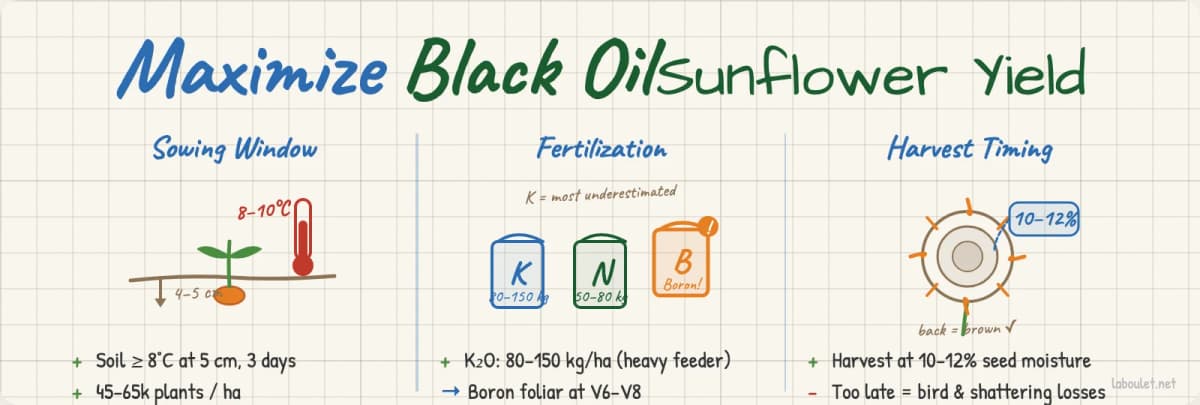
How to Maximize Black Oil Sunflower Yield: Agronomic Tips for Commercial Growers
Black oil sunflower (Helianthus annuus L.) is one of the highest-value oilseed crops available to commercial growers. Its seeds contain 40 to 50 percent oil by dry weight — substantially more than confectionery sunflower varieties — making it the preferred choice for edible oil, biodiesel, and high-energy livestock feeds. Yet black oil sunflower is also […]
Read more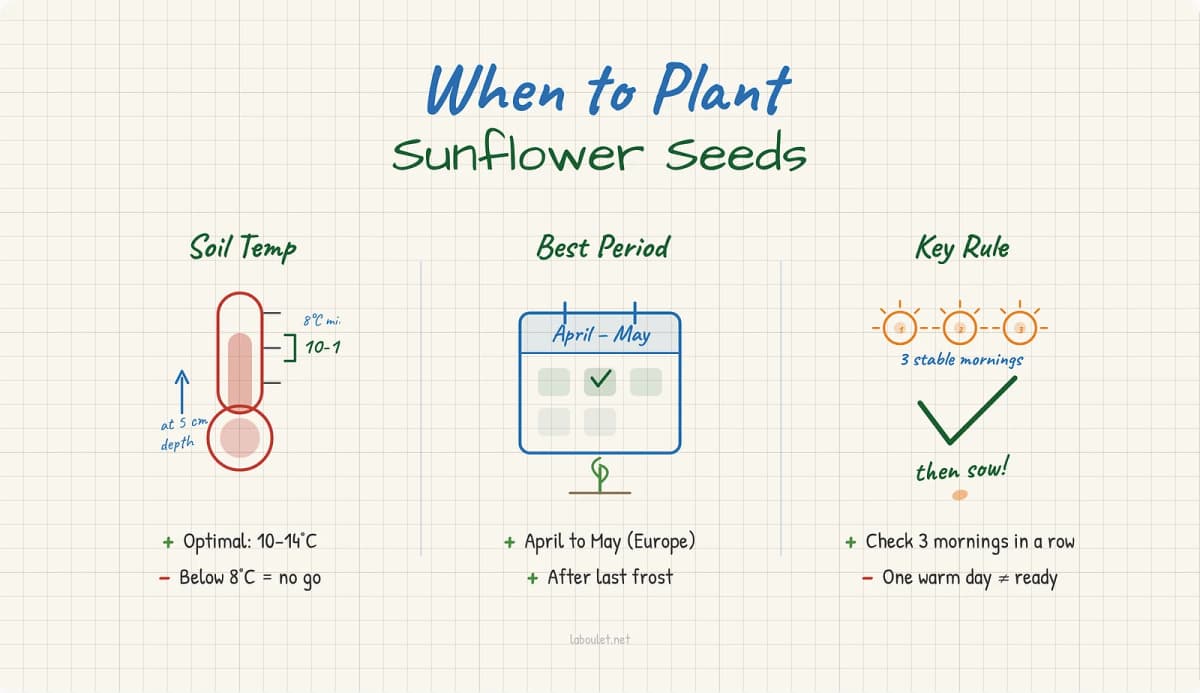
When to Plant Sunflower Seeds: Agronomic Timing for Commercial Growers
Planting date is not a calendar decision. It is an agronomic one. The difference between a productive sunflower crop and a mediocre stand often traces back to a sowing window of just ten to fifteen days. For professional growers, timing sunflower planting means reconciling soil temperature, varietal cycle length, downstream market requirements and regional climate […]
Read more
Where to Buy Sunflower Seeds for Planting
Choosing where to buy sunflower seeds for planting is not a simple sourcing question.It is an agronomic decision that conditions crop performance, market access, and production regularity over the season. Sunflower is grown across multiple filières: oilseed crushing, grain markets, animal feed, bird feed, forage, and occasionally as a cover crop.Each outlet imposes different varietal expectations, tolerance […]
Read moreUnderstanding striped sunflower seeds
Striped sunflower seeds are characterised by their distinctive seed-coat pattern, visual uniformity and suitability for various specialty markets. Within our varieties, these seeds are developed for bird-feed uses, snack applications and specific industrial markets requiring precise seed-coat quality. Their morphology and stability reflect a controlled breeding process that ensures consistent appearance and agronomic behaviour.
Our seeds originate from dedicated selection work designed to deliver predictable emergence, clean seed lots and a seed-coat pattern adapted to the expectations of buyers. These characteristics differentiate them from standard black-oil sunflower materials, particularly in speciality markets where seed appearance carries added value.
Agronomic benefits of our striped sunflower seeds
Versatility across several markets
Striped sunflower seeds offer flexibility for producers targeting different market segments. Our varieties can serve bird-feed production, snack and confection markets, and speciality uses where seed size and visual uniformity are essential. This versatility allows growers and distributors to adapt their production to evolving demand without changing crop type.
- Suitable for bird-feed, snack and specialty uses
- Predictable seed size supporting consistent product formatting
- Adapted seed-coat appearance for visual-quality markets
Uniformity and quality traits
Uniformity is a central requirement in specialty sunflower seeds. Our seeds are selected for regular seed-coat striping, stable sizing and consistent grain development. These traits ensure that each seed lot supports the quality demands of both industrial buyers and niche distributors.
- Consistent seed-coat patterns and clean stripes
- High germination and robust early vigour
- Regular seed fill and controlled moisture at maturity
Adaptability to growing conditions
Striped sunflower seeds show reliable performance across a range of soil types and climates when supported by appropriate agronomic practices. Our varieties are evaluated to confirm stable behaviour in temperate and semi-continental environments, ensuring predictable development throughout the cycle.
- Adaptation to well-drained loam or clay-loam soils
- Good stability under moderate climatic stress
- Predictable emergence under controlled sowing conditions
Production characteristics within our ranges
Producing striped sunflower seeds for speciality markets requires strict quality control. Our ranges are structured around seed purity, seed-coat uniformity and germination performance. Conditioning processes stabilise seed lots for visual and mechanical homogeneity, enabling reliable sizing and reduced breakage during handling.
Our seeds undergo multiple checks for varietal identity, purity and physiological quality. Seed-lot traceability is ensured through structured production pathways, supporting confidence for buyers seeking consistent sourcing.
- Quality control across breeding, multiplication and conditioning steps
- Precise seed sizing to meet specialty-grade expectations
- Seed-lot traceability integrated into our production organisation
Cultivation recommendations for striped sunflower seed production
Site selection and sowing conditions
Striped sunflower seeds perform best in well-structured, moderately fertile soils with good drainage. Seedbeds should be prepared to promote even emergence, with sowing depth adapted to soil moisture and seed size. Plant density may be adjusted depending on market type, with moderate densities preferred for achieving large, well-filled seeds.
- Prepare fine, firm seedbeds for uniform emergence
- Sow at controlled depth adapted to seed size and soil moisture
- Adjust density to optimise grain size and seed-coat development
Crop management: nutrition and protection
Balanced fertilisation is essential to ensure healthy vegetative development and consistent seed fill. Nitrogen rates should align with target seed size and lodging risks, while phosphorus and potassium support root and grain formation. Integrated protection strategies, combined with tolerance traits within our varieties, help maintain stable production in areas with disease pressure.
- Balanced nitrogen input to support development without lodging
- Phosphorus and potassium management oriented toward grain fill
- Monitoring critical crop stages and adjusting interventions accordingly
Harvesting and post-harvest handling
Proper harvest timing preserves the visual quality required for striped sunflower seed markets. Uniform maturity within our varieties simplifies scheduling, and careful handling reduces seed-coat damage. Post-harvest drying and storage should protect seed integrity and maintain moisture stability.
- Harvest at optimal seed moisture for quality preservation
- Adjust machinery to protect seed-coat integrity
- Store in clean, ventilated facilities with stable temperature
Comparison with conventional sunflower seed types
Key technical and market differences
Striped sunflower seeds differ from standard black-oil seeds primarily in market orientation and seed-coat characteristics. While black-oil seeds are widely used in oil extraction, striped seeds target visual and speciality markets. Our varieties maintain a balance between agronomic performance and the specific quality traits required by buyers.
- Higher market value in specialty segments
- Greater emphasis on seed-coat uniformity and visual quality
- Potential differences in yield compared to high-oil types
Operational differences for growers
Producing striped sunflower seeds requires particular attention to field uniformity, seed-coat preservation and post-harvest care. Our agronomic solutions help growers manage these operational considerations to ensure seeds meet buyer expectations.
- More attention to seed-coat integrity during harvest and handling
- Specific density and fertilisation adjustments to enhance seed appearance
- Integration of our agronomic solutions to support consistent results
Why growers choose our varieties
Our varieties benefit from dedicated breeding for specialty sunflower markets, supported by our experience in oilseeds, legumes and fertilizers. Our seeds are produced with strict quality standards, ensuring purity, germination and uniformity for distributors and growers with demanding requirements.
Through our agronomic solutions, producers gain guidance on nutrition, sowing, crop protection and harvest strategies, ensuring reliable performance across different environments. Our ranges are structured to offer flexibility and consistency for professionals targeting specialty seed markets.
- Varietal creation focused on seed quality and market alignment
- Seed production protocols ensuring purity and technical stability
- Comprehensive agronomic solutions to support cultivation choices
- Ranges adapted to diverse soil, climate and market requirements
Key questions about striped sunflower seeds
What makes striped sunflower seeds different from other sunflower types?
Striped sunflower seeds are defined by their patterned seed coat and larger seed size. Our varieties are developed to meet specific requirements in bird-feed, snack and specialty markets while maintaining reliable agronomic performance.
Which markets best suit striped sunflower seeds?
Striped sunflower seeds from our varieties are suited to bird-feed, snack and niche markets where appearance and seed uniformity are valued. Their size and seed-coat pattern support specific product categories.
What growing conditions support optimal results?
Our seeds perform best in well-drained soils with balanced fertility. Adequate moisture during establishment and controlled nutrition throughout the season help secure uniform head development and seed fill.
How do growers select the right striped sunflower variety?
Selection depends on climate, soil type and market orientation. Our ranges include options suited to different regions and quality expectations, supported by our agronomic solutions for precise placement.
What specific crop-management practices improve seed quality?
Lower to moderate plant densities, balanced nitrogen and attentive handling at harvest help preserve the seed-coat pattern. Our agronomic solutions guide these decisions for consistent results.
How do costs and returns compare with standard sunflower varieties?
Striped sunflower seeds often achieve higher market value due to their specialty status. When combined with our varieties' stability and consistent quality, growers may achieve favourable returns relative to standard oilseed types.
Do our agronomic solutions support challenging environments?
Yes. Our agronomic solutions help adjust sowing, nutrition and crop protection practices to local conditions, enabling growers to maintain quality despite seasonal variability.
For a broader comparison within sunflower varieties, growers often look back at our hybrid sunflower seeds and review nearby profiles such as high oleic sunflower seeds and linoleic sunflower seeds, which provide complementary reference points depending on agronomic needs.