
Ultra Early Corn Hybrid for professional growers worldwide
Ultra-early maturity hybrids with very fast dry-down for short growing seasons
Key advantages
Ultra Early Corn Hybrid
LS Siliciana
Very early double-cross hybrid delivering strong silage yield, good forage quality and reliable digestibility.
LS Amuria
Very early double-hybrid maize with strong forage quality and excellent digestibility.
LS Arolia
Ultra-early hybrid delivering high forage yield, strong feed value and excellent digestibility.
LS Maridol
Ultra-early hybrid with a very short cycle, ideal for early silage and fast grain maturity.
LS Joalia
A very early hybrid offering strong forage potential and excellent adaptation to high sowing densities.
LS Marelia
Ultra early hybrid with fast dry down, strong density tolerance and excellent digestibility.
LS Norvia
Ultra-early hybrid with a very short cycle, rapid dry down, and strong digestibility.
LS Parisiana
Ultra early silage-oriented hybrid with high digestibility and strong adaptation to dense planting.
TA57-23
Ultra-early double-cross hybrid suited for catch cropping, high densities and strong digestibility.
ZETA 105
Ultra-early hybrid with ultra-short cycle, rapid dry-down, and strong performance under dense planting.
ZETA 120
Ultra-early hybrid with ultra-fast dry-down, strong density adaptation and very good forage digestibility.
ZETA 125
Ultra-early hybrid with ultra-fast dry-down, strong density adaptation and excellent forage digestibility.
ZETA 200
Very early silage hybrid with strong yield potential, high feeding value and good adaptation to dense stands.
ZETA 110 S
Ultra-early hybrid with a very short cycle, fast dry-down, strong density adaptation and excellent grain-to-precocity ratio.
ZETA 115 S
Ultra-early hybrid with a very short cycle, rapid maturity, strong density adaptation and excellent feeding quality.
ZETA 140 S
Very early hybrid with ultra-short cycle, excellent silage quality, strong grain potential and catch cropping suitability.
LS BAJKALIA
Ultra-early corn hybrid offering very fast dry down and excellent digestibility.
LS MARIDOL
Ultra-early hybrid with a very fast dry down and excellent digestibility.
Compare varieties
| Variety | Maturity (FAO) | Type | Use |
|---|---|---|---|
| LS Norvia | FAO 100 | Flint to semi-flint | Silage |
| ZETA 105 | FAO 105 | Flint – soft flint | Grain and silage |
| ZETA 110 S | FAO 110 | Flint | Silage and grain |
| ZETA 115 S | FAO 115 | Flint | Silage and grain |
| LS Arolia | FAO 120 | — | Silage |
| LS Maridol | FAO 120 | — | Silage - grain |
| LS Parisiana | FAO 120 | Soft flint | Grain and silage |
| TA57-23 | FAO 120 | Flint to semi-flint | Silage |
| ZETA 120 | FAO 120 | Flint – soft flint | Grain and silage |
| LS BAJKALIA | FAO 120 | Flint – so flint | Silage |
| LS MARIDOL | FAO 120 | Flint – so flint | Silage and grain |
| ZETA 125 | FAO 125 | Flint – soft flint | Grain and silage |
| LS Marelia | FAO 130 | Flint - soft flint | Grain and silage |
| ZETA 140 S | FAO 140 | Flint–dent to dent | Silage and grain |
| LS Siliciana | FAO 170 | Flint to semi-flint | Silage |
| LS Amuria | FAO 170 | Semi-dent corn | Silage |
| LS Joalia | FAO 180 | Semi-dent | Silage and grain |
| ZETA 200 | FAO 200 | Semi-dent | Silage |
See the full range: Hybrid corn seeds for silage and grain, FAO 100 to 450 →
Where to grow corn
Guides & insights on corn
View all articles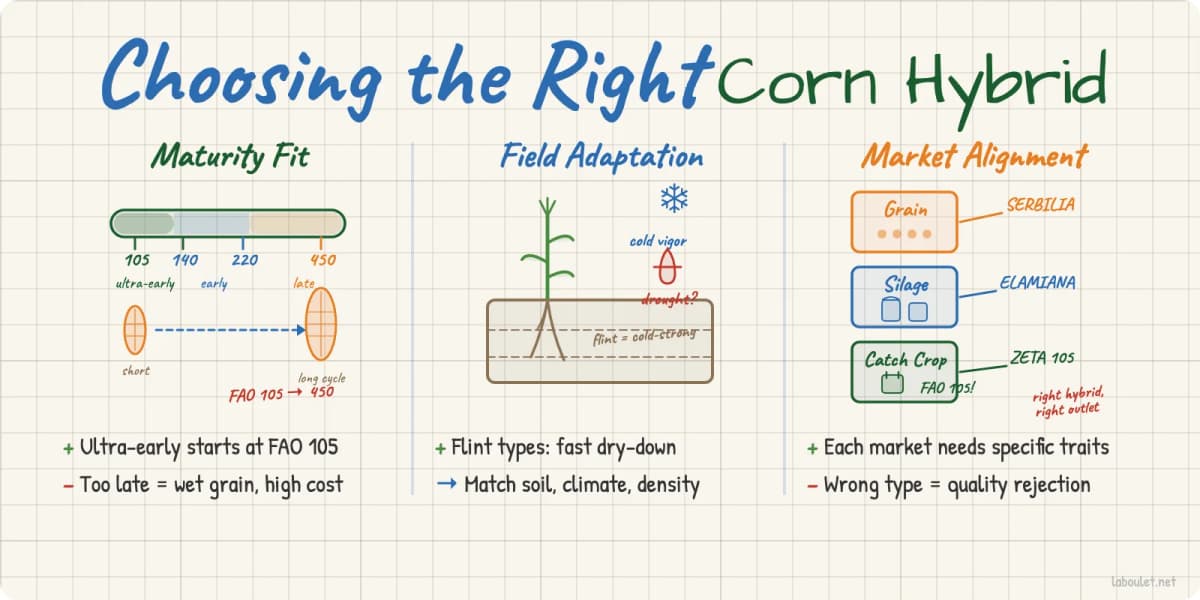
How to Choose the Right Corn Hybrid for Your Farm
Every season starts with the same question: which hybrid goes into the planter? The answer determines your yield ceiling, your harvest date, your drying costs, and ultimately your margin. Yet too many growers default to habit — replanting last year’s pick or copying a neighbor — without asking whether that hybrid actually fits their field, […]
Read more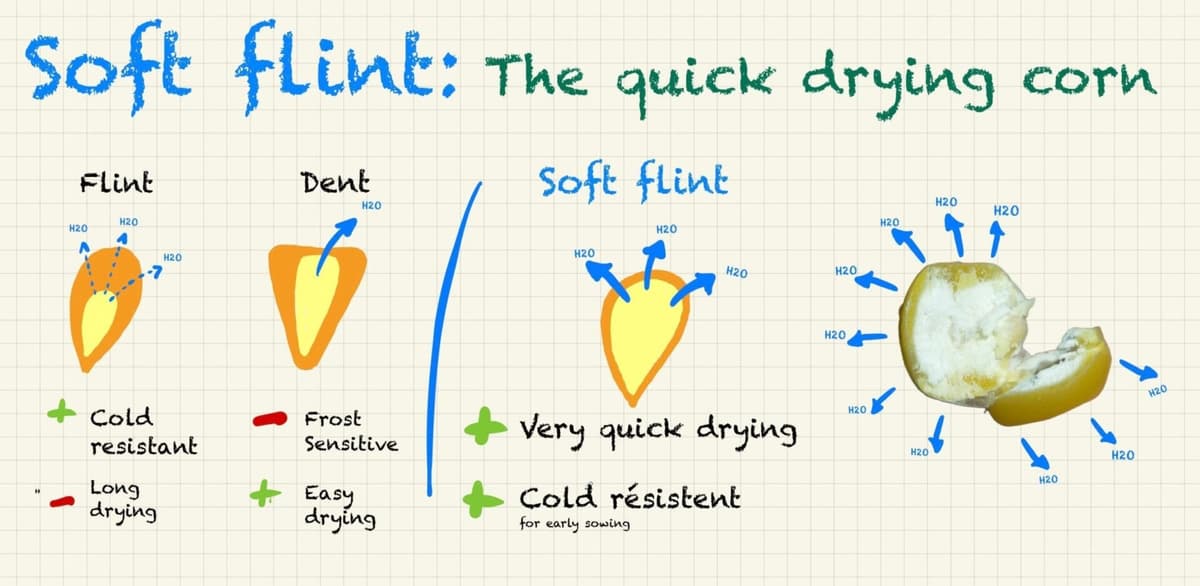
Soft flint: The quick drying corn
“Soft Flint” Corn: Flint Vigor Combined with Rapid Dry-Down Soft flint corn is an innovative type of grain corn derived from flint corn, characterized by an extremely thin vitreous endosperm. In other words, the kernel retains the visual appearance of flint corn (no dent) while being largely composed of floury starch. This unique profile gives […]
Read moreWhat defines ultra early corn seeds in modern agronomy
Ultra early corn seeds belong to the earliest maturity groups, designed to complete their cycle in a short number of growing degree days while maintaining acceptable yield and forage quality. These hybrids are mainly used in regions with cool springs, limited growing seasons or where harvest must be anticipated to free land for another crop.
Our varieties are selected for rapid emergence at low soil temperatures, fast early vigour and dry-down, while keeping good starch levels and digestibility in silage. With our seeds, the objective is not only to harvest earlier, but also to stabilise production from year to year under variable climatic conditions.
Agronomic benefits of ultra early corn seeds
The main advantage of ultra early corn is the capacity to reduce climatic risk without sacrificing too much yield. When a cold spring, early autumn frosts or heavy rains occur at harvest, ultra early hybrids tend to reach the target dry matter sooner than later-maturing hybrids.
- Secured maturity: our varieties reach harvestable dry matter earlier, limiting exposure to autumn weather hazards.
- Improved harvest planning: earlier harvest opens the window for soil preparation and sowing of following crops such as winter cereals or cover crops.
- Lower grain moisture: our seeds are bred for fast dry-down, helping to limit drying costs for grain maize in early segments.
- Forage quality: ultra early hybrids in our ranges are developed to balance high starch content with good fibre digestibility for dairy rations.
- Adaptation to marginal areas: ultra early segments enable corn production in cooler zones or at higher altitude where traditional maturity groups are risky.
Our agronomic solutions aim to optimise these benefits through precise recommendations on sowing dates, plant density and fertilisation adapted to each ultra early hybrid.
Climatic and soil conditions suited to ultra early corn
Ultra early corn seeds are particularly relevant in regions with short frost-free periods, slow spring warming or heavy soils that delay sowing. In these contexts, choosing our varieties with very short cycle reduces the probability of harvesting immature plants or very wet grain.
On lighter or well-drained soils, ultra early hybrids also make it possible to start harvest sooner and limit the risk of compaction in wet conditions. Our seeds are selected for good early vigour to cope with temporary cold spells after emergence, provided that basic agronomic rules on sowing are respected.
- Cool or oceanic climates with limited growing degree days.
- High altitude zones where first autumn frosts can be early.
- Heavy or hydromorphic soils requiring late sowing dates.
- Farms wanting to free fields early for a following crop.
Silage, grain and biogas: choosing the right ultra early profile
Ultra early corn seeds can be oriented to silage, grain or biogas according to their morphology and starch content. Within our ranges, each hybrid is characterised by its main outlet and agronomic profile.
Ultra early silage hybrids
Silage-oriented ultra early hybrids are selected for high cob proportion, good stay-green and digestible stover despite the short cycle. Our varieties in this segment are particularly adapted to dairy systems that need a secure silage volume every year.
- High proportion of cob in the total dry matter.
- Good fibre digestibility to support milk yield.
- Stay-green effect sufficient to secure harvest window.
- Rapid dry matter accumulation to reach 32–35% DM in time.
Ultra early grain and multipurpose hybrids
Some ultra early hybrids are more oriented to grain or multipurpose use. They combine good grain fill with rapid dry-down in the field. Our seeds in this group allow farmers to harvest grain at lower moisture while keeping the option of early silage if needed.
- Balanced ear size and grain number per cob.
- Fast field dry-down to limit artificial drying.
- Possibility to harvest earlier for silage in difficult years.
Ultra early corn for biogas
For biogas units, ultra early corn hybrids provide a reliable substrate with predictable dry matter and starch content, even in constrained climates. Our agronomic solutions integrate specific sowing densities and harvest timing to maximise methane potential in ultra early segments.
Key agronomic practices for ultra early corn seeds
Sowing dates and soil temperature
Because ultra early corn seeds are often grown in cool regions, controlling sowing conditions is essential. Our varieties are selected for good emergence at relatively low temperatures, but sowing into cold, wet soil remains a major risk.
- Target a minimum soil temperature of 8–10 °C at sowing depth, rising in the forecast.
- Avoid compacted seedbeds; prefer fine, firm soils that ensure seed–soil contact.
- Adapt sowing date to altitude and soil type to avoid prolonged exposure to cold after emergence.
Plant density and row spacing
Ultra early hybrids tend to be a bit smaller than later types, with a slightly higher cob proportion. Our seeds are therefore often sown at slightly higher densities than medium-early hybrids, while remaining within the recommended range for the region.
- Follow the density recommended for each of our varieties according to soil potential.
- On rich soils, higher densities can be considered to maximise yield, provided water availability is sufficient.
- On light or shallow soils, moderate densities protect against drought stress and lodging.
Fertilisation and crop nutrition
Due to the short cycle, ultra early corn requires quick access to nutrients, especially nitrogen, phosphorus and zinc. Our agronomic solutions integrate starter fertilisation strategies and, where appropriate, seed-applied technologies to secure early growth.
- Provide a readily available phosphorus source close to the seed to support root development.
- Split nitrogen in risk-prone areas to limit leaching and align supply with rapid crop uptake.
- Consider micronutrients, especially zinc, on soils with known deficiencies.
Weed, pest and disease management
The short cycle does not exempt ultra early corn from weed, pest and disease pressure. Early weed competition can strongly penalise yield in ultra early hybrids. Our varieties are accompanied by technical recommendations for herbicide programmes and integrated pest management.
- Ensure a clean field during the first six to eight weeks after emergence.
- Monitor soil pests and adjust seed treatments or agronomic strategies accordingly.
- Select hybrids in our ranges with good tolerance to major leaf and stalk diseases in the region.
Technical comparison: ultra early, very early and early corn
When defining the right maturity group, it is important to compare earliness, yield potential and agronomic risk. Ultra early corn seeds offer the greatest security on harvest date, but with a slightly lower yield potential than later groups under optimal conditions.
- Ultra early segment: very short growing cycle, ideal for marginal zones, short rotations or late sowing. Our varieties in this segment focus on stability and forage quality.
- Very early segment: compromise between earliness and yield, suitable for most temperate zones with moderate climatic risk.
- Early and medium-early segments: higher yield potential, but longer exposure to end-of-season constraints.
Our agronomic solutions help farmers position each segment according to field potential, rotation and livestock needs, so that our seeds contribute to both technical and economic performance.
How our varieties support high-performance ultra early corn
The development of ultra early hybrids requires strong breeding work on earliness, cold tolerance, stay-green and disease resistance. Our varieties result from dedicated breeding programmes combining field evaluation and laboratory analysis to secure performance in the earliest maturity groups.
- Selection on yield/earliness ratio to limit the yield gap with later groups.
- Evaluation in multi-site networks across cool and constrained regions.
- Screening for tolerance to major foliar and stalk diseases.
- Characterisation of silage quality: starch, digestibility and fibre value.
Our ranges of ultra early corn seeds are designed to complement other crops on the farm, alongside our hybrid sunflower seeds, our oilseed varieties and our legume seeds. This multi-crop approach allows farmers to build resilient rotations and secure forage autonomy.
Support and agronomic solutions around ultra early corn
Beyond genetics, the success of ultra early corn depends on technical support and decision tools adapted to the farm context. Our agronomic solutions combine varietal advice, planting recommendations and monitoring tools to help farmers make the most of our seeds.
- Choice of hybrid according to region, soil type and target outlet.
- Fine-tuning of sowing date and density based on climatic data.
- Optimisation of fertilisation plans according to expected yield and regulatory constraints.
- Harvest timing support using dry matter and kernel milk line indicators.
These elements are integrated into our technical documentation and into the different crop categories proposed to farmers, including our seed catalog for legumes and our oilseed varieties, to build a coherent agronomic strategy.
Questions from farmers about ultra early corn seeds
In which situations are ultra early corn seeds most relevant?
Ultra early corn is most relevant in regions with a short growing season, frequent late-sowing situations, heavy soils that delay field access or high altitude areas. Our varieties are also useful on farms that need to harvest early to free land for another crop or to avoid harvesting in very wet autumn conditions.
Is yield always lower with ultra early hybrids compared to later groups?
Under optimal growing conditions and long seasons, early and medium-early hybrids keep a higher theoretical yield potential. However, in risky zones, ultra early corn seeds often provide better effective yield because they secure maturity and limit harvest losses. Our seeds in the ultra early segment are selected to minimise the yield gap while maximising reliability.
How to choose between ultra early silage and grain types?
The choice depends on the main outlet and on the farm’s forage strategy. For dairy systems prioritising forage security and ration quality, ultra early silage types from our ranges are generally preferred. When grain production and drying cost reduction are priorities, ultra early grain or multipurpose hybrids from our varieties are more suitable.
Do ultra early corn seeds tolerate cold soils better?
Ultra early does not automatically mean cold tolerant. The behaviour in cold soils depends on specific genetic traits such as early vigour and root development. Our seeds are systematically evaluated under cool conditions to select hybrids with good emergence and early vigour, which allows a safer establishment when sowing is done at the right soil temperature.
What plant density should be used for ultra early hybrids?
Recommended plant density varies according to hybrid, soil potential and water availability. In general, densities for ultra early corn are similar or slightly higher than for very early types, but must always be adapted to local conditions. Each of our varieties is accompanied by a density recommendation range according to soil type and target yield.
How does ultra early corn fit into crop rotations?
Ultra early corn frees land earlier, which facilitates the introduction of winter cereals, cover crops or legumes. This can help improve soil structure, reduce erosion and diversify rotations. By combining our ultra early corn seeds with our agronomic solutions on legumes and oilseeds, farmers can build more resilient cropping systems.
What are the main quality criteria for ultra early silage?
For silage, the key criteria are dry matter at harvest, starch content, fibre digestibility and overall energy value. Our varieties in the ultra early segment are monitored for these parameters to deliver silage that supports high milk yield while preserving animal health.
Can ultra early corn be used for biogas production?
Yes, many ultra early hybrids are suitable for biogas, especially when they combine good biomass with high starch content. Our agronomic solutions include recommendations on harvest stage to optimise methane yield from ultra early corn used as a substrate.
To situate ultra-early hybrids within the full maize cycle spectrum, growers often refer to our hybrid corn seeds and compare them with early hybrid corn seeds and mid-late hybrid corn seeds, two ranges that help contextualize maturity and agronomic behavior.