
Where to Buy Sunflower Seeds for Planting
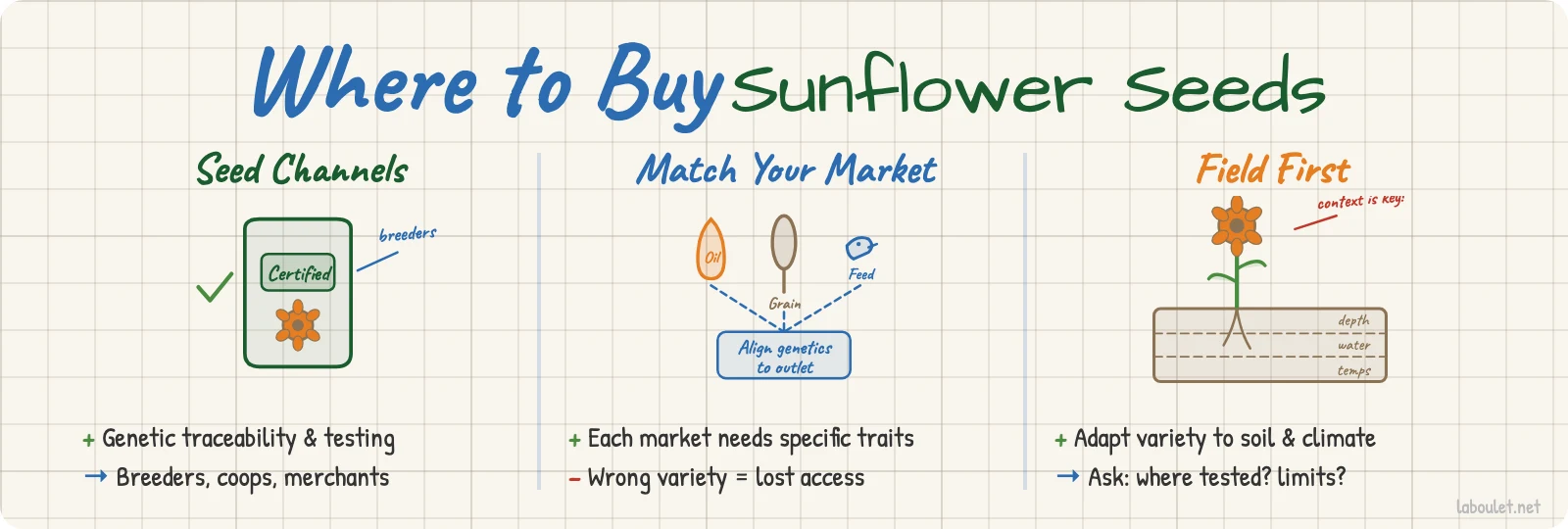
Choosing where to buy sunflower seeds for planting is not a simple sourcing question.It is an agronomic decision that conditions crop performance, market access, and production regularity over the season. Sunflower is grown across multiple filières: oilseed crushing, grain markets, animal feed, bird feed, forage, and occasionally as a cover crop.Each outlet imposes different varietal expectations, tolerance […]
Choosing where to buy sunflower seeds for planting is not a simple sourcing question.
It is an agronomic decision that conditions crop performance, market access, and production regularity over the season.
Sunflower is grown across multiple filières: oilseed crushing, grain markets, animal feed, bird feed, forage, and occasionally as a cover crop.
Each outlet imposes different varietal expectations, tolerance thresholds, and yield stability requirements.
This article is written for the actor who plants and manages the crop.
It also integrates downstream constraints (collection, processing, quality) and upstream realities (seed production, varietal creation).
Laboulet’s approach is grounded in varietal specificity, agronomic realism, and field validation across pedoclimatic contexts.
Understanding the Real Question Behind “Where to Buy Sunflower Seeds”
The visible question is commercial.
The real question is agronomic.
Before choosing a supplier, the grower must clarify:
- What is the target market?
- What is the field constraint?
- What is the risk profile of the season and region?
Buying sunflower seed is not about brand preference.
It is about alignment between genetics, soil, climate, and outlet.
Main Channels to Buy Sunflower Seeds for Planting
Certified Seed Companies and Breeders
The primary source for professional sunflower seed remains certified seed producers, particularly breeders involved in varietal creation and selection.
Advantages:
- Genetic traceability
- Stable varietal identity
- Tested performance across regions
- Access to technical recommendations
Limitations:
- Less flexibility for marginal or atypical uses
- Standardized offer may not fit all micro-contexts
For growers targeting oil, grain, or structured feed markets, this channel remains the baseline.
Laboulet operates in this space with a specific focus:
creating and selecting varieties based on real field use, not catalog positioning.
Agricultural Cooperatives and Local Distributors
Cooperatives are often the first contact point for growers.
They provide:
- Immediate availability
- Local logistics
- Integration with collection contracts
However, varietal choice may be:
- Limited to contractual needs
- Influenced by downstream agreements rather than field constraints
For growers working under strict delivery specifications (oil content, grain uniformity, volumes), cooperative sourcing is coherent — provided the variety is understood agronomically.
Specialized Seed Merchants and Technical Advisors
Some distributors focus on technical accompaniment rather than volume.
This channel is relevant when:
- Fields are heterogeneous
- Climate risk is high
- Non-standard uses are targeted (bird feed, forage, late sowing)
The value here is not the seed alone, but the interpretation of varietal behavior in a given context.
On-Farm Seed Saving (Limited and Context-Dependent)
In sunflower, farm-saved seed is rarely recommended due to:
- Genetic segregation (hybrids)
- Yield instability
- Loss of uniformity
For professional production, especially for oil and grain markets, this option is generally excluded.
Matching Seed Source to Sunflower End Markets
Oilseed Production
For oil crushing markets, seed sourcing must prioritize:
- Stable oil content (qualitative range)
- Uniform maturity
- Regular head size
- Stress tolerance during flowering
Varietal choice here is non-negotiable.
Seed must come from controlled breeding programs with multi-year trials.
Buying from uncertified or poorly characterized sources introduces unacceptable variability.
Grain and Animal Feed Markets
For whole grain or feed use:
- Yield regularity is prioritized
- Protein and oil balance matters
- Lodging tolerance becomes critical
Seed suppliers must provide clear agronomic positioning, not just yield potential.
Bird Feed Markets
This is a specific filière with distinct expectations:
- Seed size and uniformity
- Hull quality
- Visual appearance
Here, not all sunflower varieties are acceptable.
Seed sourcing must be aligned from the beginning, otherwise market access may be lost post-harvest.
Forage and Mixed Uses
Sunflower used for forage or mixed systems requires:
- Rapid biomass production
- Flexible maturity
- Compatibility with crop rotations
Seed suppliers offering forage-oriented genetics are fewer.
Technical dialogue is essential.
Cover Crop Use
When sunflower is used as a cover or structuring crop:
- Cost control matters
- Emergence vigor is key
- Termination behavior must be anticipated
Seed sourcing here may differ from commercial grain production, but varietal behavior still matters.
Agronomic Criteria That Should Guide Where You Buy
Earliness and Crop Cycle
Earliness determines:
- Exposure to summer stress
- Harvest timing
- Rotation compatibility
Seed suppliers must clearly position varieties by relative maturity, not vague marketing terms.
Stress Tolerance
Drought, heat, and soil constraints vary by region.
A seed source that cannot explain:
- Root behavior
- Flowering resilience
- Stand stability
…is not suitable for professional planting decisions.
Soil and Pedoclimatic Adaptation
Sunflower reacts strongly to:
- Soil depth
- Water holding capacity
- Spring temperature dynamics
Buying seed without contextual advice leads to theoretical performance, not real yield.
Laboulet’s varietal work integrates multi-region trials precisely to address this gap.
Sowing Logic: Why Seed Source Matters at Implementation
Sowing Date Windows
Different varieties tolerate different sowing windows.
Seed suppliers must clarify:
- Early sowing suitability
- Cold soil emergence behavior
- Late sowing risk
This affects machinery planning and labor organization.
Sowing Depth and Density
Depth and density are variety-dependent.
Generic recommendations are insufficient.
A reliable seed source provides:
- Density ranges
- Emergence behavior insights
- Compensation capacity data (qualitative)
Field Positioning
Sunflower placement in rotation depends on:
- Residue management
- Weed pressure
- Disease history
Seed choice interacts directly with these factors.
Why Varietal Creation Changes the Buying Decision
Buying sunflower seed is not only about choosing from existing options.
It is about accessing genetics designed for real constraints.
Laboulet’s positioning is clear:
- Varieties are created with field logic first
- Trials are conducted across contrasting pedoclimatic zones
- Feedback loops integrate growers, technicians, and downstream needs
This approach reduces the gap between catalog promise and field reality.
Downstream Expectations You Must Anticipate When Buying Seed
Even if the grower plants and manages the crop, downstream actors impose constraints:
- Crushers expect regular oil profiles
- Collectors expect homogeneous lots
- Feed buyers expect volume stability
Seed sourcing that ignores these expectations creates friction at delivery.
A good seed supplier understands both ends of the chain.
How to Choose the Right Supplier in Practice
Ask concrete questions:
- Where has this variety been tested?
- In what soil types?
- With which end markets in mind?
- What are the known limitations?
Avoid suppliers who only speak in yield rankings.
Laboulet’s Approach to Sunflower Seed Sourcing
Laboulet is not positioned as a generic seed seller.
The focus is:
- Varietal creation
- Specificity over volume
- Agronomic coherence across filières
Each sunflower variety is positioned with:
- Clear use cases
- Identified constraints
- Realistic performance expectations
When to Seek Direct Technical Exchange
Seed choice cannot always be resolved through catalogs.
Direct discussion is relevant when:
- Fields are heterogeneous
- Markets are niche or segmented
- Climate risk is high
A technical exchange allows adjustment before sowing, not after emergence.
You can contact Laboulet by email or WhatsApp for a factual discussion based on your fields, not assumptions.
Our varieties: sunflower
| Variety | Seed | Oil profile | Earliness |
|---|---|---|---|
| LS SWIFT | Striped | Linoleic | Early to very early |
| LS Starly | Striped | Oleic | Early |
| LS SKIPPY | Striped | — | Early to very early |
| LS Pickit | Striped | Linoleic | Early |
| LS Luminal | Black | Linoleic | Early |
| LS Lollipop | Striped | Oleic | Early to very early |
Frequently asked questions
Where can I buy hybrid sunflower seeds for planting?
Hybrid sunflower seed for planting is sold by specialized seed breeders and their authorized distributors. Laboulet Semences ships F1 hybrid sunflower seed (high oleic, linoleic, IMI, sulfo, and confection types) to over 30 countries directly or through national distributors. Contact us via WhatsApp or the contact form for a quote and shipping options.
What is the difference between sunflower seed for planting and sunflower seed for eating?
Planting seed (also called crop seed) is certified F1 hybrid seed selected for germination rate, varietal purity, and crop performance. It is sold in calibrated bags for sowing. Edible sunflower seed (snack and bakery) comes from confection varieties grown for human consumption. The two markets are distinct and use different pricing.
Can I order sunflower seeds internationally?
Yes. Laboulet ships hybrid sunflower seed to over 30 countries, with phytosanitary certificates and import documentation handled per destination. Lead time for international orders is typically 4-8 weeks depending on the country and the planting calendar.
How much sunflower seed do I need per hectare?
Standard seeding rate is around 60,000 to 70,000 plants/ha for oilseed sunflower, equivalent to roughly 4-5 kg of certified hybrid seed per hectare with seeds at 60-70 g/1000. Confection varieties use lower densities (45,000-55,000 plants/ha) for larger seeds.
What types of hybrid sunflower seed are available?
Major hybrid sunflower types: high oleic (premium oil for cooking and biofuel), linoleic (standard oil profile), IMI/Clearfield (herbicide-tolerant), Sulfonylurea-tolerant, and confection (snack market). Black-grain types target oil; striped-grain types target the snack market.