
Black High Oleic Sunflower Hybrid for professional growers worldwide
Dark-hulled hybrids with premium oleic acid profiles for oil markets
Key advantages
Black High Oleic Sunflower Hybrid
See the full range: Hybrid sunflower seeds →
Where to grow sunflower
Guides & insights on sunflower
View all articles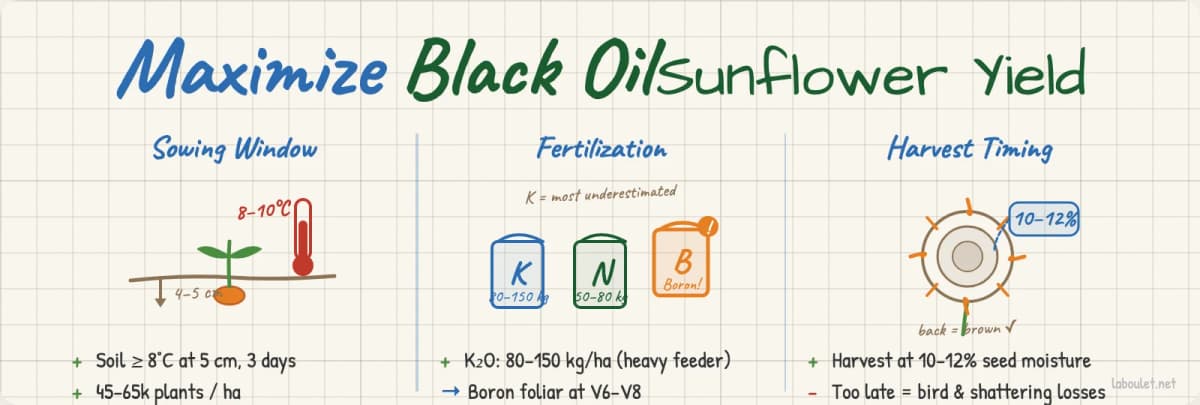
How to Maximize Black Oil Sunflower Yield: Agronomic Tips for Commercial Growers
Black oil sunflower (Helianthus annuus L.) is one of the highest-value oilseed crops available to commercial growers. Its seeds contain 40 to 50 percent oil by dry weight — substantially more than confectionery sunflower varieties — making it the preferred choice for edible oil, biodiesel, and high-energy livestock feeds. Yet black oil sunflower is also […]
Read more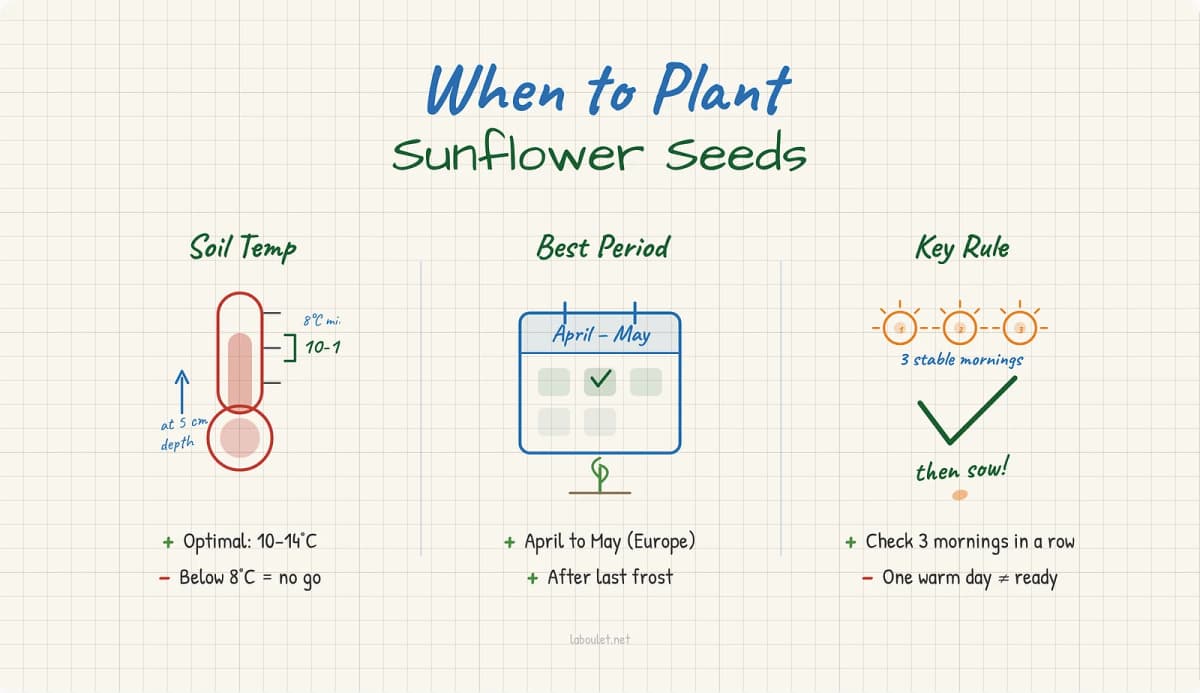
When to Plant Sunflower Seeds: Agronomic Timing for Commercial Growers
Planting date is not a calendar decision. It is an agronomic one. The difference between a productive sunflower crop and a mediocre stand often traces back to a sowing window of just ten to fifteen days. For professional growers, timing sunflower planting means reconciling soil temperature, varietal cycle length, downstream market requirements and regional climate […]
Read more
Where to Buy Sunflower Seeds for Planting
Choosing where to buy sunflower seeds for planting is not a simple sourcing question.It is an agronomic decision that conditions crop performance, market access, and production regularity over the season. Sunflower is grown across multiple filières: oilseed crushing, grain markets, animal feed, bird feed, forage, and occasionally as a cover crop.Each outlet imposes different varietal expectations, tolerance […]
Read moreUnderstanding black oil high oleic sunflower seeds
Black oil high oleic sunflower seeds combine a dark, uniform husk with a fatty acid profile rich in oleic acid, often above eighty percent. This combination makes them suitable for premium edible oil production where oxidative stability and shelf life are critical factors.
Our hybrid sunflower seeds are bred to deliver a stable high oleic profile while maintaining strong agronomic performance in various growing regions.
Why choose our varieties of black oil high oleic sunflower seeds?
Our varieties are the result of focused breeding efforts to maximize oil content, oleic acid stability and field reliability. These hybrids are positioned for growers targeting premium markets that require consistent high oleic levels.
With our agronomic solutions, growers benefit from adapted guidance, ensuring that our seeds express their genetic potential in yield and oil quality.
Agronomic benefits of our seeds
- High and stable oleic acid content for premium oil production.
- Efficient oil extraction supported by the black husk structure.
- Reliable standability and tolerance to environmental stress.
- Early-cycle options available in our ranges for shortened growing windows.
- Consistent seed uniformity supporting stable industrial processing.
Field and usage conditions for our varieties
- Select well-structured soils promoting early establishment and root development.
- Use planting densities adapted to each hybrid’s architecture for optimal yield.
- Limit excessive nitrogen to preserve oil concentration and fatty acid balance.
- Harvest at correct moisture to maintain oleic profile stability.
- Store seeds in cool, dry conditions to protect oil quality.
Technical comparison: black oil high oleic vs conventional sunflower seeds
Black oil high oleic sunflower seeds differ from standard linoleic black-oil types primarily in their fatty acid profile and market destination. While both formats are crushed for oil, high oleic hybrids offer superior oxidative stability and longer shelf life.
Oil profile differences
- High oleic hybrids exceed eighty percent oleic acid, while linoleic types have higher polyunsaturated levels.
- High oleic oil provides improved heat resistance for frying and food manufacturing.
- Longer shelf life reduces oxidation risks and enhances industrial utility.
Seed and processing characteristics
- Black husk seeds are preferred for crushing efficiency in oil extraction.
- Uniform seed size supports consistent industrial processing.
- Our ranges ensure stable oil concentration across diverse environments.
Market opportunities for black oil high oleic sunflower seeds
The high oleic oil market offers premium opportunities for growers due to the increasing demand for stable, healthy edible oils. Our varieties enable reliable access to these segments through their consistent oleic profile.
Premium oil and value-chain opportunities
- Frying oils requiring high oxidative stability.
- Food manufacturing applications where shelf life is critical.
- Industrial blends designed for premium oil formulations.
- Export markets valuing certified high oleic seed lots.
Storage and transport considerations
Maintaining the oleic profile requires proper storage conditions. Seeds should be dried to recommended moisture levels and stored in cool, ventilated facilities to prevent oxidation or degradation of oil quality.
Key agronomic parameters for cultivating our black oil high oleic sunflower seeds
Successful production of high oleic sunflower seeds depends on correct placement, tailored nutrition and careful harvest management. Our hybrid sunflower seeds are designed to sustain oil quality under a wide range of agronomic conditions.
Soil, climate and maturity
- Our early-cycle varieties adapt well to regions with shorter growing seasons.
- Sunflowers prefer deep, fertile soils with good structure.
- Warm temperatures during flowering support effective oil synthesis.
Nutrition, crop protection and field management
- Moderate nitrogen inputs preserve the high oleic balance in seeds.
- Control of weeds and early pests supports uniform stand establishment.
- Monitor diseases through region-appropriate protection programs.
Harvest and storage to maintain oil quality
Harvest should occur when seeds reach correct moisture to protect oil quality. Storage facilities should be dry and well ventilated to avoid oxidation or seed deterioration. Our agronomic solutions provide hybrid-specific recommendations.
Selecting the right variety from our ranges
Choosing the right hybrid depends on maturity class, climate, expected yield, oil objectives and regional disease pressures. Our ranges include multiple options to meet growers' diverse requirements.
Selection criteria
- Maturity level adapted to planting date and region.
- Oil potential and stability across field trials.
- Stress tolerance and standing ability.
- Yield potential under local climatic constraints.
Integrating our agronomic solutions
Our agronomic solutions support growers in optimizing sowing density, fertilization, field management and harvest strategy. This ensures our hybrid sunflower seeds express their full genetic potential in terms of oil yield and quality.
FAQ
What are black oil high oleic sunflower seeds?
They are sunflower hybrids featuring a black husk and a high oleic fatty acid profile widely used for premium edible oil production.
How do they differ from standard black oil sunflower seeds?
The difference is the oleic profile: high oleic seeds have elevated monounsaturated fats, improving oil stability and shelf life.
What is the typical oleic acid level?
High oleic sunflower seeds generally achieve above eighty percent oleic acid in well-managed environments.
Do high oleic varieties yield less?
Modern hybrids show competitive yields, and our varieties are bred to minimise historical yield gaps.
How can growers optimise oil content?
Balanced nutrition, correct sowing date and timely harvest help maintain oil concentration and quality.
Which markets use high oleic sunflower oil?
Frying oil, premium food manufacturing, industrial blends and export markets rely heavily on high oleic oil.
Does climate influence the oleic profile?
Yes, extreme temperatures can affect fatty acid ratios, but our varieties are selected for stability.
How to choose the right hybrid from your ranges?
Consider maturity, oil potential, disease tolerance and performance in local trials to make the best choice.
How to preserve oil quality during storage?
Store seeds at low moisture levels in cool, ventilated environments to prevent oxidation.
Why is high oleic oil valued?
It exhibits superior oxidative stability and longer shelf life, making it ideal for food and industrial uses.
High oleic black hybrids are often evaluated alongside the parent Black Sunflower Seeds and the broader Hybrid Sunflower Seeds, with growers frequently comparing them to Black Linoleic Sunflower Seeds and Striped High Oleic Sunflower Seeds to understand contrasts in oil profile and agronomic expression.