
How to Maximize Black Oil Sunflower Yield: Agronomic Tips for Commercial Growers
Black oil sunflower (Helianthus annuus L.) is one of the highest-value oilseed crops available to commercial growers. Its seeds contain 40 to 50 percent oil by dry weight — substantially more than confectionery sunflower varieties — making it the preferred choice for edible oil, biodiesel, and high-energy livestock feeds. Yet black oil sunflower is also […]
Black oil sunflower (Helianthus annuus L.) is one of the highest-value oilseed crops available to commercial growers. Its seeds contain 40 to 50 percent oil by dry weight — substantially more than confectionery sunflower varieties — making it the preferred choice for edible oil, biodiesel, and high-energy livestock feeds. Yet black oil sunflower is also one of the most management-responsive crops in the field: the gap between a mediocre result and a top-performing hectare can exceed 1 t/ha, driven almost entirely by agronomic decisions that are entirely within the grower’s control.
This guide covers the management levers that reliably move the yield needle: hybrid selection, soil preparation, optimised planting, fertilisation strategy, water management, disease control, and harvest timing. The recommendations draw on replicated field trial data, breeder experience, and commercial-scale production across diverse growing environments.
1. Start With the Right Hybrid
No management practice compensates for the wrong genetics. Hybrid selection is the single highest-leverage decision in the production system, and it must be made before the season begins.
For commercial oil production, evaluate hybrids against four criteria:
- Oil content: Choose hybrids with documented oil content above 48% under commercial conditions. Most modern black oil hybrids bred specifically for oil production achieve 46 to 52% oil in dry seed. This figure directly determines revenue on oil-basis contracts, so a 2-percentage-point difference in oil content translates to a meaningful price premium.
- Maturity group: Match the hybrid’s days-to-maturity (DTM) rating to your frost-free growing season. Planting a long-season hybrid in a short-season environment delivers immature seed at harvest and collapsed test weight. Most commercial black oil hybrids range from 95 to 130 days from sowing to physiological maturity.
- Disease resistance package: Downy mildew (Plasmopara halstedii) resistance to local races is non-negotiable — a susceptible hybrid in a downy mildew-prevalent region will fail regardless of agronomy. Sclerotinia stem and head rot tolerance and Phomopsis/grey mould resistance are equally important, particularly in humid production regions.
- Standability: Lodging and head drooping at harvest cause significant combine losses. Hybrids with strong stems, stiff neck resistance, and a compact head profile minimise these losses at the critical harvest window.
Laboulet Semences offers a selection of black oil sunflower hybrids bred for high oil content, strong disease packages, and reliable adaptation across European and sub-tropical growing conditions.
2. Soil Preparation for Maximum Root Development
Sunflower has one of the deepest root systems of any annual field crop. Under favourable conditions, tap roots regularly reach 1.5 to 2 metres depth — a structural advantage that gives sunflower genuine drought tolerance and the ability to mine subsoil nutrients unavailable to shallower-rooted crops. But exploiting this advantage requires that the soil allows roots to go where the plant sends them.
Soil Depth and Compaction
Target a minimum of 60 cm to tap root depth with no compaction layers or hardpans. Where subsoil compaction exists from repeated tillage at the same depth or heavy axle loads, deep ripping or subsoiling in the preceding autumn is the most cost-effective intervention. Compaction at 40 cm restricts rooting, reduces drought tolerance, and limits the plant’s ability to access deep P and K reserves.
pH and Drainage
Optimal soil pH is 6.0 to 7.5 (water). Below 5.5, aluminium toxicity risks increase and phosphate availability drops sharply. Lime acid soils before planting, targeting pH 6.5 as the working optimum. Sunflower does not tolerate waterlogged soils — poorly drained fields show dramatically lower yield potential, higher Sclerotinia pressure, and uneven crop establishment. Tile drainage or ridging before planting is justified on heavy soils with impeded drainage.
Seedbed Quality
A firm, fine seedbed to 6 to 8 cm depth is optimal for accurate sowing depth and reliable seed-to-soil contact. Excessive tillage that dries the seedbed is counterproductive — moisture conservation is as important as friability. On well-structured soils, minimum tillage systems combined with precision row-unit planters deliver equivalent or better establishment than intensive cultivation.
3. Optimising Planting Timing
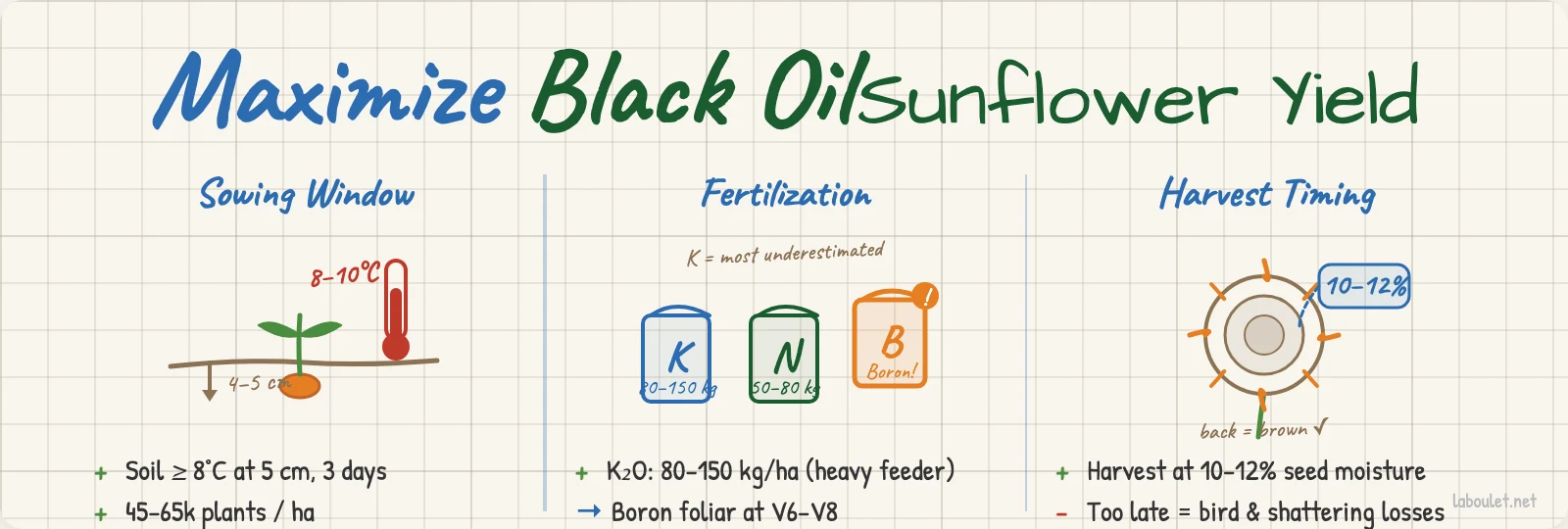
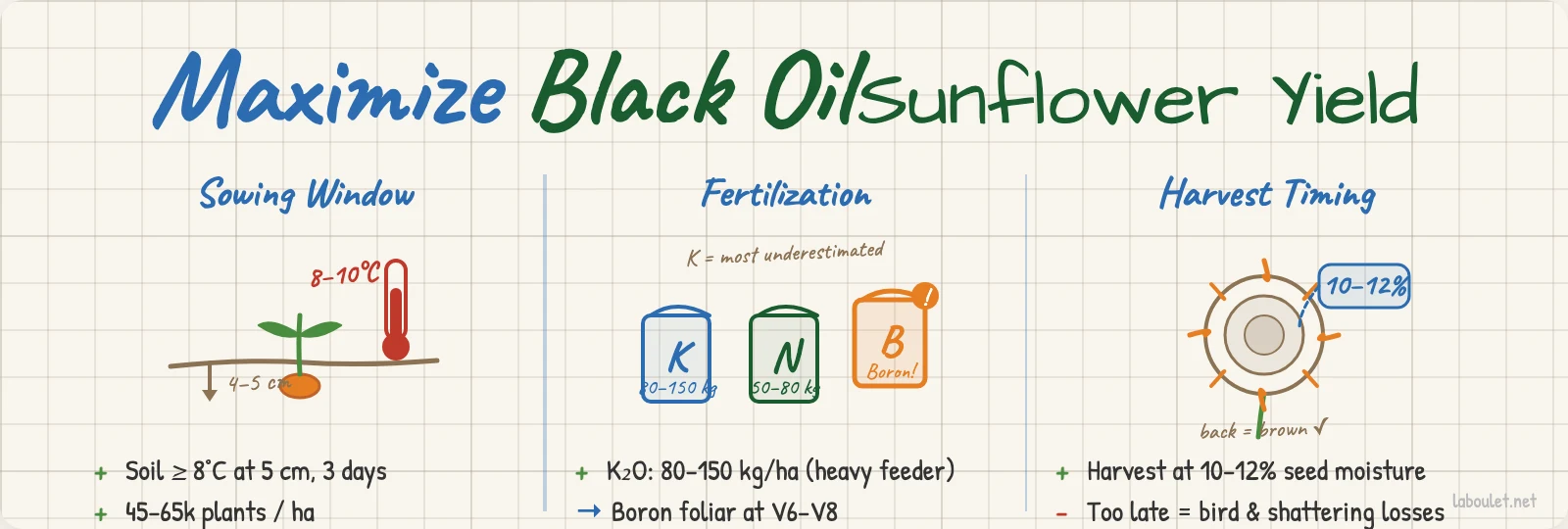
Sunflower is a warm-season crop. The most important planting rule is: do not sow until soil temperature at 5 cm depth has reached 8 to 10°C for three consecutive days. Below this threshold, germination is slow and uneven (12 to 20 days instead of 5 to 8), seedling disease pressure from Pythium and Rhizoctonia increases sharply, and early-season weed competition establishes before the crop can compete.
In continental Europe, this threshold corresponds to late April to mid-May depending on latitude and seasonal conditions. In warmer production zones — Mediterranean, sub-tropical, semi-arid Africa — sowing windows open from March onwards.
The yield case for timely planting is well established in replicated trials: each week of delay beyond the optimal sowing window costs 50 to 100 kg/ha in final yield. Head size and seed number per head are determined during the vegetative phase before the photoperiod-triggered switch to flowering. A longer vegetative phase produces larger heads with more seeds — and larger heads are the primary yield component in sunflower.
4. Seeding Rate and Spacing
Sunflower yield is built from three components: number of plants per hectare, seeds per head, and individual seed weight. The first component is management-driven; the others are influenced by genetics, environment, and the quality of in-season management.
For black oil sunflower grown for oil, the target plant population is 45,000 to 65,000 plants per hectare across most commercial environments. Higher populations increase yield potential on deep soils with adequate water but also amplify competition for resources and can increase Sclerotinia and Botrytis risk. Lower populations leave yield on the table and allow weed re-infestation after row closure.
Standard row spacings:
- 70 cm rows (most common in Europe): 20 to 30 cm in-row spacing gives 47,600 to 71,400 seeds/ha before emergence allowances
- 50 to 75 cm rows adjusted to give equivalent population with higher-clearance tractor systems
Sow at 4 to 5 cm depth into moist soil. Shallower sowing risks poor emergence in dry spring conditions; deeper sowing delays emergence and increases the risk of hypocotyl deformation. Always calibrate the target seeding rate upward to account for the seed lot’s germination percentage: if seed germination is 92% and the target is 55,000 emerged plants/ha, sow at 59,800 seeds/ha.
5. Fertilisation: A Nutrient-Specific Approach
Sunflower has a distinctive nutrient uptake profile that differs significantly from cereals. Understanding the hierarchy of nutrient responses prevents both deficiency and waste, and is one of the most actionable yield levers available to the commercial grower.
Nitrogen (N)
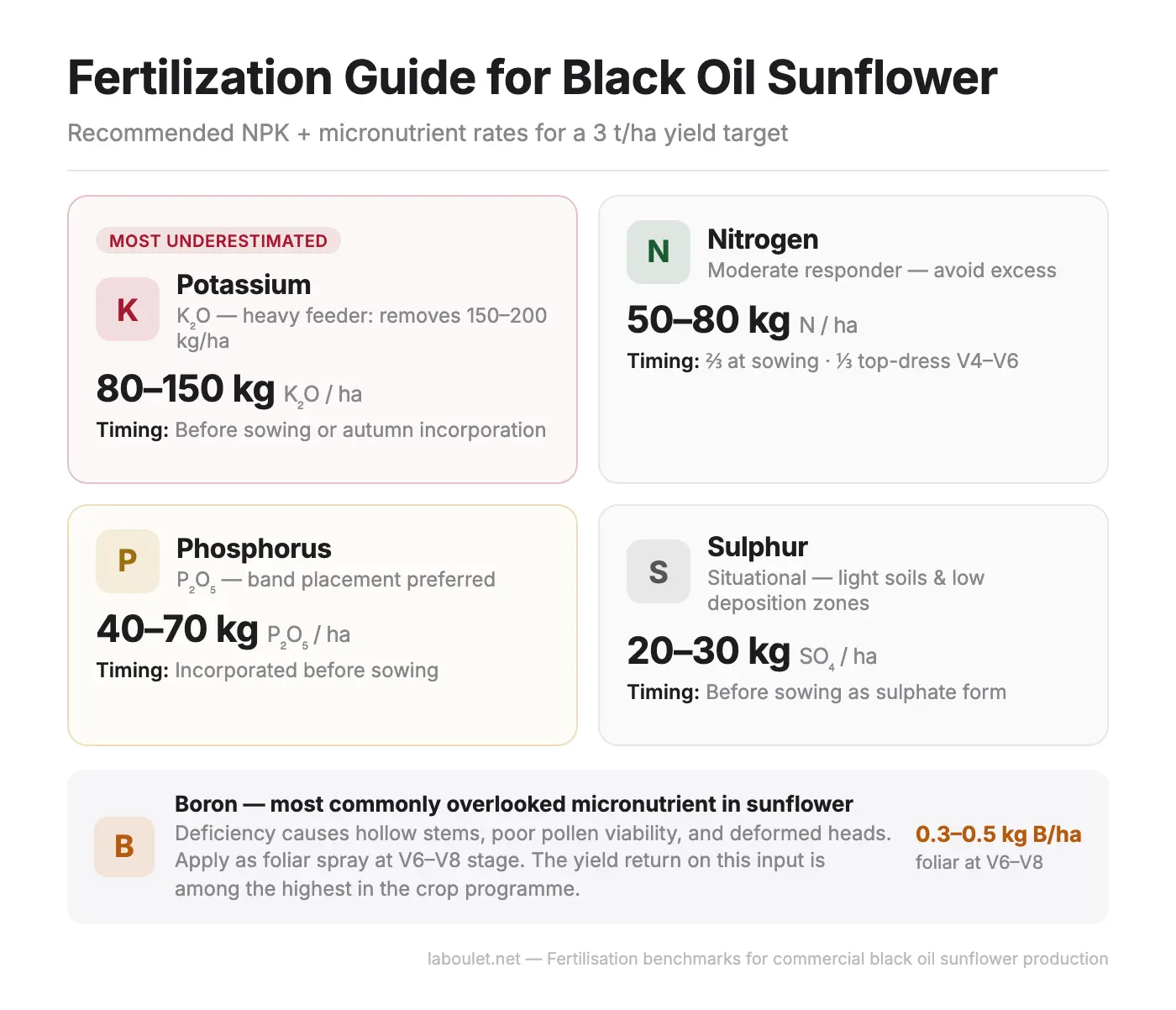
Total nitrogen removal for a 3 t/ha crop is approximately 100 to 120 kg N/ha. Sunflower has a relatively modest yield response to applied N compared to maize or wheat, because its deep root system can mine residual soil N from depth. Apply 50 to 80 kg N/ha on low-to-medium fertility soils. Split applications are beneficial: two-thirds at or shortly after sowing, one-third as side-dress before elongation (V4 to V6 stage, four to six leaves). Avoid excessive nitrogen — it promotes tall, poorly lodging-resistant plants and delays maturity without improving oil yield.
Phosphorus (P)
Sunflower responds well to phosphate on deficient soils. Recommended rates are 40 to 70 kg P₂O₅/ha, incorporated before sowing. Band placement at 5 cm beside and below the seed row significantly improves P use efficiency, particularly on neutral to alkaline soils where P fixation reduces broadcast availability.
Potassium (K)
This is the nutrient most frequently underestimated in sunflower programmes. Unlike castor bean, which shows a modest K response, sunflower is a heavy potassium feeder: a 3 t/ha crop removes 150 to 200 kg K₂O from the soil — more than any other common broadleaf oilseed crop. On soils with exchangeable K below 100 mg/kg, apply 80 to 150 kg K₂O/ha. On high-K soils, maintenance rates of 60 to 80 kg/ha suffice. Potassium deficiency manifests as marginal leaf scorch, premature lower-leaf death, and significantly reduced seed fill and test weight.
Boron (B)
Boron is the micronutrient most commonly limiting sunflower yield on light-textured and high-pH soils, yet it is frequently absent from fertilisation programmes. B deficiency causes hollow stems, poor pollen viability, and head deformity — all of which directly reduce seeds per head and seed weight. Apply 0.3 to 0.5 kg B/ha as foliar spray at the 6 to 8 leaf stage, or 1.0 to 1.5 kg B/ha as soil incorporation before sowing where deficiency has been confirmed. The return on this input is among the highest in the crop programme.
Sulphur (S)
On light soils and in environments where atmospheric S deposition has declined, 20 to 30 kg S/ha as sulphate gives measurable yield responses in trials. Sulphur application is particularly justified where the previous crop showed S deficiency symptoms, or on sandy soils in rainfall-leaching environments.
6. Water Management: When It Counts Most
Sunflower’s reputation for drought tolerance is well earned — its deep tap root gives it access to subsoil moisture that most crops cannot reach. But the crop is highly responsive to water at specific growth stages, and understanding these critical periods is essential for both irrigated production and dryland risk management.
Critical Water Demand Periods
- V6 to R1 (late vegetative to bud stage): Head size is being determined. Water stress here permanently reduces head diameter and seed number per head — yield losses at this stage cannot be compensated later in the season.
- R1 to R6 (flowering through seed fill): The highest demand period. Water stress during pollination reduces fertilisation rate; stress during seed fill reduces oil content and thousand-seed weight.
Total consumptive water use for a commercial sunflower crop is 400 to 600 mm over the full season, with approximately 50% of that required during the 30-day flowering-to-seed fill window.
Practical Irrigation Rules
- Maintain soil water above 50% field capacity from V6 onwards through seed fill
- Cease irrigation 2 to 3 weeks before anticipated harvest — this accelerates maturity and improves standing
- Avoid overhead irrigation during flowering — wet conditions during pollen shed significantly reduce fruit set and increase Sclerotinia and Botrytis risk
- Never allow wilting during early stages and flowering — plants that wilt before midday will produce blasted or poorly filled seeds, particularly on high-potential hybrids
7. Weed and Disease Management
Weed Control
Sunflower is a moderate weed competitor — better than young castor but worse than a dense maize canopy once it reaches canopy closure. The critical weed-free period is from emergence to row closure, approximately 35 to 45 days after emergence (V6 to V8). A practical programme combines a pre-emergence herbicide (pendimethalin or S-metolachlor, depending on weed spectrum) with post-emergence options. Where Clearfield hybrids are available and registered for your region, the imazamox system provides the most complete broadleaf and grass weed control. Inter-row cultivation to 5 cm depth remains an effective and economic complement to chemical control, and reduces selection pressure for herbicide-resistant populations.
Key Diseases to Monitor
- Downy mildew (Plasmopara halstedii): Choose hybrids with resistance to locally prevalent races. Seed treatment with metalaxyl provides additional protection in high-pressure seasons. Systemic infection produces stunted, distorted plants with white sporulation on leaf undersides — infected plants should be removed promptly.
- Sclerotinia stem rot: Favoured by wet soils and high humidity. Variety tolerance is the primary defence; fungicide at early flowering (R1) is justified when weather forecasts indicate prolonged wet conditions during the risk period.
- Sclerotinia head rot: Apply fungicide (boscalid/pyraclostrobin or tebuconazole) at petal fall (R3 to R5) when wet conditions coincide with the critical head development window. Drone application is effective at canopy penetration.
- Grey mould (Botrytis cinerea): Canopy management (adequate spacing, timely irrigation termination) is the primary defence. Fungicide at R4 to R6 if prolonged wet weather is forecast.
Insect Pests
The sunflower moth (Homoeosoma nebulella) is the primary insect threat in European production. Larval feeding in the florets reduces seed fill and creates entry points for Botrytis and other secondary pathogens. Monitor adult flight with pheromone traps from R1; the intervention threshold is 3 moths per trap per day. Lygus bugs cause direct seed damage and are significant in some regions — pyrethroid treatment at early R3 is justified if populations exceed local threshold recommendations.
8. Harvest Timing and Post-Harvest Management
Getting the harvest right is as important as any other management decision in the season. Combine losses increase sharply when harvest is either too early (immature seed, high moisture, excessive trash, combine overload) or too late (head shattering, bird damage, stalk lodging, oil oxidation).
Target Harvest Window
Wait for physiological maturity (R9 stage): the back of the head turns from yellow to brown, bracts dry, and seeds reach minimum viable moisture for storage. Target harvest at 10 to 12% seed moisture for direct combining. At this moisture level, oil oxidation during storage is manageable and combining efficiency is high. Do not wait for natural drying below 8% — shattering, head drooping, and bird losses accelerate rapidly once the crop has fully dried in the field.
Combine Settings
Sunflower requires different combine settings to cereals, and taking the time to calibrate correctly is consistently worth 100 to 200 kg/ha in recovered yield:
- Cylinder/rotor speed: Reduce to 800–1,000 rpm (conventional) or equivalent rotor peripheral speed. Adjust until cracked seed percentage falls below 2%.
- Concave clearance: Widen compared to cereals — the goal is to rub seeds off the head, not to crack them
- Fan speed: Reduce to retain seeds without overloading the cleaning shoe — sunflower seeds are lighter than grain and susceptible to blowover losses
- Sunflower header: Use of a dedicated sunflower header with lifter plates and seed-catching pans significantly reduces head-shatter and pre-harvest losses, particularly on lodged or drooping heads
Storage
Store at less than 9% moisture and below 15°C to prevent oxidation of the oil fraction and to inhibit mycotoxin development. Sunflower oil is relatively stable compared to linseed but is vulnerable to heating in wet, poorly ventilated storage. Aeration management in the first 30 days after filling is critical to achieving uniform moisture distribution and preventing hot spots.
9. Yield Benchmarks: What Separates Top Performers
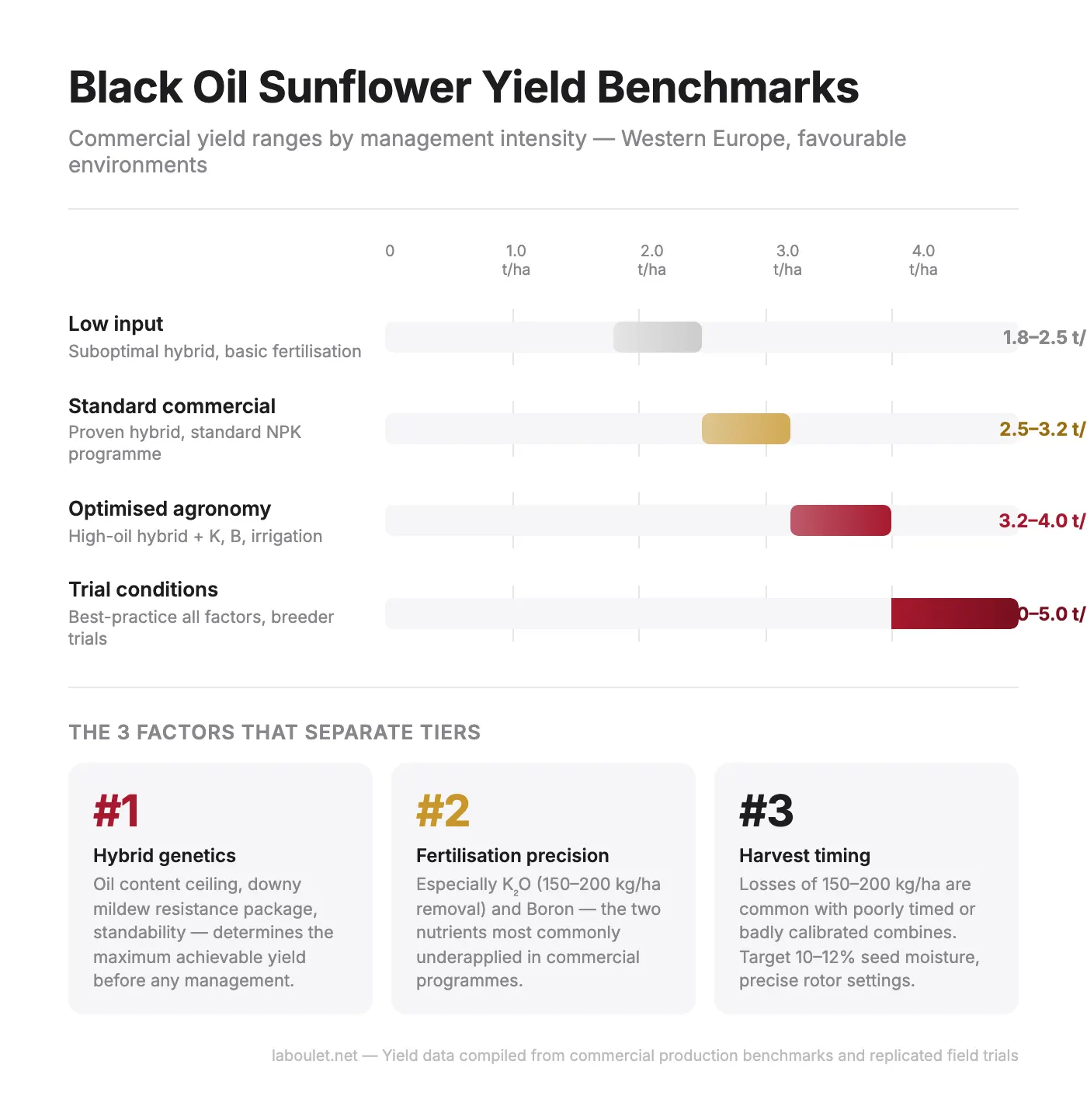
Under commercial conditions in Western Europe, yield outcomes typically cluster into distinct tiers determined by management intensity and hybrid quality:
- Low input, suboptimal hybrid: 1.8 to 2.5 t/ha
- Standard commercial management: 2.5 to 3.2 t/ha
- Optimised agronomy: 3.2 to 4.0 t/ha
- Trial conditions, best practice: 4.0 to 5.0 t/ha
The consistent differences between the bottom and top tiers trace back to three factors: hybrid choice (oil content ceiling, disease resistance), fertilisation precision — particularly K and Boron, which are frequently underapplied — and harvest timing accuracy, where losses of 150 kg/ha or more are common in poorly timed or poorly set-up combines.
One underappreciated factor is the interaction between hybrid genetics and management level. High-potential hybrids require high management to express their ceiling yield — a top hybrid under low management will not outperform a mid-tier hybrid under optimised management. Match your hybrid to your management capability, then push both upward together.
Conclusion
Maximising black oil sunflower yield is not about any single intervention — it is about stacking marginal gains across the whole management chain. The grower who selects a proven hybrid with a strong disease package, prepares a deep and well-drained seedbed, plants at the right soil temperature and population, fertilises with attention to potassium and boron, manages water through the critical flowering window, and harvests at precise seed moisture will consistently outperform market averages by 0.5 to 1.0 t/ha.
The practical starting point is hybrid selection: the right genetics opens the yield ceiling, while good agronomy fills it. Laboulet Semences provides black oil sunflower hybrids bred for high oil content, strong disease packages, and reliable performance under diverse growing conditions. Explore the full sunflower seed range to find the hybrid matched to your region, rotation, and yield target.
Our varieties: sunflower
| Variety | Seed | Oil profile | Earliness |
|---|---|---|---|
| LS SWIFT | Striped | Linoleic | Early to very early |
| LS Starly | Striped | Oleic | Early |
| LS SKIPPY | Striped | — | Early to very early |
| LS Pickit | Striped | Linoleic | Early |
| LS Luminal | Black | Linoleic | Early |
| LS Lollipop | Striped | Oleic | Early to very early |
Frequently asked questions
What is black oil sunflower used for?
Black oil sunflower (high oil content varieties with black hull) is the dominant oilseed type in commercial sunflower production. The seed is crushed for sunflower oil (cooking oil and biofuel feedstock) and the meal is used as livestock feed. Black oil is preferred over striped because of its higher oil content (40-50% vs 30-40%).
How can I increase sunflower yield per hectare?
Five high-impact levers: (1) match hybrid to the GDD available — under-using FAO group caps your yield; (2) optimize plant density (60,000-70,000 plants/ha for oilseed); (3) ensure adequate boron and sulfur supply at flowering; (4) control sclerotinia and phomopsis pressure with timing and rotation; (5) harvest at correct moisture (10-12%) to avoid losses.
What is the average yield of black oil sunflower?
Under good rainfed conditions, black oil sunflower yields 2.5 to 3.5 tonnes/ha. Top performance with ideal conditions and irrigation can reach 4.5 tonnes/ha. National averages vary widely: ~2 t/ha in dry-rainfed Eastern Europe, ~2.8 t/ha in France, ~3 t/ha in Argentina.
What is the optimal plant population for black oil sunflower?
Optimum plant density for oilseed sunflower is 60,000 to 70,000 plants/ha at harvest, equivalent to a sowing rate of 70,000-75,000 seeds/ha to account for emergence losses. Higher densities reduce head size and oil content per seed; lower densities waste yield potential.
How do I prevent disease in sunflower?
Three main practices: (1) rotation — minimum 4-year break between sunflower crops to break sclerotinia and phomopsis cycles; (2) hybrid choice — select varieties with strong genetic tolerance to local disease pressure; (3) timing — early sowing escapes some late-summer disease windows. Avoid wet field operations that compact soil and favor pathogens.