
Hybrid corn seeds for silage and grain, FAO 100 to 450
Hybrid corn seeds for grain and silage with strong vigor and adaptability
Key advantages
All Corn varieties
LS Siliciana
FAO 170Very early double-cross hybrid delivering strong silage yield, good forage quality and reliable digestibility.
LS Amuria
FAO 170Very early double-hybrid maize with strong forage quality and excellent digestibility.
LS Arolia
FAO 120Ultra-early hybrid delivering high forage yield, strong feed value and excellent digestibility.
LS Maridol
FAO 120Ultra-early hybrid with a very short cycle, ideal for early silage and fast grain maturity.
LS Joalia
FAO 180A very early hybrid offering strong forage potential and excellent adaptation to high sowing densities.
LS Marelia
FAO 130Ultra early hybrid with fast dry down, strong density tolerance and excellent digestibility.
LS Norvia
FAO 100Ultra-early hybrid with a very short cycle, rapid dry down, and strong digestibility.
LS Parisiana
FAO 120Ultra early silage-oriented hybrid with high digestibility and strong adaptation to dense planting.
TA57-23
FAO 120Ultra-early double-cross hybrid suited for catch cropping, high densities and strong digestibility.
ZETA 105
FAO 105Ultra-early hybrid with ultra-short cycle, rapid dry-down, and strong performance under dense planting.
ZETA 120
FAO 120Ultra-early hybrid with ultra-fast dry-down, strong density adaptation and very good forage digestibility.
ZETA 125
FAO 125Ultra-early hybrid with ultra-fast dry-down, strong density adaptation and excellent forage digestibility.
ZETA 200
FAO 200Very early silage hybrid with strong yield potential, high feeding value and good adaptation to dense stands.
ZETA 110 S
FAO 110Ultra-early hybrid with a very short cycle, fast dry-down, strong density adaptation and excellent grain-to-precocity ratio.
ZETA 115 S
FAO 115Ultra-early hybrid with a very short cycle, rapid maturity, strong density adaptation and excellent feeding quality.
ZETA 140 S
FAO 140Very early hybrid with ultra-short cycle, excellent silage quality, strong grain potential and catch cropping suitability.
LS BAJKALIA
FAO 120Ultra-early corn hybrid offering very fast dry down and excellent digestibility.
LS MARIDOL
FAO 120Ultra-early hybrid with a very fast dry down and excellent digestibility.
Corn EFEZIA
Semi-early silage corn with strong health, high yield potential and excellent feeding value.
Corn ELAMIANA
FAO 250Medium-early silage corn hybrid combining strong vigor, high protein levels and excellent digestibility.
LSM 0811 (Algor)
An early hybrid offering strong silage and grain potential with excellent rusticity and luxuriant vegetation.
Rudilia
Semi-early hybrid with strong silage potential, solid stress tolerance, and very good feeding value.
Smyrna
Early silage hybrid offering strong yield potential and solid agronomic performance.
LS Tirnavia
Early to semi-early hybrid combining strong yield potential, solid agronomic health and very good forage quality.
LS Zetalia
FAO 220Early double-cross hybrid with strong and consistent yield, very good digestibility and solid agronomic balance.
SERBILIA
FAO 450Late dent hybrid delivering strong grain performance, robust plant structure and excellent tolerance to lodging and diseases.
Ultra Early Corn Hybrid
Key advantages
- Fast emergence and rapid early vigor
- Shortest growing cycle for extremely early harvest
- Strong cold tolerance for northern climates
LS Siliciana
FAO 170Very early double-cross hybrid delivering strong silage yield, good forage quality and reliable digestibility.
LS Amuria
FAO 170Very early double-hybrid maize with strong forage quality and excellent digestibility.
LS Arolia
FAO 120Ultra-early hybrid delivering high forage yield, strong feed value and excellent digestibility.
LS Maridol
FAO 120Ultra-early hybrid with a very short cycle, ideal for early silage and fast grain maturity.
LS Joalia
FAO 180A very early hybrid offering strong forage potential and excellent adaptation to high sowing densities.
LS Marelia
FAO 130Ultra early hybrid with fast dry down, strong density tolerance and excellent digestibility.
LS Norvia
FAO 100Ultra-early hybrid with a very short cycle, rapid dry down, and strong digestibility.
LS Parisiana
FAO 120Ultra early silage-oriented hybrid with high digestibility and strong adaptation to dense planting.
TA57-23
FAO 120Ultra-early double-cross hybrid suited for catch cropping, high densities and strong digestibility.
ZETA 105
FAO 105Ultra-early hybrid with ultra-short cycle, rapid dry-down, and strong performance under dense planting.
ZETA 120
FAO 120Ultra-early hybrid with ultra-fast dry-down, strong density adaptation and very good forage digestibility.
ZETA 125
FAO 125Ultra-early hybrid with ultra-fast dry-down, strong density adaptation and excellent forage digestibility.
ZETA 200
FAO 200Very early silage hybrid with strong yield potential, high feeding value and good adaptation to dense stands.
ZETA 110 S
FAO 110Ultra-early hybrid with a very short cycle, fast dry-down, strong density adaptation and excellent grain-to-precocity ratio.
ZETA 115 S
FAO 115Ultra-early hybrid with a very short cycle, rapid maturity, strong density adaptation and excellent feeding quality.
ZETA 140 S
FAO 140Very early hybrid with ultra-short cycle, excellent silage quality, strong grain potential and catch cropping suitability.
LS BAJKALIA
FAO 120Ultra-early corn hybrid offering very fast dry down and excellent digestibility.
LS MARIDOL
FAO 120Ultra-early hybrid with a very fast dry down and excellent digestibility.
Corn EFEZIA
Semi-early silage corn with strong health, high yield potential and excellent feeding value.
Corn ELAMIANA
FAO 250Medium-early silage corn hybrid combining strong vigor, high protein levels and excellent digestibility.
LSM 0811 (Algor)
An early hybrid offering strong silage and grain potential with excellent rusticity and luxuriant vegetation.
Rudilia
Semi-early hybrid with strong silage potential, solid stress tolerance, and very good feeding value.
Smyrna
Early silage hybrid offering strong yield potential and solid agronomic performance.
LS Tirnavia
Early to semi-early hybrid combining strong yield potential, solid agronomic health and very good forage quality.
LS Zetalia
FAO 220Early double-cross hybrid with strong and consistent yield, very good digestibility and solid agronomic balance.
Early Corn Hybrid
Key advantages
- Rapid emergence and early vigor
- Suited for short-season or northern regions
- Reliable maturity before autumn rains
Late Corn Hybrid
Key advantages
- Maximum yield potential in long seasons
- Excellent grain fill and weight
- Deep root system for water efficiency
Range overview
| Type | Maturity (FAO) | Varieties |
|---|---|---|
| Ultra Early Corn Hybrid | FAO 100-200 | LS Siliciana, LS Amuria, LS Arolia, LS Maridol, LS Joalia, LS Marelia, LS Norvia, LS Parisiana, +10 |
| Early Corn Hybrid | FAO 220-250 | Corn EFEZIA, Corn ELAMIANA, LSM 0811 (Algor), Rudilia, Smyrna, LS Tirnavia, LS Zetalia |
| Late Corn Hybrid | FAO 450 | SERBILIA |
Where to grow corn
Guides & insights on corn
View all articles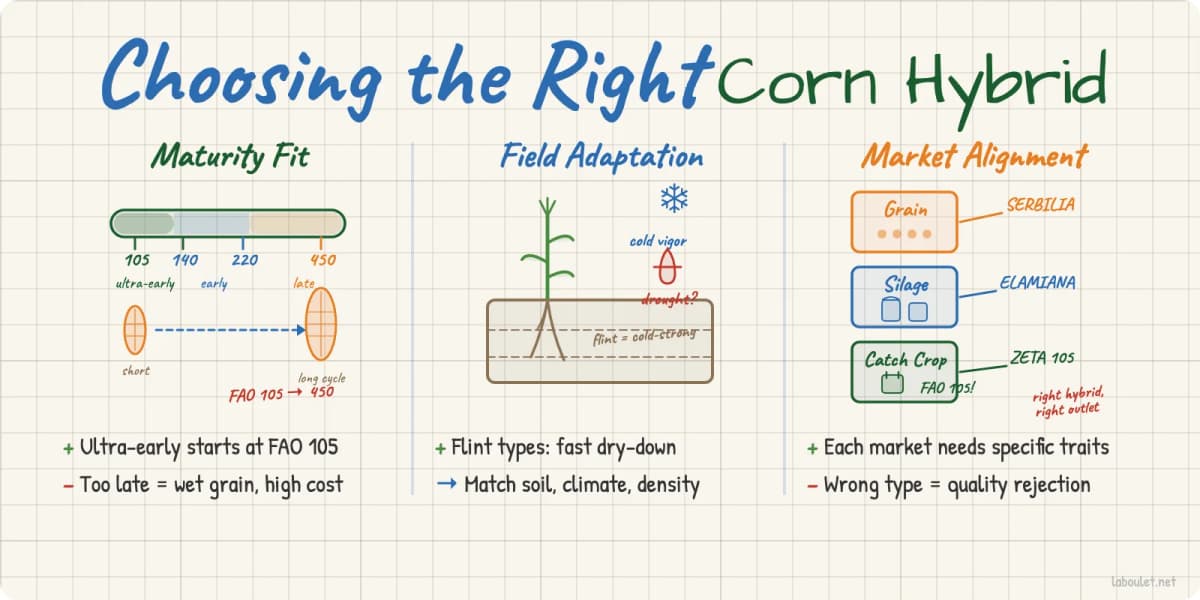
How to Choose the Right Corn Hybrid for Your Farm
Every season starts with the same question: which hybrid goes into the planter? The answer determines your yield ceiling, your harvest date, your drying costs, and ultimately your margin. Yet too many growers default to habit — replanting last year’s pick or copying a neighbor — without asking whether that hybrid actually fits their field, […]
Read more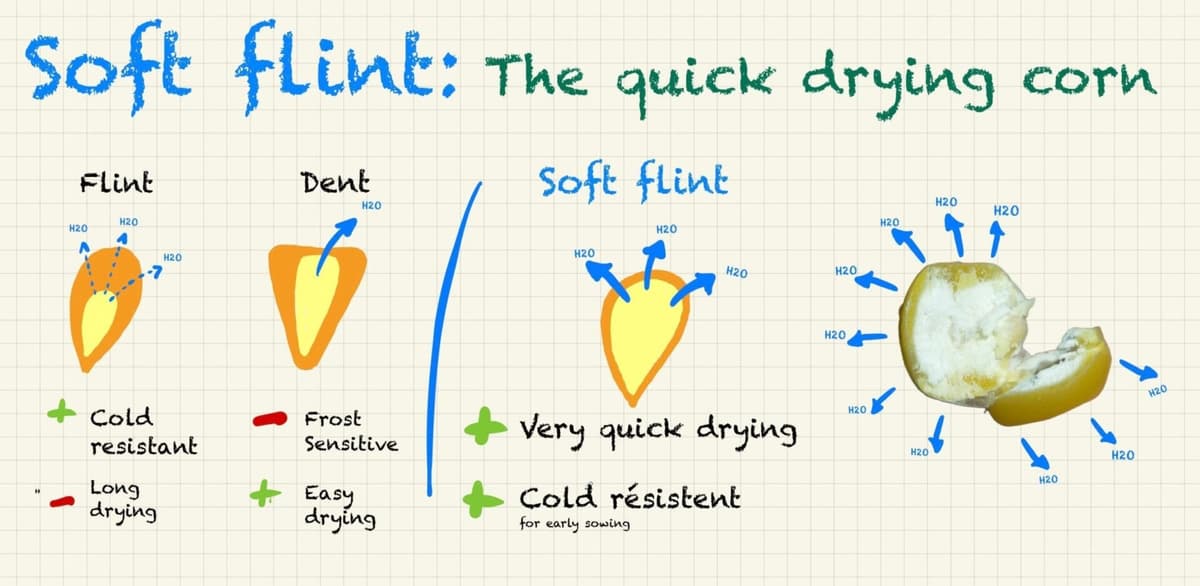
Soft flint: The quick drying corn
“Soft Flint” Corn: Flint Vigor Combined with Rapid Dry-Down Soft flint corn is an innovative type of grain corn derived from flint corn, characterized by an extremely thin vitreous endosperm. In other words, the kernel retains the visual appearance of flint corn (no dent) while being largely composed of floury starch. This unique profile gives […]
Read moreThe Role of Hybrid Corn in Modern Cropping Systems
Hybrid corn seeds support productive, stable and uniform crop expression across variable soil and climate environments. Their genetic combination enhances vigor, seed set consistency and growth regularity, making them well suited for intensive farming systems. These characteristics allow producers to pursue predictable harvests while managing agronomic constraints.
Laboulet’s Foundations in Varietal Development
Laboulet develops hybrid corn seeds through a controlled varietal-creation process that emphasizes yield potential, early-cycle behavior and structural regularity. Our varieties undergo multi-site evaluations to confirm agronomic stability, biomass distribution and cob uniformity. Seed production follows stringent quality protocols to ensure that our seeds meet high standards of purity and germination.
Main Criteria for Selecting Hybrid Corn Seeds
Yield Potential and Productivity
Yield remains a primary consideration when selecting hybrid corn. Productive hybrids combine strong early vigor, balanced vegetative growth and efficient grain filling. These traits allow crops to express stability across diverse environments and production systems.
- Regular cob size and kernel fill
- Stable performance under moderate stress
- Uniform plant architecture for mechanized systems
- Efficient biomass partitioning
Cycle Length and Early Development
Cycle length influences planting windows, harvest planning and rotation management. Early-cycle hybrids allow earlier grain maturity and reduce exposure to late-season risks. Laboulet examines emergence speed, early vigor and reproductive timing when developing our varieties.
- Adaptation to early sowing
- Reduced exposure to late-season heat
- Compatibility with intensive rotations
Agronomic and Structural Traits
Beyond yield, hybrid corn must express solid agronomic profiles. Stem strength, root anchorage, uniform flowering and ear height contribute to operational stability and harvest efficiency. Laboulet evaluates these traits during long-term varietal screening.
- Firm stems to reduce lodging
- Balanced height for uniform stands
- Tolerance to common fungal pressures
- Consistent grain maturity
Soil Adaptation and Rotation Fit
Correct hybrid placement depends on soil type, water availability and preceding crop. Understanding root behavior, nutrient requirements and soil compatibility helps optimize performance within different production systems. Our ranges are assessed under multiple soil scenarios to validate adaptability.
Hybrid Corn Solutions Developed by Laboulet
Laboulet’s hybrid corn portfolio integrates early-cycle regularity, productive potential and agronomic resilience. Our varieties are tested across contrasting conditions to ensure consistent behavior in real farming environments. These solutions help producers secure stable grain output and efficient crop management.
- Hybrids selected for rapid establishment
- Profiles validated for uniform emergence
- Adaptation to varied soil structures
- Stable traits confirmed over multi-year trials
Agronomic Practices for Enhancing Hybrid Corn Performance
Seedbed Preparation and Sowing Management
Proper soil preparation supports uniform emergence and early root development. Hybrid corn benefits from controlled sowing depth, well-structured soil and appropriate planting density. Early sowing can be considered when soil temperatures allow rapid germination.
- Sowing depth generally between 3 and 5 cm
- Density adjusted to soil potential and target yield
- Reduced compaction during early phases
Fertilization and Nutrient Balance
Corn hybrids require balanced nutrition to support vegetative growth, root strength and kernel formation. Nitrogen must be managed to avoid excessive vegetative biomass, while phosphorus and potassium reinforce flowering and grain fill. Micronutrient availability contributes to physiological stability.
- Moderate nitrogen aligned with production targets
- Attention to phosphorus and potassium in low-fertility soils
- Soil analysis recommended for precise adjustment
Phytosanitary Monitoring and Disease Behavior
Hybrid corn expresses tolerance to common pathogens, but integrated management remains essential. Crop monitoring, rotation planning and balanced fertilization help limit disease expression and sustain stable agronomic behavior.
- Regular vegetative stage monitoring
- Rotational strategies to reduce pathogen loads
- Support from varietal tolerance when pressure increases
Harvest and Post-Harvest Considerations
Harvest timing is driven by kernel maturity and moisture content. Hybrid regularity helps maintain predictable maturation, allowing smoother planning and improved grain quality preservation.
- Monitoring grain moisture closely
- Adjusting machinery to kernel size and texture
- Ensuring controlled storage conditions
Common Questions on Hybrid Corn
What defines a hybrid corn seed?
A hybrid corn seed results from controlled crossbreeding between two parental lines, producing uniform growth and enhanced agronomic traits.
How do I choose the right hybrid for my operation?
Selection depends on yield objectives, soil conditions, rotation intensity and climate. Cycle length, tolerance levels and productivity guide hybrid choice.
Why is early-cycle behavior important?
Early-cycle hybrids mature sooner, reduce exposure to late-season risks and support more flexible harvest planning.
How do hybrids perform in variable field conditions?
Hybrids offer strong emergence, balanced vegetative growth and stable ear development across varied environments.
Are hybrids suitable for intensive cropping systems?
Hybrids with controlled growth and predictable maturity integrate effectively into high-intensity rotations.
What traits influence disease behavior in hybrid corn?
Stem strength, flowering synchronicity and selected tolerance traits affect disease expression under pressure.
What soil conditions best support hybrid corn?
Well-structured soils with adequate nutrient availability and moderate moisture allow optimal expression of hybrid traits.
How do I determine the best harvest window?
Grain moisture, kernel maturity and field dry-down patterns define the optimal harvest period.
Depending on crop strategy or field conditions, producers often explore our hybrid sunflower seeds and hybrid castor beans as complementary reference points, each developed through targeted varietal work combining stable productivity, early-cycle traits, and practical agronomic profiles.