
When to Plant Sunflower Seeds: Agronomic Timing for Commercial Growers
Planting date is not a calendar decision. It is an agronomic one. The difference between a productive sunflower crop and a mediocre stand often traces back to a sowing window of just ten to fifteen days. For professional growers, timing sunflower planting means reconciling soil temperature, varietal cycle length, downstream market requirements and regional climate […]
Planting date is not a calendar decision. It is an agronomic one. The difference between a productive sunflower crop and a mediocre stand often traces back to a sowing window of just ten to fifteen days.
For professional growers, timing sunflower planting means reconciling soil temperature, varietal cycle length, downstream market requirements and regional climate patterns. No single date applies universally. The logic must be field-specific.
Soil Temperature: the First Decision Threshold
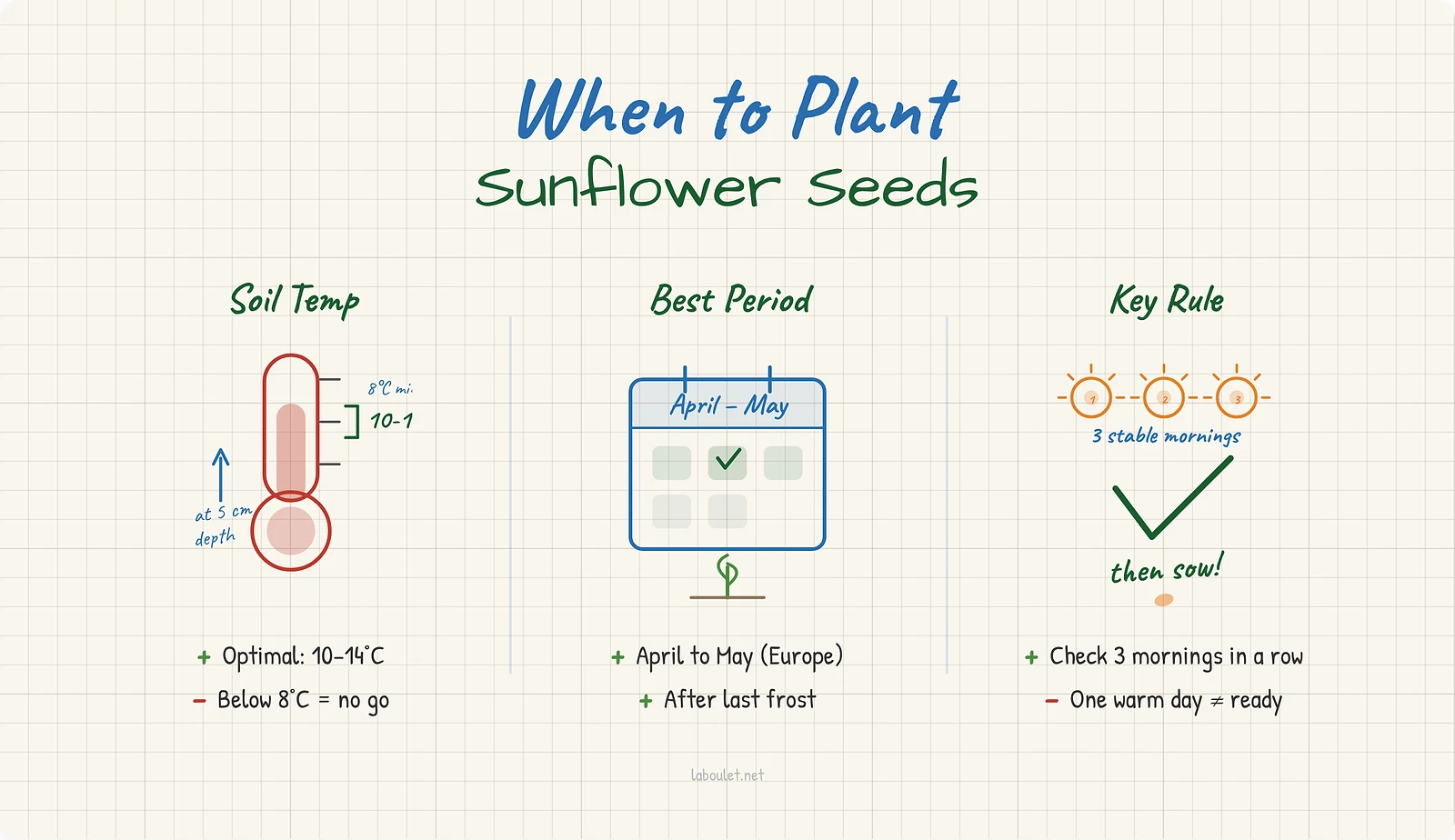
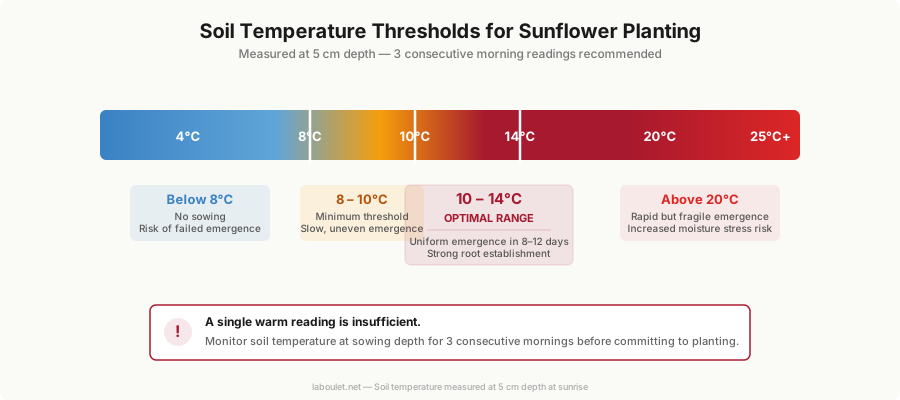
Sunflower germination requires a minimum soil temperature of 8°C at a depth of 5 cm. Below this threshold, emergence is slow, uneven and vulnerable to soilborne pathogens.
Optimal germination occurs between 10°C and 14°C. At this range:
- Emergence is uniform within 8 to 12 days
- Root establishment is vigorous from the outset
- Early weed competition pressure is reduced by faster canopy closure
Soil temperature is more reliable than air temperature. A warm week in early spring does not mean the soil has followed. Growers should monitor soil temperature at sowing depth for three consecutive mornings before committing to planting. A single warm reading is insufficient.
Starting with germination-tested seeds ensures that once the temperature window opens, emergence translates into a strong, uniform stand.
Regional Sowing Windows: Adapting to Pedoclimatic Reality
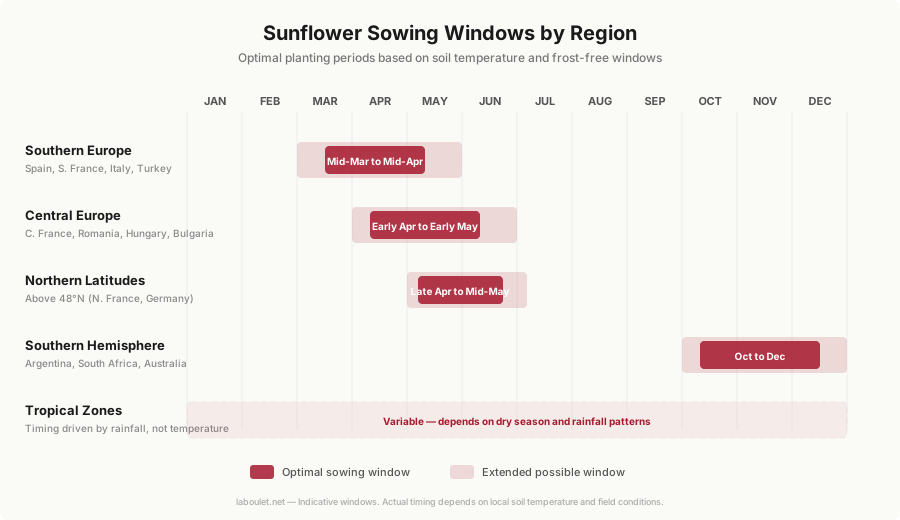
Sunflower is grown commercially across a wide range of latitudes and climates. Sowing windows vary accordingly.
Southern Europe and Mediterranean Climates
In southern France, Spain, Italy, Turkey and similar latitudes, sowing typically occurs from mid-March to mid-April. Soil temperatures reach the 8–10°C threshold early. The key constraint is not cold but moisture: early sowing captures residual winter soil moisture before summer drought stress.
Central Europe and Temperate Continental Zones
In central France, Romania, Hungary, Bulgaria and Ukraine, the window opens from early April to early May. Late frost risk must be weighed against delayed sowing penalties. Sunflower tolerates light frost at the cotyledon stage but is sensitive once true leaves emerge.
Northern Latitudes and Short-Season Regions
Above 48°N, the window narrows to late April through mid-May. Here, variety selection becomes critical. Only early to very early hybrids complete their cycle before autumn conditions deteriorate. Varieties like LS SWIFT or LS Pickit — bred for rapid cycle completion — give growers flexibility when the spring sowing window is compressed.
Southern Hemisphere and Tropical Zones
In Argentina, South Africa and parts of Australia, sowing follows the reversed calendar: October to December. In tropical and subtropical regions, sunflower can be sown as a dry-season crop, with timing driven by rainfall patterns rather than temperature.
No universal sowing date exists. Correct timing reconciles soil conditions, climate patterns and varietal response.
Variety Cycle Length and Planting Date Interaction
Planting date and varietal cycle are inseparable. A semi-early hybrid sown late behaves differently than an early hybrid sown at the same date.
The relationship is direct:
- Early and very early hybrids (cycle 100–115 days) tolerate later sowing and still reach physiological maturity before harvest conditions degrade. They are essential in short-season zones or when spring planting is delayed.
- Semi-early hybrids (cycle 115–130 days) require timely sowing to express their full yield potential. Delayed planting compresses the grain-filling period and reduces oil accumulation.
In practice, this means variety selection is a planting-date decision. Choosing a hybrid without considering the available thermal window leads to misalignment between genetics and environment.
Laboulet’s hybrid sunflower seed range spans maturity groups precisely for this reason — allowing growers to match varietal cycle to their specific sowing calendar and regional constraints.
Oil Type, Market Destination and Sowing Timing
Downstream market requirements influence planting strategy. Oil profile development is sensitive to temperature during the grain-filling phase.
High Oleic Production
High oleic sunflower hybrids need adequate thermal accumulation during seed development to reach the oleic acid thresholds that crushers require. Early sowing — within the first third of the regional window — maximizes this accumulation period. Varieties like LS Starly, delivering approximately 89% oleic content, perform best when given the full growing season.
Linoleic and Standard Oil Production
Linoleic sunflower hybrids offer slightly more flexibility in sowing dates. The fatty acid profile is less temperature-dependent, and yield stability across a wider planting window is generally higher.
Bird Feed and Confectionery Markets
Striped sunflower seeds for bird feed or confectionery demand visual grain quality. Adequate growing days are needed for kernel fill and husk development. Late planting risks undersized seeds that receive quality reductions at collection.
The grower who ignores downstream expectations when choosing a sowing date is making a commercial error, not just an agronomic one.
Late Planting: Risks and Compensating Strategies
Delayed planting is sometimes unavoidable. Wet springs, delayed preceding crop harvest or logistical constraints push sowing beyond the optimal window.
The consequences of late planting are measurable:
- Reduced thermal time for grain filling, lowering test weight and oil content
- Flowering during peak summer heat, increasing flower abortion risk
- Later harvest, exposing heads to bird damage, Sclerotinia and autumn moisture
- Higher grain moisture at harvest, increasing drying costs
Compensating strategies exist. The most effective is switching to an earlier-maturing hybrid. If the standard sowing window has passed, very early varieties such as LS Lollipop or L 15-13 OS Bluebird shorten the cycle enough to recover part of the lost time.
Increasing sowing density by 5–10% can also partially compensate for reduced individual plant performance under compressed growing conditions.
Late planting is a compromise. The goal is to minimize the yield and quality penalty, not to eliminate it.
Sowing Depth, Density and Seedbed Conditions
Timing alone does not guarantee a good start. Sowing execution must match the planting date logic.
- Depth: 3 to 5 cm in moist conditions. Deeper sowing (up to 6 cm) may be necessary in dry seedbeds to reach moisture, but delays emergence and increases energy expenditure.
- Density: Target plant population for oilseed sunflower ranges from 55,000 to 75,000 plants per hectare, depending on hybrid, soil type and water availability. Confectionery types are sown at lower densities (50,000–60,000/ha) to allow larger kernel size.
- Row spacing: 45 to 80 cm. Narrower rows improve early canopy closure and weed suppression, which is particularly valuable when planting is delayed.
- Seedbed quality: Fine, firm and moist. Cloddy or compacted seedbeds impair seed-soil contact and produce uneven emergence regardless of planting date.
Consistency at sowing surpasses precise calendar adherence. A well-executed planting five days late outperforms a poorly executed planting on the ideal date.
Weed Management Strategy Starts at Planting
The weed management approach is decided before or at sowing — not after. Herbicide-tolerant varieties allow post-emergence weed control, which influences both variety choice and planting timing.
IMI-tolerant hybrids such as LS Colibry, LS Forsy or LS Skippy provide post-emergence herbicide solutions that simplify weed control when planting into fields with high weed pressure. This is particularly relevant for late-sown crops where pre-emergence applications may have lost efficacy.
The interaction between sowing date, weed emergence timing and herbicide strategy must be considered as a system, not as isolated decisions.
Crop Rotation and Preceding Crop Influence
The preceding crop affects when sunflower can be sown. Wheat or barley harvested in July allows full seedbed preparation. But a late-harvested grain maize or soybean compresses the window for soil work.
Sunflower should not return to the same field more frequently than every three to four years. Short rotations increase Sclerotinia, Phomopsis and Verticillium pressure — diseases that amplify under suboptimal planting conditions.
Rotation planning is planting planning. The two cannot be separated.
Laboulet’s Approach to Planting Date Guidance
Laboulet does not publish a fixed sowing calendar. Planting dates depend on local soil, climate and production objectives — variables that no single table can capture.
What Laboulet provides is varietal architecture designed for timing flexibility. Each hybrid in the sunflower range is field-tested across multiple regions, soil types and sowing dates. The agronomic data behind each variety includes emergence behavior, stress response windows and maturity stability — the information growers need to match genetics to their specific planting calendar.
For those sourcing sunflower seeds for planting, the decision is not only which variety to buy, but which variety fits the sowing window that local conditions dictate.
Planting Date Decision: a Synthesis
The decision of when to plant sunflower seeds integrates five dimensions:
- Soil temperature — is the 8°C minimum reached at sowing depth?
- Regional climate window — what is the realistic frost-free period?
- Variety cycle — does the hybrid have enough thermal time to complete its cycle?
- Market requirements — does the oil type or grain quality need early or flexible sowing?
- Field logistics — seedbed readiness, preceding crop, equipment availability
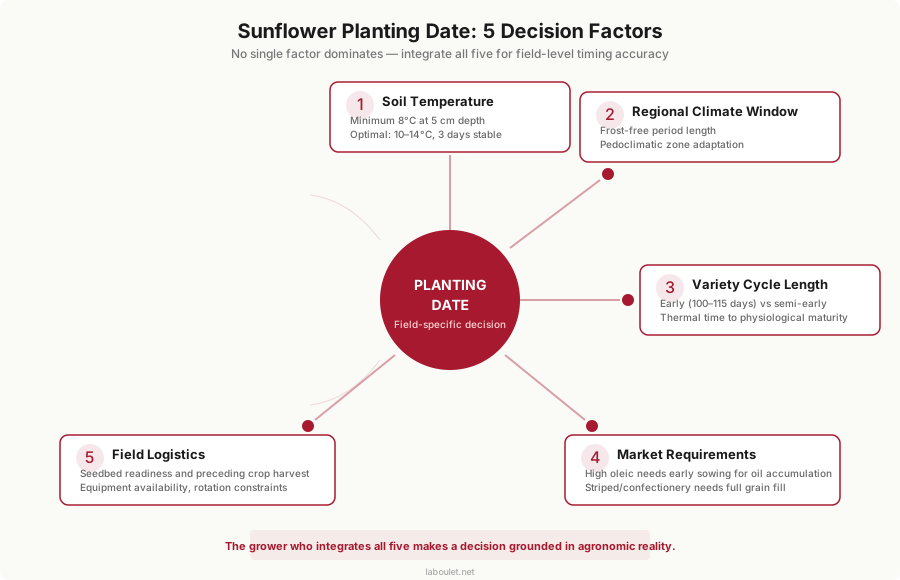
No single factor dominates. The grower who integrates all five makes a planting decision grounded in agronomic reality, not in calendar convenience.
For specialized technical dialogue regarding sunflower sowing strategy in your specific conditions, Laboulet’s team is available by email at info@laboulet.fr or via WhatsApp for field-based discussions.
Our varieties: sunflower
| Variety | Seed | Oil profile | Earliness |
|---|---|---|---|
| LS SWIFT | Striped | Linoleic | Early to very early |
| LS Starly | Striped | Oleic | Early |
| LS SKIPPY | Striped | — | Early to very early |
| LS Pickit | Striped | Linoleic | Early |
| LS Luminal | Black | Linoleic | Early |
| LS Lollipop | Striped | Oleic | Early to very early |
Frequently asked questions
When is the best time to plant sunflower seeds?
Sunflower is sown when soil temperature at 5 cm depth reaches 8-10°C (46-50°F) and stable, with no frost risk in the 10-day forecast. In temperate Europe this means mid-April to mid-May. In southern France, Spain, or Argentina, sowing can start as early as late March.
What soil temperature is needed for sunflower germination?
Minimum soil temperature for reliable sunflower germination is 8°C (46°F) at 5 cm depth, but the optimum is 10-15°C. Below 8°C, germination is slow and uneven, increasing exposure to soil-borne diseases (downy mildew, sclerotinia) and pest damage. Above 25°C, germination accelerates but moisture stress can become limiting.
Can I plant sunflower seeds too early?
Yes. Sowing before soil reaches 8°C delays emergence by 2-3 weeks, exposes seedlings to crow predation, and increases risk of damping-off pathogens. Early sown sunflower also flowers under poor pollinating conditions if cool weather persists. Wait until soil is warm and stable.
How long does sunflower take from planting to harvest?
Standard oilseed sunflower hybrids reach physiological maturity in 110-130 days from sowing. Ultra-early varieties (FAO 100 group) finish in 95-110 days, while late varieties can take 140+ days. Harvest is 2-3 weeks after physiological maturity once moisture drops below 12%.
When to plant sunflower in different regions?
Northern France and Germany: late April to mid-May. Southern France and Spain: late March to mid-April. Argentina and Brazil: October to November (Southern Hemisphere spring). India and Eastern Africa: depends on the monsoon — typically July to August or January to February.
When to Plant Sunflower Seeds
- Wait for soil temperature ≥ 8°C at 5 cm
Sunflower germinates reliably above 8°C (46°F) at 5 cm depth. Below this threshold, germination is slow and uneven, exposing seedlings to soil-borne diseases (downy mildew) and bird predation.
- Verify no frost in the 10-day forecast
Sunflower seedlings tolerate temperatures down to -2°C briefly but die below -4°C. Check the 10-day weather forecast and avoid sowing if frost is expected during emergence (5-10 days post-sowing).
- Adjust to your latitude
Northern France and Germany: late April to mid-May. Southern France and Spain: late March to mid-April. Italy and Hungary: late April. Argentina (Southern Hemisphere): October to November. India: depends on monsoon (July-August or January-February).
- Match sowing date to FAO group
Ultra-early FAO 100-150 hybrids (95-110 day cycle) tolerate later sowing — useful as fallback after a failed first crop. Standard FAO 300-500 hybrids need the full window for proper grain filling. Don't sow late hybrids late.
- Sow into moist, warm, well-prepared seedbed
A fine, moist seedbed at 8-12°C is the ideal target. Avoid sowing immediately after heavy rain (compaction, crusting). Sow at 3-5 cm depth, 60,000-70,000 plants/ha density for oilseed types.