
Black Sulfo Sunflower Hybrid for professional growers worldwide
Sulfonylurea-tolerant black oil hybrids for post-emergence weed control
Key advantages
See the full range: Hybrid sunflower seeds →
Where to grow sunflower
Guides & insights on sunflower
View all articles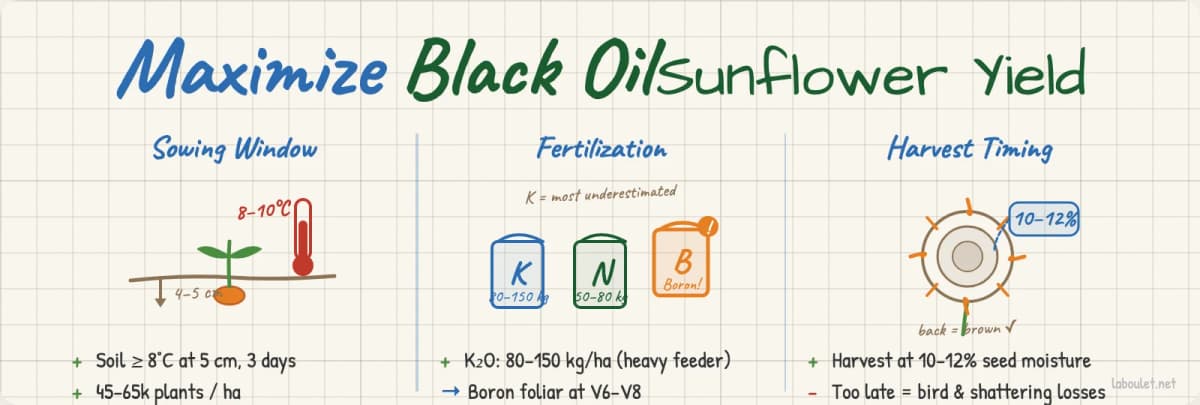
How to Maximize Black Oil Sunflower Yield: Agronomic Tips for Commercial Growers
Black oil sunflower (Helianthus annuus L.) is one of the highest-value oilseed crops available to commercial growers. Its seeds contain 40 to 50 percent oil by dry weight — substantially more than confectionery sunflower varieties — making it the preferred choice for edible oil, biodiesel, and high-energy livestock feeds. Yet black oil sunflower is also […]
Read more
When to Plant Sunflower Seeds: Agronomic Timing for Commercial Growers
Planting date is not a calendar decision. It is an agronomic one. The difference between a productive sunflower crop and a mediocre stand often traces back to a sowing window of just ten to fifteen days. For professional growers, timing sunflower planting means reconciling soil temperature, varietal cycle length, downstream market requirements and regional climate […]
Read more
Where to Buy Sunflower Seeds for Planting
Choosing where to buy sunflower seeds for planting is not a simple sourcing question.It is an agronomic decision that conditions crop performance, market access, and production regularity over the season. Sunflower is grown across multiple filières: oilseed crushing, grain markets, animal feed, bird feed, forage, and occasionally as a cover crop.Each outlet imposes different varietal expectations, tolerance […]
Read moreDefinition and characteristics of black oil sulfo sunflower seeds
Black oil sulfo sunflower seeds are hybrids that combine a black-husk oilseed format with genetic tolerance to sulfonylurea herbicides, particularly tribenuron-methyl. This SU tolerance allows growers to apply specific ALS-inhibiting herbicides without harming the crop.
Our varieties maintain a stable oil profile while supporting efficient weed control for clean and uniform fields.
Why choose our varieties of black oil sulfo sunflower seeds?
Our varieties deliver consistent SU tolerance expression, reliable agronomic performance and uniform seed format for oilseed crushing. Bred through our R&D expertise, these hybrids offer strong adaptability in diverse environments.
Through our agronomic solutions, growers receive guidance on SU programs, spray timing and overall crop management.
Agronomic benefits of SU tolerance
- Flexibility in weed control using sulfonylurea herbicides.
- Improved establishment through reduced early weed competition.
- Reliable performance in early-cycle production systems.
- Consistent results supported by our ranges of hybrids.
- Efficient integration into existing oilseed rotations.
Usage conditions and stewardship
- Alternate herbicide modes of action to protect long-term SU efficacy.
- Follow recommended spray timing for tribenuron-methyl applications.
- Avoid repeated SU-only programs across consecutive seasons.
- Manage volunteers rigorously in follow-up crops.
- Clean equipment to maintain purity and trait integrity.
Technical comparison: black oil sulfo vs other sunflower types
Sulfo-tolerant hybrids differ from IMI-tolerant and conventional options based on herbicide compatibility. While the SU trait enables tribenuron-methyl usage, the seed and oil characteristics remain aligned with standard black oil crushing requirements.
Herbicide-program differences (SU vs IMI)
- Sulfo hybrids tolerate tribenuron-methyl, while IMI hybrids tolerate imidazolinone herbicides.
- Weed spectrum and timing differ between SU and IMI programs.
- Both systems require stewardship to maintain efficacy.
Seed and processing characteristics
- The black oil format ensures high extraction efficiency for crushing facilities.
- The SU trait does not alter oil profile or seed-processing behaviour.
- Our varieties offer uniform seed size and stable industrial performance.
Market opportunities for black oil sulfo sunflower seeds
By enabling clean fields and uniform stands, SU hybrids support consistent oilseed yields that meet processor expectations. Growers can integrate these hybrids into commodity oil markets and industrial applications.
Value-chain considerations
- Cleaner fields support uniform seed quality.
- Stable oil content ensures compatibility with crushing operations.
- Trait integrity must be preserved for reliable market delivery.
Key agronomic parameters for cultivating our black oil sulfo sunflower seeds
Effective cultivation combines proper SU herbicide application with balanced nutrition, optimal density and timely harvest. Our hybrid sunflower seeds perform strongly when grown under correct management conditions.
Soil, climate and maturity class
- Our early-cycle hybrids adapt well to varied sowing windows.
- Warm soil conditions favour rapid emergence and uniform stands.
- Deep, fertile soils enhance oil synthesis potential.
Nutrition and crop protection
- Balanced nitrogen ensures growth without compromising oil quality.
- Monitor pests and diseases to protect plant development.
- Apply SU herbicides at recommended phenological stages.
Harvest and storage
Harvest should target appropriate seed moisture to preserve quality. Store seeds in dry, cool and well-ventilated facilities to maintain oil stability.
Selecting the right hybrid from our ranges
The ideal hybrid depends on weed pressure, maturity targets, soil characteristics and expected oil yield. Our ranges offer multiple sulfo-tolerant options to suit different production contexts.
Selection criteria
- Weed spectrum requiring sulfonylurea management.
- Maturity class aligned with planting and harvest timing.
- Expected yield stability across seasons.
- Compatibility with local climate and soil type.
Integrating our agronomic solutions
Our agronomic solutions support growers in SU herbicide timing, sowing density and stewardship practices, helping ensure strong performance from our hybrid sunflower seeds.
FAQ
What does sulfo tolerance mean in sunflower?
It refers to genetic tolerance to sulfonylurea herbicides, particularly tribenuron-methyl.
Which herbicides can be used with SU hybrids?
Approved sulfonylurea herbicides such as tribenuron-methyl can be used according to label recommendations.
Does the SU trait alter oil characteristics?
No, the SU trait does not change oil composition or seed-processing behaviour.
How do your varieties ensure stable SU tolerance?
Our varieties are developed through rigorous breeding and testing to maintain consistent SU trait expression.
How do sulfo hybrids differ from IMI hybrids?
Sulfo hybrids tolerate sulfonylurea herbicides, whereas IMI hybrids tolerate imidazolinones.
What stewardship rules apply?
Growers should alternate herbicide modes of action, manage volunteers and avoid repeated SU-only programs.
What weeds are effectively controlled?
SU programs control a range of broadleaf weeds and some grasses depending on timing and conditions.
How can resistance be avoided?
By rotating modes of action, monitoring fields and following best-practice herbicide protocols.
What are the advantages of black oil sulfo hybrids?
They offer herbicide flexibility while preserving black oilseed efficiency for crushing.
How do I select the right hybrid?
Consider maturity, weed pressure, climate and stability across local conditions.
To position this Sulfo profile within black sunflower types, growers often refer to its parent category Black Sunflower Seeds and the wider Hybrid Sunflower Seeds, while also comparing it with Black IMI Sunflower Seeds and Striped Sulfo Sunflower Seeds to evaluate herbicide-tolerance contrasts.