
Mid Late Corn Hybrid for professional growers worldwide
Medium-late maturity hybrids balancing cycle length with high yield potential
Key advantages
See the full range: Hybrid corn seeds for silage and grain, FAO 100 to 450 →
Where to grow corn
Guides & insights on corn
View all articles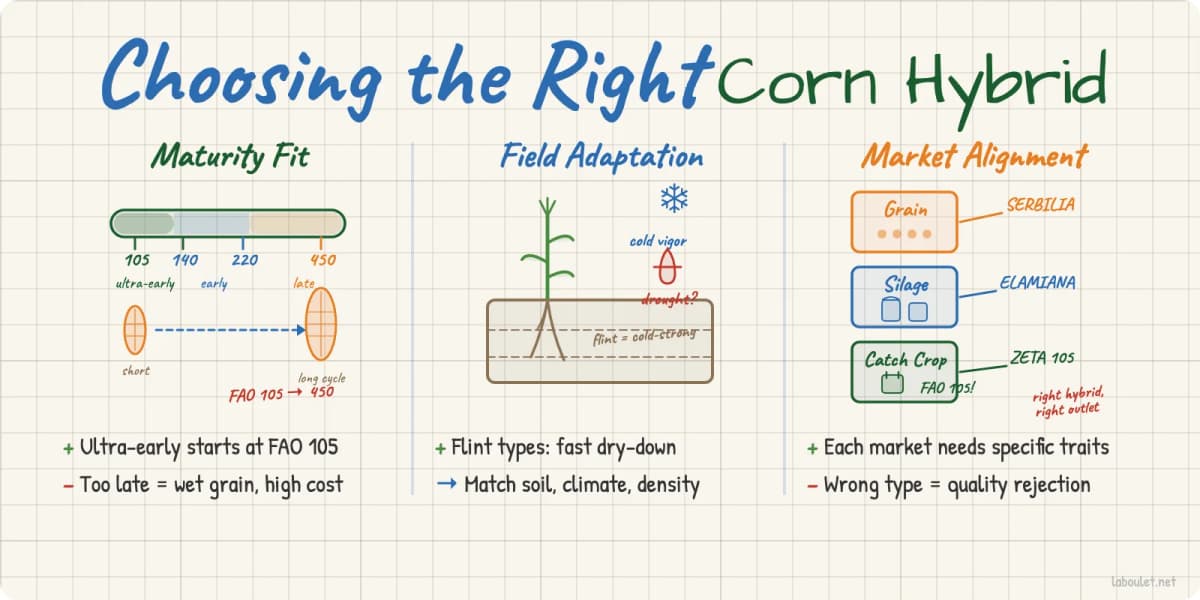
How to Choose the Right Corn Hybrid for Your Farm
Every season starts with the same question: which hybrid goes into the planter? The answer determines your yield ceiling, your harvest date, your drying costs, and ultimately your margin. Yet too many growers default to habit — replanting last year’s pick or copying a neighbor — without asking whether that hybrid actually fits their field, […]
Read more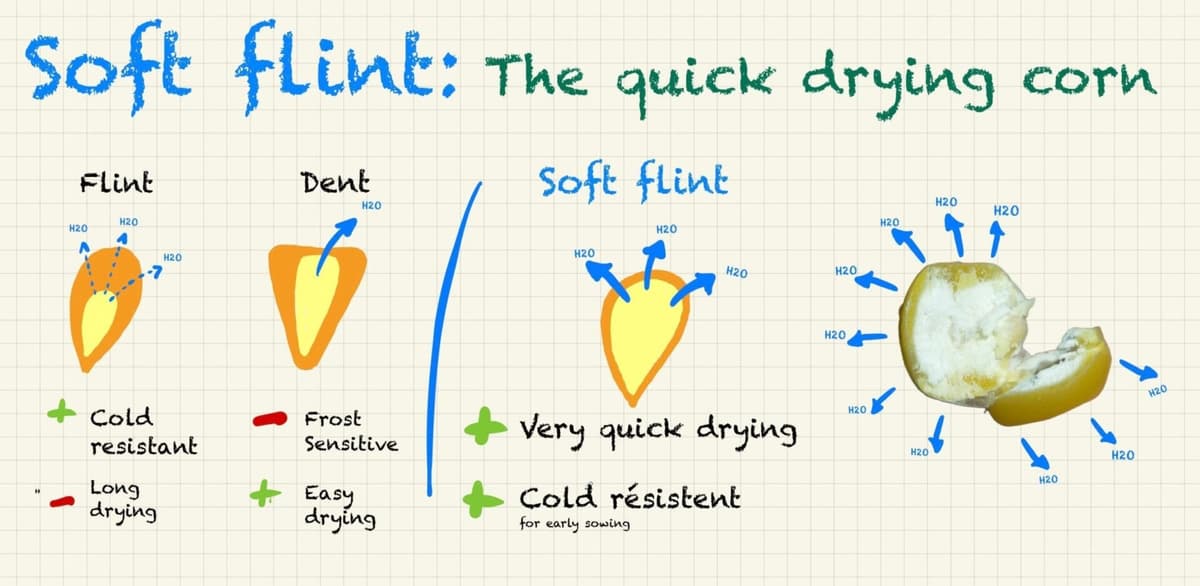
Soft flint: The quick drying corn
“Soft Flint” Corn: Flint Vigor Combined with Rapid Dry-Down Soft flint corn is an innovative type of grain corn derived from flint corn, characterized by an extremely thin vitreous endosperm. In other words, the kernel retains the visual appearance of flint corn (no dent) while being largely composed of floury starch. This unique profile gives […]
Read moreRole of mid late hybrid corn seeds in maize maturity groups
Mid late hybrid corn seeds correspond to maturity groups that require more growing degree days than early hybrids but remain below the very late segments. They are typically chosen in regions where the growing season is long enough to exploit their higher yield potential while keeping harvest dates compatible with climate and workload.
Our varieties in the mid late segment are positioned to deliver strong yield and starch production for grain, silage or multipurpose use. By selecting our seeds, farmers aim to maximise the use of heat units available on their best fields while maintaining a controlled agronomic risk.
Definition and FAO maturity segment
In practice, mid late hybrid corn seeds often correspond to FAO classes around 430–500, depending on the country and classification system. These hybrids flower later and fill grain over a longer period than early types, which allows higher biomass and starch accumulation when conditions are favourable.
- Flowering date later than early and medium-early hybrids.
- Longer grain filling phase and higher potential cob weight.
- Higher total dry matter at harvest under adequate water and nutrition.
Our ranges cover several FAO values within this segment so that our seeds can be precisely positioned according to local climatic data and soil potential.
Agronomic and economic benefits of mid late hybrid corn seeds
When the growing season allows, mid late hybrids are often the most productive segment in terms of tonnage and starch per hectare. They transform available radiation and heat into grain and forage more efficiently, provided that agronomic practices follow their requirements.
Yield potential and starch production
The main benefit of mid late hybrid corn seeds lies in their yield ceiling. With longer grain filling and larger vegetative structure, they can reach high yields in grain or silage when sown on suitable fields.
- High grain yield potential on deep, fertile soils.
- High starch content for energy-dense silage and grain.
- Large cob size and good kernel weight in our varieties.
Forage and grain quality
For silage, mid late hybrids combine high cob proportion with a significant vegetative part, allowing both energy and fibrous volume. Grain-oriented types in our ranges focus on grain density and homogeneity.
- High energy value for milk production or feed efficiency.
- Balanced fibre digestibility for ration stability.
- Uniform grain with good test weight for market requirements.
Risk profile and stability
The main risk with mid late hybrid corn seeds is exposure to late-season weather constraints if they are sown on marginal fields. When correctly positioned on adapted plots, however, they provide good yield stability thanks to robust plant architecture and disease tolerance.
- Best suited to fields with reliable water supply and sufficient growing degree days.
- Requires careful management of sowing dates and harvest timing.
- Our agronomic solutions include decision criteria to limit late-harvest risks.
Environments and farming systems suited to mid late hybrids
Mid late hybrid corn seeds are best used where the climate, soil and rotation give them enough time to reach full maturity. They are particularly interesting in high-potential zones and in farming systems seeking maximum yield per hectare.
Climatic and soil conditions
These hybrids require a reliable accumulation of growing degree days from sowing to harvest. They perform best on deep, well-structured soils with good water-holding capacity.
- Temperate regions with long, warm summers.
- Deep loam or clay-loam soils with good water reserves.
- Irrigated plots where water supply is controlled.
- Fields with low risk of early autumn frost and prolonged waterlogging.
Livestock, biogas and cash-crop systems
Mid late hybrids can be used in a variety of systems: dairy farms seeking maximum silage yield, beef and feedlot systems requiring high-energy grain, and biogas units needing a high-methane substrate.
- Silage-focused dairy farms aiming at high forage autonomy.
- Mixed farms combining grain sales and on-farm feed.
- Biogas units targeting high methane yield per hectare.
Our agronomic solutions describe for each of our varieties which systems they fit best, taking into account climate, soil and rotation constraints.
Key traits of our mid late hybrid corn varieties
The design of mid late hybrids requires a balance between vegetative vigour, grain filling capacity and resistance to stress. Our varieties in this segment are selected on a broad set of agronomic and quality traits.
Plant architecture and stay-green behaviour
A robust architecture allows the crop to intercept light efficiently and resist lodging until harvest. Stay-green behaviour must support grain filling without delaying the achievement of the target dry matter.
- Medium to tall plants with good stem strength.
- Appropriate ear insertion height to limit lodging and ease harvest.
- Stay-green expression adapted to the maturity class and targeted harvest date.
Rooting, lodging resistance and disease tolerance
Mid late hybrid corn seeds are exposed longer to wind, storms and diseases. For this reason, our ranges focus strongly on root and stalk strength and tolerance to main foliar and stalk diseases.
- Deep and dense root system for anchorage and water uptake.
- High resistance to stalk lodging and root lodging.
- Tolerance to major diseases such as leaf blights and fusarium on stalks and ears.
Silage, grain and dual-purpose profiles
Within our varieties, mid late hybrids cover several profiles: silage-oriented, grain-oriented and dual-purpose. This classification helps farmers to select the most suitable hybrid for each field and outlet.
- Silage types with high cob proportion and digestible stover.
- Grain types with high kernel depth and fast grain dry-down at the end of the cycle.
- Dual-purpose hybrids offering flexibility between grain and silage use.
These profiles are described alongside our hybrid sunflower seeds, our oilseed varieties and other crops in our ranges to help design coherent rotations.
Agronomic guidelines for mid late hybrid corn seeds
To fully benefit from the potential of mid late hybrids, agronomic practices must be adjusted to their longer cycle. Our agronomic solutions combine varietal choice with clear recommendations on sowing, nutrition and protection.
Choosing maturity and positioning on the farm
The first step is to position mid late hybrid corn seeds on the most suitable plots. These hybrids are generally reserved for fields with the highest potential and the most reliable climatic conditions.
- Allocate mid late hybrids to the best soils and most favourable microclimates.
- Reserve earlier hybrids for late-sown fields or plots with higher climatic risk.
- Distribute several maturity groups across the farm to spread harvest and risk.
Sowing window and plant population
Sowing must take into account soil temperature, structure and the need to complete the cycle before adverse weather. Plant density influences both yield and lodging risk.
- Sow when soil temperature is adequate and rising, usually from 10 °C at sowing depth.
- Adapt plant population to soil potential and water availability, following the specific recommendations for each of our varieties.
- On irrigated or deep soils, slightly higher densities can be used to maximise yield; on shallow or drought-prone soils, moderate densities limit stress.
Fertilisation and water management
The longer cycle of mid late hybrids requires sustained nutrient and water availability throughout vegetative growth and grain filling. Nutrition plans should be aligned with high yield targets and regulatory constraints.
- Adjust nitrogen rates to the high yield potential, with split applications when needed.
- Ensure balanced phosphorus and potash supply to support root development and stalk strength.
- Secure water availability around flowering and grain filling, particularly for irrigated systems.
Weed, pest and disease management
Mid late hybrid corn seeds remain in the field longer, increasing exposure to weeds, insects and diseases. Protection programmes must account for this longer exposure while respecting local regulations.
- Maintain a clean crop during the early stages to secure light and nutrients for the plants.
- Monitor insect pressure in susceptible regions and apply integrated strategies when necessary.
- Consider the benefit of fungicide applications on hybrids and fields with high disease pressure, according to local advice.
Harvest timing and dry matter targets
Harvest must be planned so that mid late hybrids reach the target dry matter while avoiding excessive moisture or field deterioration. Our agronomic solutions provide indicative calendars and decision tools.
- For silage, monitor kernel milk line and whole-plant dry matter to target the optimal range.
- For grain, follow grain moisture evolution and forecast weather to choose the best compromise between drying costs and field conditions.
- Adjust harvest order between early, mid late and very late hybrids to optimise logistics and field traffic.
Technical comparisons with other maturity groups
Comparing mid late hybrid corn seeds with other maturity groups helps to clarify their role on the farm. Each segment presents a specific balance of yield potential and risk.
Comparison with early and medium-early hybrids
Early and medium-early hybrids offer greater security on harvest date but a lower maximum yield ceiling under very favourable conditions. Mid late hybrids raise the potential but require more careful positioning.
- Higher average yield potential for mid late hybrids on high-potential plots.
- Earlier harvest and lower climatic risk with early hybrids.
- Medium-early segment often used as a compromise in variable regions.
Comparison with late and very late hybrids
Late and very late hybrids theoretically push yield potential even higher, at the cost of very long cycles and increased risk in many regions. Mid late hybrids often represent the most realistic upper segment in terms of cycle duration.
- Mid late hybrids require fewer growing degree days than the latest types, reducing exposure to autumn risks.
- They represent a practical ceiling for many regions, especially where early frost or autumn rains are frequent.
- Our ranges allow farms to place a limited proportion of very late hybrids where conditions are exceptionally favourable, while relying mainly on mid late and earlier types.
These comparisons are used in our agronomic solutions to define distribution keys between maturity groups and secure both yield and harvest logistics.
Practical questions about mid late hybrid corn seeds
On which fields are mid late hybrid corn seeds most appropriate?
Mid late hybrids are most appropriate for deep, fertile soils with good water-holding capacity and for regions with sufficient growing degree days up to harvest. They should be prioritised on the best plots where their yield potential can be fully expressed.
How should mid late hybrids be combined with other maturity groups?
A common approach is to use a core of early and medium-early hybrids for security, complemented by mid late hybrids on the best fields. This combination spreads harvest dates, balances risk and takes advantage of higher yield potential where conditions allow.
Do mid late hybrids always give higher yields than early hybrids?
Under favourable conditions and on correctly chosen plots, mid late hybrid corn seeds generally offer higher yield potential. However, in years with strong climatic constraints or on marginal fields, early hybrids may perform better because they reach maturity more reliably.
What is the impact of mid late hybrids on silage quality?
When harvested at the correct stage, mid late silage hybrids in our varieties offer high starch content and good fibre digestibility. The combination of high cob proportion and significant vegetative biomass contributes to energy density and forage volume.
Are mid late hybrids suitable for biogas production?
Yes, many mid late hybrids are well suited to biogas thanks to their high dry matter yield and starch-rich biomass. On adapted fields, they can maximise methane production per hectare when integrated into a cropping plan designed for biogas supply.
How do mid late hybrids fit into crop rotations?
Mid late hybrid corn seeds generally free land later than early types, which may limit the choice of following crops. They are often positioned before spring crops, or in rotations where late harvest does not penalise soil preparation. Our agronomic solutions integrate them with our seed catalog for legumes and our oilseed varieties to design balanced rotations.
What management points deserve particular attention for mid late hybrids?
The key points are choice of field, sowing date, plant density and harvest timing. Nutrition and disease management must also be aligned with high yield targets. Our ranges are accompanied by detailed technical sheets specifying these points for each hybrid.
How our agronomic solutions support mid late hybrids
The performance of mid late hybrid corn seeds depends on both genetics and agronomic management. Our agronomic solutions are designed to guide farmers from hybrid choice to harvest, taking into account their specific objectives and constraints.
- Support for choosing hybrids according to climate, soil and target outlet.
- Recommendations on sowing windows and plant density for each of our varieties.
- Guidance on fertilisation strategies adapted to high yield targets and regulations.
- Harvest decision tools based on dry matter and grain moisture monitoring.
These services are integrated with the rest of our offer, including our hybrid sunflower seeds, our oilseed varieties and our seed catalog for legumes. By combining these crops and our agronomic support, farmers can structure rotations that secure both yield and quality over the long term.
Mid-late hybrids are often reviewed alongside our hybrid corn seeds and compared with early hybrid corn seeds and late hybrid corn seeds, offering useful maturity references for cycle planning.