
High Oleic Sunflower Hybrid for professional growers worldwide
Premium oilseed hybrids with 80-92% oleic acid for stable, high-value oil production
Key advantages
High Oleic Sunflower Hybrid
LS Forsy
High oleic IMI sunflower hybrid with strong agronomic balance and high production potential.
LS Starly
High-oleic striped sunflower with IMI tolerance, strong grain quality and multi-market suitability.
LS Lollipop
Striped high-oleic sunflower with strong yield, high oil quality and wide market suitability.
L 25-02 IOS
Striped high oleic hybrid with excellent yield potential and strong oleic acid content.
L 25-01 IOS
Striped high oleic sunflower hybrid with IMI tolerance, strong yield potential and attractive striped seed.
L 15-13 OS – BLUEBIRD
Striped high oleic hybrid with strong grain yield, excellent seed quality and high oleic acid content.
Compare varieties
| Variety | Seed | Herbicide tolerance | Earliness | Use | Yield potential |
|---|---|---|---|---|---|
| LS Forsy | Black | IMI | Semi-early | Oil and biofuel | 9/10 |
| LS Starly | Striped | IMI | Early | Bird food, Oil and Industry | 10/10 |
| LS Lollipop | Striped | — | Early to very early | Bird and human food, oil and biofuel | 9/10 |
| L 25-02 IOS | Striped | — | Early to very early | Bird food, oil and biofuel | 10/10 |
| L 25-01 IOS | Striped | IMI | Early to very early | Bird food, oil and biofuel | 10/10 |
| L 15-13 OS – BLUEBIRD | Striped | — | Early to very early | Bird food, oil and biofuel | 9/10 |
See the full range: Hybrid sunflower seeds →
Where to grow sunflower
Guides & insights on sunflower
View all articles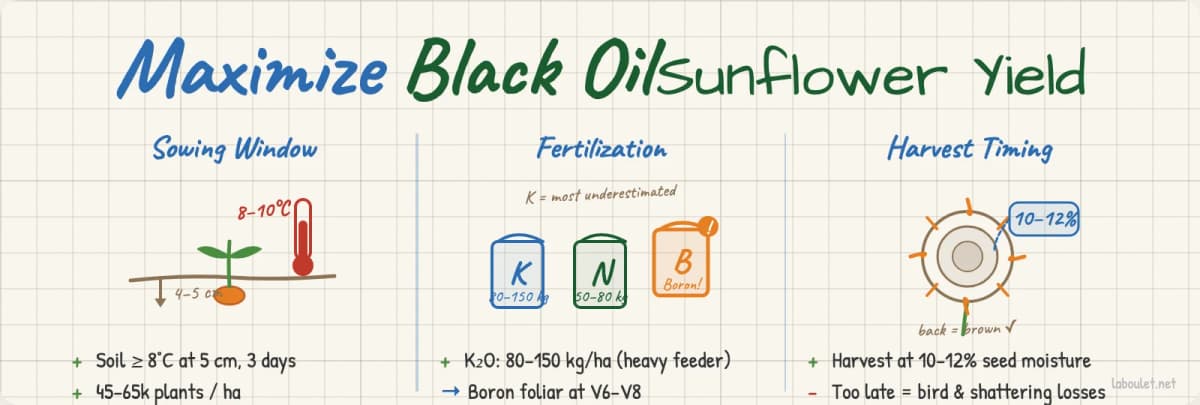
How to Maximize Black Oil Sunflower Yield: Agronomic Tips for Commercial Growers
Black oil sunflower (Helianthus annuus L.) is one of the highest-value oilseed crops available to commercial growers. Its seeds contain 40 to 50 percent oil by dry weight — substantially more than confectionery sunflower varieties — making it the preferred choice for edible oil, biodiesel, and high-energy livestock feeds. Yet black oil sunflower is also […]
Read more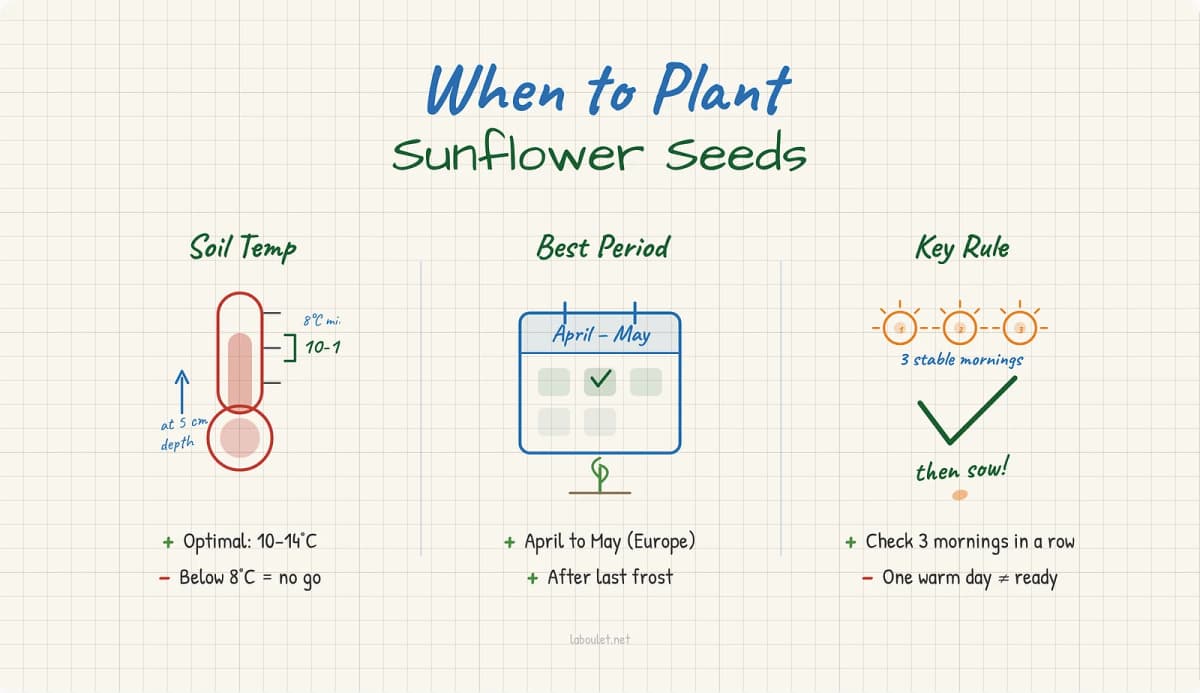
When to Plant Sunflower Seeds: Agronomic Timing for Commercial Growers
Planting date is not a calendar decision. It is an agronomic one. The difference between a productive sunflower crop and a mediocre stand often traces back to a sowing window of just ten to fifteen days. For professional growers, timing sunflower planting means reconciling soil temperature, varietal cycle length, downstream market requirements and regional climate […]
Read more
Where to Buy Sunflower Seeds for Planting
Choosing where to buy sunflower seeds for planting is not a simple sourcing question.It is an agronomic decision that conditions crop performance, market access, and production regularity over the season. Sunflower is grown across multiple filières: oilseed crushing, grain markets, animal feed, bird feed, forage, and occasionally as a cover crop.Each outlet imposes different varietal expectations, tolerance […]
Read moreDiscover how our varieties deliver high-oleic sunflower seeds that combine premium oil profile and strong agronomic performance.
High oleic sunflower seeds
What are high oleic sunflower seeds?
High oleic sunflower seeds refer to oilseed hybrids specifically bred to contain a very high percentage of oleic acid (monounsaturated fat) compared with conventional sunflower types. These seeds yield oil with improved oxidative stability, a neutral flavour profile and suitability for premium edible and industrial applications.
In practical terms, high oleic hybrids commonly exceed 80 % oleic acid, significantly reducing linoleic acid content and thereby enhancing performance for frying, processing and bio-based uses.
Why choose our high-oleic varieties?
At our company, we offer hybrid sunflower seeds that combine the latest in varietal creation, seed production and agronomic support. Our varieties are developed for oil-seed growers seeking both reliable yield and differentiated premium oil quality.
Thanks to our R&D programme and seed production expertise, our agronomic solutions ensure strong field performance, robust resistance traits and clear support pathways from sowing to harvest and delivery to the oil-seed supply chain.
Agronomic benefits of high oleic sunflower seeds
- High oleic acid content (> 80 %) results in oil with better oxidative stability and longer shelf-life.
- Access to premium contracts and higher oil-seed price due to differentiated oil quality.
- Yield and field performance now comparable to conventional types thanks to improved breeding.
- Suitable for high-temperature applications (frying, industrial uses) due to low linoleic acid content.
- Provides crop rotation and diversification options for arable systems with evolving market demand.
Usage conditions and best practices for our seeds
- Aim for a plant density of approximately 60 000 plants per hectare to optimise yield potential.
- Ensure field isolation and dedicated storage to maintain oil-seed purity and high-oleic quality.
- Monitor moisture in harvest and storage to preserve oil quality and avoid degradation.
- Implement bird protection measures during flowering and seed fill stages – sunflowers may attract birds.
- Select fields with adequate drainage, good fertility and minimal risk of severe heat stress or lodging.
Technical comparison : high-oleic vs conventional sunflower seeds
The table below summarises key differences between high-oleic hybrids and conventional sunflower types:
- Oil profile : Conventional sunflower oil typically contains ~20 % oleic acid; high-oleic varieties exceed 80–90 % oleic acid.
- Oxidative stability : High-oleic oil resists oxidation far better, which improves shelf-life and processing performance.
- Yield gap : Earlier generations of high-oleic hybrids showed a small yield penalty, but current varieties narrow this gap significantly.
- Market chain : High-oleic seed production often involves contracts and premiums; conventional types follow commodity pathways.
- Applications : Conventional oil used broadly for food; high-oleic oil also targets specialty edible uses, frying, oleochemicals and bio-based products.
Our varieties are designed to close the yield gap and deliver oil-seed quality compatible with premium supply chains.
Market and value-chain opportunities for high-oleic sunflower seeds
The demand for high-oleic sunflower oil continues to grow in both food and non-food markets. In food processing the high oleic profile supports clean-label, high-heat stable oils for frying and snacks. In non-food applications, the near-mono-acid profile facilitates oleochemical derivation (biolubricants, bio-polymers).
Growers who adopt our hybrid sunflower seeds can position themselves for premium contracts, improved income per hectare and linked value-chain support.
Key agronomic parameters for cultivating our high-oleic sunflower seeds
Successful cultivation of high-oleic hybrids requires attention to agronomic parameters such as sowing date, soil fertility, crop rotation, disease and pest control, and harvest timing. These factors influence both yield and final oleic acid content.
For instance, environmental conditions during grain fill (temperature, moisture) can affect oleic acid levels; monitoring and managing these risks ensures that the premium oil profile is maintained.
How to select the right variety from our range
When choosing from our range of high-oleic sunflower hybrids, consider the following criteria:
- Maturity class (early, mid) adapted to your region and rotation.
- Oil content and expected oleic acid level in your local environment.
- Disease and pest resistance traits relevant to your farm conditions.
- Contractual supply chain availability and premium metrics.
- Support and seed production logistics (seed availability, delivery timing).
Our team can advise you on matching the right variety from our seeds portfolio to your farm conditions and market outlets.
FAQ
What qualifies a sunflower variety as “high oleic”?
A variety is considered high oleic when the resulting oilseed consistently shows oleic acid levels typically above 80 %, achieved through targeted breeding and maintained in production and supply chain conditions.
Do high-oleic sunflower seeds yield less than conventional types?
Early generation high-oleic hybrids had a small yield gap compared with conventional types, but modern hybrids have narrowed this gap significantly, offering competitive agronomic performance.
What soil and climate conditions are best for our high-oleic sunflower seeds?
Our hybrids perform best on well-drained soils with good fertility, in rotations that avoid recent sunflower or heavy disease pressure, sown timely with appropriate density, and managed to avoid severe heat or moisture stress during seed fill.
What premium can growers expect for high-oleic sunflower seed production?
Premiums vary by region, contract and oil-processor. In many European markets, growers receive a premium over commodity sunflower for high-oleic quality, given the differentiated oil profile and market demand.
How does oil profile of high-oleic compare with conventional sunflower oil?
Conventional sunflower oil has a higher linoleic acid fraction and lower oleic acid (~20 %); high-oleic types reverse this ratio, often achieving 80–90 % oleic acid, resulting in better oxidation resistance and processing characteristics.
Are our high-oleic varieties suitable for non-food uses (oleochemistry, bio-lubricants)?
Yes. The high oleic acid content makes the oil suitable for non-food applications where stability, clean-profile and biosourced feedstocks are valued, including biolubricants, bio-polymers and oleochemicals.
What crop management differences should I expect when growing our seeds?
You may need closer attention to supply-chain segregation, cleaning of equipment to avoid mixing, precise agronomic management to ensure oil quality (plant density, fertilisation, harvest timing) and possible contract requirements for moisture or oil profile.
How do I ensure the supply chain meets quality standards for high-oleic oil?
Work with your seed supplier and oil-processor on segregation protocols, cleaning of equipment, dedicated storage, sampling and testing of seed for oleic acid content, and contract compliance to ensure the premium oil profile is met.
What risks are associated with high-oleic sunflower cropping and how to mitigate them?
Risks include seed mixing with conventional types (reducing oleic level), bird damage in sunflower fields, heat or drought stress reducing oil quality, and market premium fluctuations. Mitigation includes rigorous supply-chain protocols, field scouting, insurance and contract clarity.
How soon will my harvested crop meet the required oleic acid level for premium markets?
With our hybrid sunflower seeds, growers who apply recommended agronomic practices and contract to processors typically achieve the required oleic acid levels in the same season. Consistent results depend on variety selection, field management and harvesting/storage conditions.
To situate high oleic profiles within the wider sunflower range, many producers compare them with our hybrid sunflower seeds as well as with linoleic sunflower seeds and black oil sunflower seeds, which represent the closest agronomic alternatives.