
Linoleic Sunflower Hybrid for professional growers worldwide
Versatile oil-profile hybrids rich in polyunsaturated fatty acids for food-grade markets
Key advantages
Linoleic Sunflower Hybrid
LS Luminal
High-yield linoleic sunflower with strong disease resistance and wide adaptability.
LS GLOBSUN
High-yielding linoleic sunflower hybrid with strong lodging and mildew tolerance.
LS SWIFT
This early to very early hybrid combines stable productivity with good disease tolerance, making it suitable for bird food, oil and biofuel markets alike.
LS Pickit
Early striped linoleic sunflower with strong yield potential and high-quality grains.
L 24-01 IS
Striped linoleic sunflower hybrid with high seed quality, strong yield and IMI tolerance.
L 22-01 S
Very early striped linoleic hybrid with strong yield potential and attractive seed quality.
Compare varieties
| Variety | Seed | Earliness | Use | Yield potential |
|---|---|---|---|---|
| LS Luminal | Black | Early | Crushing | 10/10 |
| LS GLOBSUN | Black | Early | Crushing | 9/10 |
| LS SWIFT | Striped | Early to very early | Bird food, oil and biofuel | 8/10 |
| LS Pickit | Striped | Early | Bird food, oil | 9/10 |
| L 24-01 IS | Striped | Early | Bird food, oil | 9/10 |
| L 22-01 S | Striped | Very early | Bird food, oil | 9/10 |
See the full range: Hybrid sunflower seeds →
Where to grow sunflower
Guides & insights on sunflower
View all articles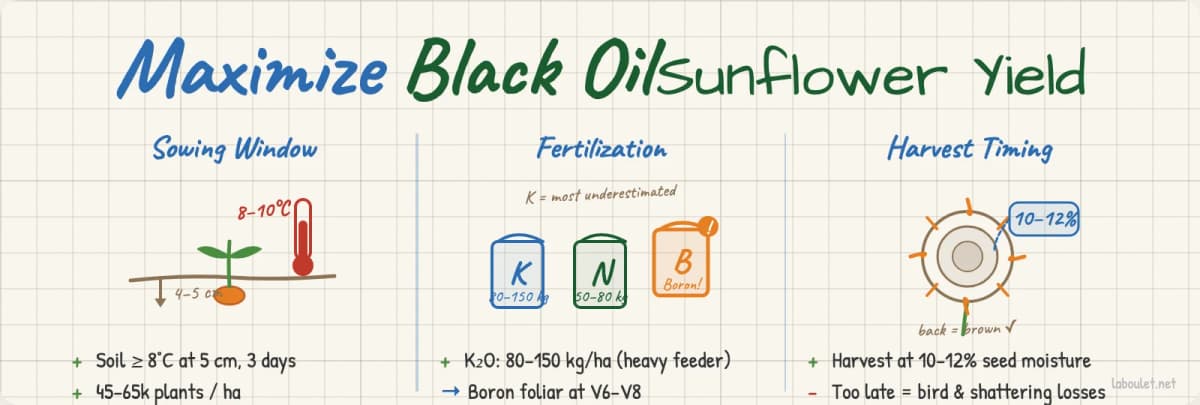
How to Maximize Black Oil Sunflower Yield: Agronomic Tips for Commercial Growers
Black oil sunflower (Helianthus annuus L.) is one of the highest-value oilseed crops available to commercial growers. Its seeds contain 40 to 50 percent oil by dry weight — substantially more than confectionery sunflower varieties — making it the preferred choice for edible oil, biodiesel, and high-energy livestock feeds. Yet black oil sunflower is also […]
Read more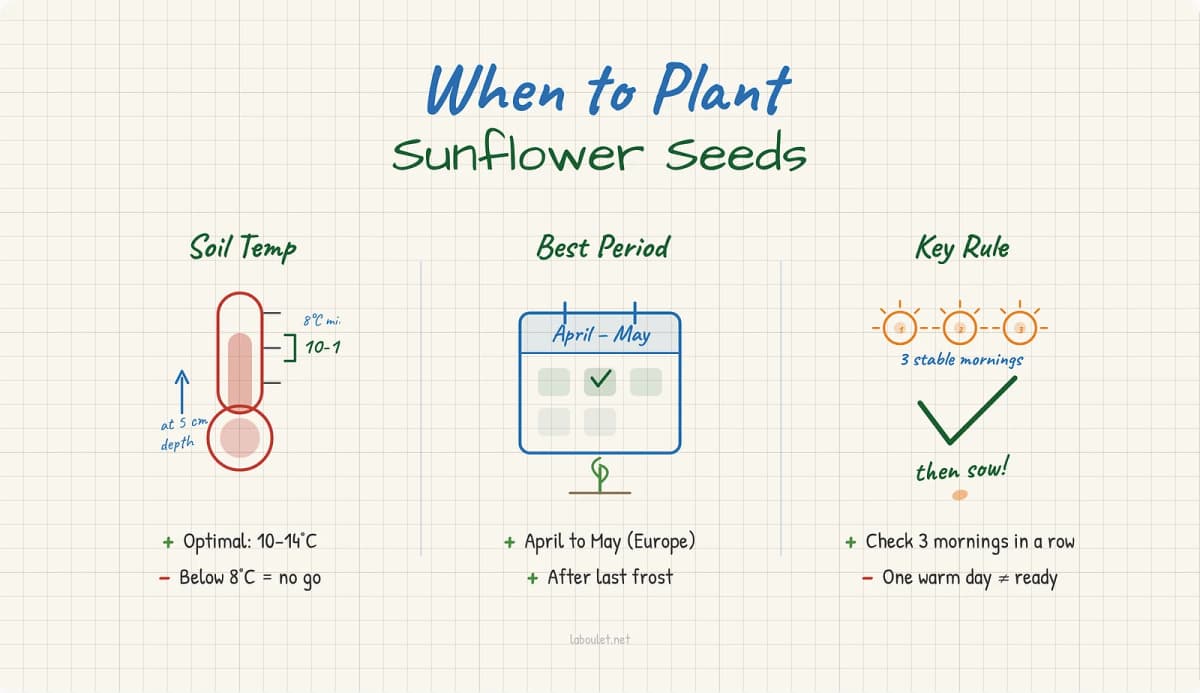
When to Plant Sunflower Seeds: Agronomic Timing for Commercial Growers
Planting date is not a calendar decision. It is an agronomic one. The difference between a productive sunflower crop and a mediocre stand often traces back to a sowing window of just ten to fifteen days. For professional growers, timing sunflower planting means reconciling soil temperature, varietal cycle length, downstream market requirements and regional climate […]
Read more
Where to Buy Sunflower Seeds for Planting
Choosing where to buy sunflower seeds for planting is not a simple sourcing question.It is an agronomic decision that conditions crop performance, market access, and production regularity over the season. Sunflower is grown across multiple filières: oilseed crushing, grain markets, animal feed, bird feed, forage, and occasionally as a cover crop.Each outlet imposes different varietal expectations, tolerance […]
Read moreDefining linoleic sunflower seeds and their oil profile
Linoleic sunflower seeds refer to sunflower hybrids in which the oil is naturally rich in linoleic acid, a polyunsaturated fatty acid that has long been the standard profile for sunflower oil. These seeds differ from high oleic types by offering higher levels of polyunsaturated fat and a more traditional composition used in many food applications.
Within global production, linoleic types remain the most common category of sunflower seeds, serving as a reference point for both agronomic performance and nutritional characteristics. Our hybrid sunflower seeds are bred to maintain this linoleic profile while delivering stable yields and reliable field behaviour.
Why choose our linoleic hybrid sunflower seeds?
Our hybrid sunflower seeds are developed through targeted varietal creation to provide linoleic oil profiles combined with early to medium maturity, strong establishment and consistent yield potential. Our varieties are selected to perform in a range of environments while supporting the specific needs of linoleic oil supply chains.
Through our agronomic solutions, growers have access to technical guidance that covers the full cycle, from variety choice and sowing strategies to harvest and post-harvest handling. Our ranges are designed to align with the requirements of processors and buyers who value linoleic oil characteristics, ensuring that agronomy and market expectations are considered together.
Agronomic benefits of our linoleic varieties
- Balanced combination of yield potential and oil content adapted to linoleic markets.
- Early to mid-early maturity profiles supporting flexible rotations and harvest dates.
- Varietal tolerance to key sunflower diseases, helping to secure production stability.
- Good early vigour and rooting capacity contributing to resilience in variable conditions.
- Compatibility with established crop management practices used by many growers.
Nutritional and oil characteristics of linoleic sunflower seeds
Linoleic sunflower oil typically shows a high proportion of linoleic acid and a lower level of monounsaturated fatty acids compared with high oleic types. This profile is valued in many food applications where polyunsaturated fats and a neutral flavour are required.
The oil obtained from our hybrid sunflower seeds is intended to deliver stable linoleic levels, with attention to both agronomy and harvest management to preserve quality. Our varieties are selected so that the oil from our ranges integrates smoothly into existing edible oil formulations and blends.
Usage conditions and crop management for our ranges
Linoleic sunflower cropping requires careful management of soil, climate and rotation in order to secure both yield and oil quality. Our agronomic solutions provide frameworks that help growers adapt planting decisions to their specific context while respecting the linoleic profile.
Soil, climate and rotation requirements
- Select well-drained soils with medium texture and moderate to good fertility for our hybrid sunflower seeds.
- Avoid compacted or waterlogged areas that may restrict root development or increase lodging risk.
- Place sunflowers within rotations that limit disease pressure, avoiding too frequent return on the same field.
- Choose regions or micro-climates with sufficient heat units for full seed and oil filling within the maturity group of our varieties.
- Integrate sunflower after cereals, pulses or non-host crops to manage soil health and weed control.
Sowing, fertilisation and crop protection for our seeds
- Target a plant population adapted to the potential of each field and to the architecture of our varieties.
- Use seedbed preparation that ensures uniform emergence and depth for our hybrid sunflower seeds.
- Apply nitrogen and other nutrients based on local recommendations and realistic yield objectives.
- Monitor weed pressure and select herbicide strategies compatible with the herbicide tolerance characteristics of the chosen hybrid.
- Implement disease and pest monitoring, using appropriate thresholds and control strategies developed within our agronomic solutions.
Harvest and storage to maintain oil quality
Harvest timing influences both yield and oil characteristics in linoleic sunflower seeds. Growers should monitor seed moisture and maturity to determine the optimal window for each hybrid. Delayed harvest can increase the risk of lodging, bird damage and quality loss.
Once harvested, seed should be dried and stored under conditions that limit oxidation and moisture migration. Our agronomic solutions emphasise simple but effective storage practices that help preserve the linoleic oil profile and maintain the technical value of the harvested crop.
Technical comparison between linoleic and high oleic sunflower seeds
Linoleic and high oleic sunflower seeds belong to the same species but differ in oil composition and some market uses. For growers and buyers, understanding these differences supports informed decisions about which category from our ranges to use.
Oil composition and nutritional profile
- Linoleic sunflower oil is rich in polyunsaturated linoleic acid and forms the traditional sunflower oil profile used in many food products.
- High oleic sunflower oil contains a higher proportion of monounsaturated oleic acid, which improves oxidative stability for some uses.
- Both oils are low in saturated fat, but they respond differently to heat, storage and blending due to their fatty acid profiles.
- Our varieties are positioned to provide clear linoleic oil specifications, which remain in demand across multiple segments.
Yield, stability and disease resistance
Modern linoleic and high oleic hybrids often show comparable yield potential, with differences driven more by genetic background and management than by oil profile alone. Within our ranges, linoleic hybrids are selected for field stability rather than for extreme traits in a single direction.
Our agronomic solutions include disease and lodging risk assessments that help position each hybrid from our varieties on the right soils and in the correct rotations. This approach supports consistent results regardless of the oil profile chosen.
Market outlets and contract types
- Linoleic sunflower seeds typically feed into established edible oil markets, food ingredients and some snack applications.
- High oleic types often supply specialised frying, industrial or niche markets with specific oxidative stability requirements.
- Depending on region, linoleic seeds may be sold on open markets or under contracts with agreed quality criteria.
- Our agronomic solutions help align variety choice with the marketing route, whether commodity or contract-based.
Market segments and value chain for linoleic sunflower seeds
Linoleic sunflower seeds serve a broad value chain that includes crushers, refiners, food manufacturers and feed operators. Our hybrid sunflower seeds are designed so that farmers can integrate smoothly into these segments with clear technical specifications.
Food uses and linoleic oil outlets
- Refined linoleic sunflower oil for cooking oils, dressings and sauces.
- Use of sunflower kernels and oil in bakery products and cereal mixes.
- Ingredients for processed foods that rely on neutral flavour and defined fatty acid profiles.
- Blending with other vegetable oils to reach targeted nutritional and functional specifications.
Our varieties are selected to deliver oil and seed characteristics that meet these uses, contributing to reliable supply for industrial partners.
Non-food and industrial applications
Beyond direct food uses, linoleic sunflower oil can be integrated into technical and industrial applications, such as coatings, resins or bio-based products that benefit from its polyunsaturated nature. In some regions, by-products from crushing are also used in animal nutrition.
Our agronomic solutions take into account the quality parameters requested by processors, helping growers align production practices with industrial expectations in these segments.
Selecting the right linoleic variety within our ranges
Choosing a specific linoleic hybrid involves balancing maturity, yield potential, oil content and local constraints. Our ranges of linoleic sunflower include options suited to different sowing dates, climatic zones and management intensities.
Maturity and regional adaptation
- Early-cycle varieties for regions with shorter growing seasons or late sowings.
- Mid-early to mid-late varieties for standard rotations and higher yield potential where conditions allow.
- Hybrids adapted to cool or warmer zones, depending on the target production area.
- Our agronomic solutions provide region-specific recommendations based on trial results.
Oil content and quality targets
Within our varieties, each hybrid carries a typical range for oil content, which contributes to the gross margin per hectare. Growers can use these indicators, together with local yield expectations, to estimate the value of a linoleic crop.
Our agronomic solutions supply technical sheets that summarise oil content, linoleic level and agronomic behaviour, helping farms align hybrid choice with their quality objectives and buyer demands.
Integrating our agronomic solutions and support
Selecting a hybrid is only one component of success; implementation on the farm is equally important. Our agronomic solutions combine variety knowledge with field support so that sowing density, fertilisation and crop protection match the potential of our hybrid sunflower seeds.
By considering rotation, soil structure and local pest and disease profiles, our support helps growers capture the full value of our ranges of linoleic sunflower seeds season after season.
Practical summary of key agronomic parameters
- Planting window: adapted to each maturity group within our varieties, respecting soil temperature and regional climate.
- Population: plant density adapted to field potential and hybrid architecture.
- Nutrient management: balanced fertilisation to support both yield formation and oil content.
- Crop protection: targeted strategies against weeds, diseases and pests according to local pressure.
- Harvest and storage: timely harvest, controlled moisture and adequate storage to maintain oil and seed quality.
Key questions on linoleic sunflower seeds
What defines linoleic sunflower seeds compared with other types?
Linoleic sunflower seeds are hybrids whose oil naturally contains a high proportion of linoleic acid, giving a polyunsaturated profile distinct from high oleic types that focus on monounsaturated oleic acid.
Are linoleic sunflower seeds still widely used in the oil industry?
Yes. Linoleic sunflower remains a major reference in many regions, supplying established edible oil markets that appreciate its neutral taste and recognised nutritional profile.
How do our linoleic varieties perform in terms of yield?
Our hybrid sunflower seeds in the linoleic segment are selected for stable yield potential, integrating early vigour, standability and disease tolerance to secure production across varied seasons.
Do linoleic and high oleic hybrids require different agronomic practices?
Core agronomic principles are similar, but specific adjustments may be made to sowing date, choice of hybrid and marketing route. Our agronomic solutions help fine-tune these details based on the oil profile and the buyer’s requirements.
Which markets can be supplied with linoleic sunflower oil from our ranges?
Linoleic oil from our varieties can be used in bottled oils, food manufacturing, snacks and bakery, as well as in certain technical applications where its polyunsaturated nature is an asset.
What are the main agronomic risks associated with linoleic sunflower crops?
Key risks include drought or heat stress at flowering and grain fill, lodging, disease outbreaks and bird damage. Our agronomic solutions provide guidance on hybrid positioning and crop protection to mitigate these risks.
How can growers maintain oil quality from field to storage?
Maintaining oil quality relies on appropriate harvest timing, careful handling to minimise damage, controlled drying and storage conditions that protect against moisture and temperature extremes.
Can linoleic sunflower seeds be combined with other crops in rotation?
Yes, linoleic sunflower fits well in rotations with cereals and legumes, helping to diversify cropping systems and spread workload, provided rotation intervals and disease management rules are respected.
How do our agronomic solutions support decision-making on farm?
Our agronomic solutions offer technical sheets, trial data and field advice so that growers can adapt hybrid choice, sowing density, fertilisation and protection strategies to their conditions.
Where do our ranges of linoleic sunflower seeds fit within a broader seed strategy?
Our ranges allow producers to combine linoleic sunflower with other crops and market segments, using our varieties to balance risk, agronomic constraints and access to processors in both food and non-food chains.
Within the sunflower segment, linoleic profiles are often assessed alongside our hybrid sunflower seeds and compared with high oleic sunflower seeds and black oil sunflower seeds, offering practical agronomic benchmarks for producers.