
Early Corn Hybrid for professional growers worldwide
Short maturity corn hybrids adapted to cool regions and constrained harvest windows
Key advantages
Early Corn Hybrid
Corn EFEZIA
Semi-early silage corn with strong health, high yield potential and excellent feeding value.
Corn ELAMIANA
Medium-early silage corn hybrid combining strong vigor, high protein levels and excellent digestibility.
LSM 0811 (Algor)
An early hybrid offering strong silage and grain potential with excellent rusticity and luxuriant vegetation.
Rudilia
Semi-early hybrid with strong silage potential, solid stress tolerance, and very good feeding value.
Smyrna
Early silage hybrid offering strong yield potential and solid agronomic performance.
LS Tirnavia
Early to semi-early hybrid combining strong yield potential, solid agronomic health and very good forage quality.
LS Zetalia
Early double-cross hybrid with strong and consistent yield, very good digestibility and solid agronomic balance.
Compare varieties
| Variety | Maturity (FAO) | Type | Use | Silage maturity | Grain maturity |
|---|---|---|---|---|---|
| LS Zetalia | FAO 220 | Semi-dent to dent | Silage | — | — |
| Corn ELAMIANA | FAO 250 | Flint to semi-dent | Silage | — | — |
| Corn EFEZIA | Semi-early (end of C1 group) | — | Silage | — | — |
| LSM 0811 (Algor) | Early, end of group B | Flint–dent | Dual-purpose with grain tendency | 1480° | 1680° |
| Rudilia | Semi early – C1 group | Semi-dent to Dent | Silage | 1,520°C | 1,770°C |
| Smyrna | Early – B group | Flint to semi flint | Silage | 1,390°C | 1,630°C |
| LS Tirnavia | Early to semi early (end of B group) | Flint to semi flint | Grain and silage | 1,480°C | 1,700°C |
See the full range: Hybrid corn seeds for silage and grain, FAO 100 to 450 →
Where to grow corn
Guides & insights on corn
View all articles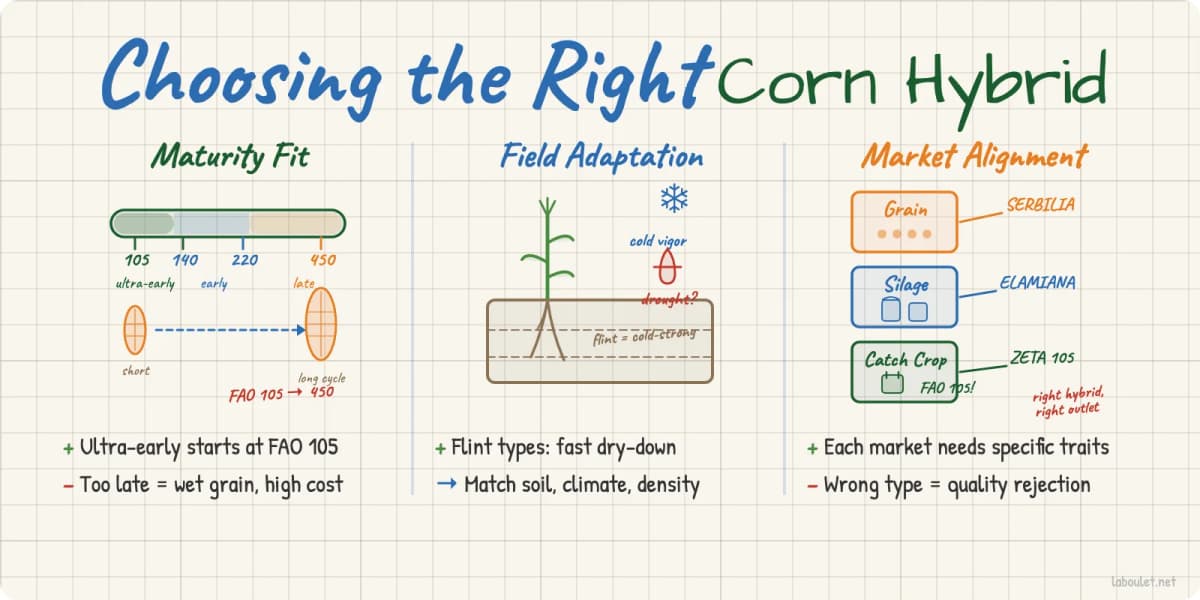
How to Choose the Right Corn Hybrid for Your Farm
Every season starts with the same question: which hybrid goes into the planter? The answer determines your yield ceiling, your harvest date, your drying costs, and ultimately your margin. Yet too many growers default to habit — replanting last year’s pick or copying a neighbor — without asking whether that hybrid actually fits their field, […]
Read more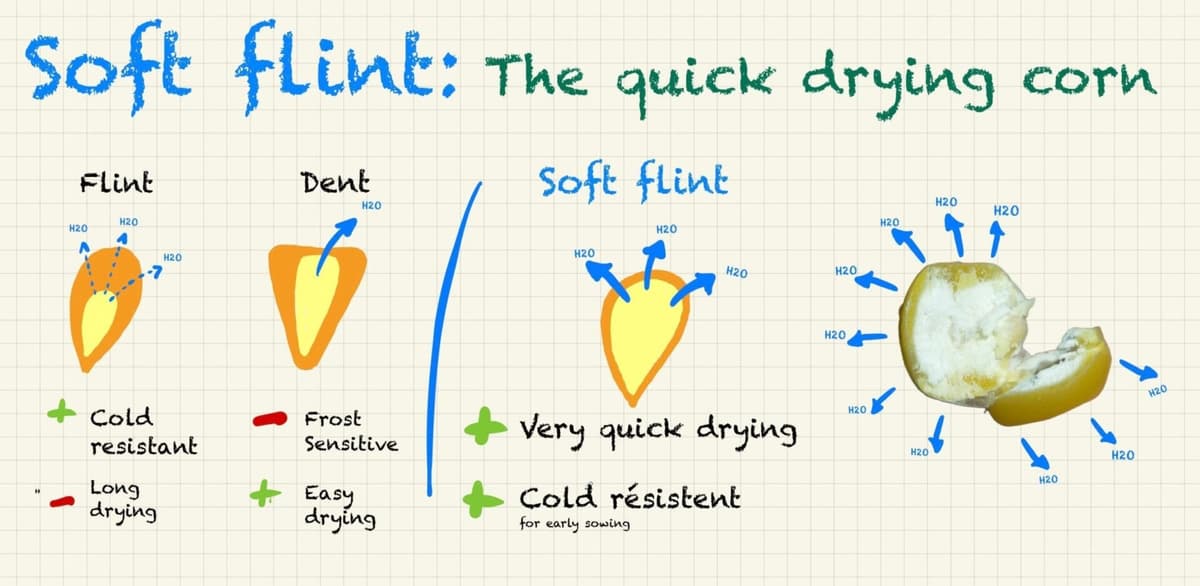
Soft flint: The quick drying corn
“Soft Flint” Corn: Flint Vigor Combined with Rapid Dry-Down Soft flint corn is an innovative type of grain corn derived from flint corn, characterized by an extremely thin vitreous endosperm. In other words, the kernel retains the visual appearance of flint corn (no dent) while being largely composed of floury starch. This unique profile gives […]
Read moreDefining early corn seeds and maturity groups
Early corn seeds are hybrids belonging to short maturity groups that reach physiological maturity more quickly than standard types. They are adapted to regions with limited growing degree days, constrained harvest windows or where farmers want to free land earlier for following crops.
Our varieties in early segments are selected to combine rapid development, good dry-down and stable yield. With our seeds, the target is to secure maturity and quality while limiting the yield gap with longer-cycle hybrids in favourable years.
Agronomic benefits of early corn seeds
Choosing early corn seeds is a way to reduce climatic and operational risks without abandoning productivity objectives. In many situations, an early hybrid that reaches the right dry matter at the right time will produce more usable tonnes than a later hybrid harvested too wet or too late.
- Secured maturity: our varieties reduce the risk of incomplete grain fill or immature silage in cool or late seasons.
- Flexible harvest window: the shorter cycle of our seeds allows a wider harvest window, limiting work peaks and weather-related delays.
- Lower grain moisture: early hybrids in our ranges generally reach lower grain moisture at harvest, reducing drying needs.
- Forage quality stability: silage-oriented early hybrids maintain a good balance between starch content and fibre digestibility.
- Adaptation to marginal zones: early segments open possibilities for corn in higher altitude or oceanic areas where full-season hybrids are risky.
Our agronomic solutions are built to enhance these benefits, with recommendations tuned to each maturity group and to the specific behaviour of our products.
Where and when early corn seeds are most relevant
Early corn seeds are adapted to a broad range of climatic and soil contexts where earliness is a strategic lever. These contexts are not limited to the coldest zones; they also include farms seeking to secure work organisation or to integrate additional crops into the rotation.
- Cool or humid regions with short frost-free periods.
- Heavy soils where access to fields is delayed in spring and autumn.
- High altitude zones exposed to early autumn frosts.
- Farms aiming to sow winter cereals or cover crops after corn.
- Situations where silage or grain must be harvested early to feed livestock or supply a biogas unit.
Our ranges of early hybrids are positioned precisely for these contexts, with a gradation from ultra early to medium-early to adjust earliness to local conditions.
Choosing early corn seeds according to end use
Early corn seeds can be oriented to several outlets: silage, grain, cob mix, high-moisture corn or biogas. Within our varieties, each hybrid is characterised by its primary use and agronomic profile, allowing farmers to adapt their choice to the objectives of the farm.
Early silage hybrids
Early silage hybrids are bred for balanced whole-plant yield, high cob proportion and good digestibility despite a shorter cycle. They are particularly suited to dairy farms that must secure a minimum forage tonnage each year while keeping stable milk performance.
- High proportion of cob in the dry matter for energy density.
- Fibre with good digestibility to support intake and rumen function.
- Stay-green behaviour calibrated to maintain leaf area until harvest, without delaying dry-down.
- Rapid accumulation of dry matter to reach the 32–35% silage target within the desired harvest period.
Early grain and multipurpose hybrids
Grain-oriented early hybrids combine good grain fill with fast field dry-down. These hybrids from our ranges are interesting where drying costs are critical, or where the harvest window is constrained by weather or logistics.
- Robust cob with consistent grain number and kernel weight.
- Rapid grain dehydration in the field, limiting energy use in dryers.
- Possibility to harvest earlier for silage or cob mix in case of forage deficit.
Early corn for biogas
Biogas units require reliable dry matter and energy input over several years. Early corn seeds can secure a regular substrate, even on plots with climatic or agronomic constraints. Our agronomic solutions integrate specific sowing densities and harvest stages to optimise methane yield with early hybrids.
Key agronomic practices for early corn seeds
The performance of early corn does not rely only on genetics; agronomic management must be adjusted to the shorter cycle. Our agronomic solutions combine sowing, nutrition and protection guidelines tailored to early segments.
Sowing conditions and dates
Early hybrids are often chosen to cope with cool conditions, but sowing into cold, wet soil remains risky for emergence and plant health. Establishment quality is fundamental to fully benefit from the potential of our seeds.
- Target a minimum soil temperature of 8–10 °C at sowing depth, with a warming trend in the forecast.
- Prepare a fine, firm seedbed ensuring close seed–soil contact and homogeneous depth.
- Avoid excessive early sowing in heavy soils that stay waterlogged; a few days of delay can secure emergence.
Plant density and row spacing
Early hybrids often show a slightly smaller vegetative development than medium-late types. Adjusting plant density helps to optimise light interception and ear size without increasing lodging risk.
- Position plant density according to the potential of each field and the characteristics of our varieties.
- On high-potential or irrigated plots, higher densities can raise yield, provided that nutrition and water are sufficient.
- On shallow or drought-prone soils, moderate densities reduce competition and limit stress during flowering.
Fertilisation and crop nutrition
Early corn seeds must access nutrients quickly, because the vegetative phase is short. Management of nitrogen, phosphorus and potash must be aligned with the rapid growth dynamics of early hybrids.
- Provide a starter fertiliser rich in phosphorus close to the row in situations of cold or low-P soils.
- Adjust nitrogen rate to the targeted yield, taking into account residual N and organic fertiliser contributions.
- Ensure balanced potash supply to support stalk strength and water regulation.
Weed, pest and disease management
Competition and stress during the first weeks can penalise early corn more heavily than later types, because the crop has less time to compensate. Our agronomic solutions propose integrated strategies combining chemical and mechanical tools when relevant.
- Keep the crop free of weeds during at least the first six to eight weeks after emergence.
- Monitor soil pests such as wireworms and grubs in risk fields and adapt seed treatments or cultural practices.
- Select, within our ranges, hybrids with good tolerance to foliar and stalk diseases present in the region.
Technical comparison between early, ultra early and medium-early corn
The choice between early, ultra early and medium-early corn should be based on a balance between yield potential and risk management. In practice, many farms benefit from combining several maturity groups within their cropping plan.
- Ultra early: very short cycle, maximum security on harvest date, but potential yield slightly reduced in favourable years.
- Early: compromise between earliness and productivity; our seeds in this segment aim to stabilise yield while keeping a comfortable harvest window.
- Medium-early: higher potential in regions with sufficient heat units, but greater exposure to late-season risks.
Our varieties cover these three segments, allowing farmers to adapt the proportion of each maturity group to their climate, soil types and forage needs. This distribution is one of the levers used in our agronomic solutions to spread risks.
Genetic progress and R&D behind our early corn varieties
Early corn segments benefit from continuous genetic progress, especially in the relationship between earliness and yield. Research and development focus on combining early flowering and rapid dry-down with robust agronomic traits.
- Selection for yield stability across multi-year, multi-site trials in constrained environments.
- Evaluation of early vigour and cold tolerance during emergence and juvenile stages.
- Screening for resistance to major diseases and for good stalk strength.
- Characterisation of silage quality parameters such as starch content, fibre digestibility and energy value.
Our ranges of early corn seeds are developed alongside our hybrid sunflower seeds, our oilseed varieties and our legume seeds. This multi-crop approach reinforces our capacity to design coherent rotations and diversified agronomic solutions.
Integrating early corn seeds into cropping systems and rotations
Early corn is not only a technical choice; it is also a strategic lever for crop rotation and forage planning. By freeing land earlier or securing harvest dates, early corn seeds create opportunities for the rest of the system.
- Introduction of winter cereals after corn, improving soil cover and economic performance.
- Establishment of cover crops that limit erosion and contribute to soil structure and fertility.
- Combination with legumes in the rotation to diversify nitrogen sources and break pest cycles.
- Better distribution of workload between silage, grain harvest and other key tasks on the farm.
Our agronomic solutions integrate early corn together with our seed catalog for legumes and our oilseed varieties. The objective is to build robust, diversified rotations that respond to both agronomic and economic constraints.
Practical questions about early corn seeds in the field
In which situations are early corn seeds preferable to standard hybrids?
Early corn seeds are particularly interesting when climatic risk is significant, when the harvest window is constrained by weather or logistics, or when a following crop must be sown early. They are also relevant on high altitude plots or heavy soils that dry slowly in autumn. In these cases, our varieties in early segments help to secure maturity and forage quality.
Does choosing early corn always mean accepting lower yield?
In theory, longer-cycle hybrids have a higher maximum yield potential. In practice, when conditions are limiting or variable, early corn seeds often deliver better effective yields, because they reach maturity more reliably. The objective of our seeds in early groups is to reduce the gap with medium-early hybrids while providing greater stability over years.
How should sowing dates be adjusted with early hybrids?
Sowing dates should be reasoned according to soil type, climate and the behaviour of each hybrid. Early corn can be sown at similar dates to standard hybrids, as long as soil temperature and structure are suitable. In risky situations, our agronomic solutions recommend prioritising soil conditions over calendar dates to secure emergence.
What plant density is recommended for early silage corn?
Recommended plant density depends on the hybrid, soil potential and water availability. As a general rule, silage-oriented early hybrids tolerate slightly higher densities than grain types, especially on fertile or irrigated soils. For each of our varieties, agronomic documentation indicates the appropriate density ranges according to yield target and soil conditions.
Can early corn be combined with ultra early and medium-early hybrids on the same farm?
Combining several maturity groups is often a good strategy. Ultra early hybrids can secure the earliest plots, early hybrids constitute the core of the surface, and medium-early hybrids complete the plan on the best fields. Our ranges are designed to be complementary and our agronomic solutions propose distribution keys adapted to each region.
How does early corn fit into forage planning for dairy cows?
Early silage hybrids help to secure a base of energy-rich forage each year. Their earliness allows harvest at an optimal stage, often before weather degrades field conditions, and can free land for a second forage or a cover crop. Our seeds are characterised for their silage quality to facilitate ration formulation and integration into existing forage systems.
Is early corn suitable for biogas plants all over the rotation?
Early corn can provide a regular and secure substrate for biogas when fields or climates are constrained. It is often combined with other crops such as rye, sorghum or legumes to ensure year-round supply. Our agronomic solutions detail the harvest stage and dry matter targets for early hybrids used in biogas production.
How to integrate early corn with other crops like sunflower or legumes?
Early corn frees up planting windows that facilitate the introduction of other crops such as sunflower or protein legumes. By combining our hybrid sunflower seeds, our ranges of legumes and our early corn seeds, it is possible to design rotations that improve soil cover, diversify income and optimise the use of climatic resources over the year.
For growers assessing early-cycle hybrids, it is common to compare them with our hybrid corn seeds as well as with ultra-early corn seeds and mid-late hybrid corn seeds, which provide perspective on cycle length and field performance.