
What Are Castor Beans Used For? Uses, Oil & Industry
Few crops can match the industrial versatility of the castor bean (Ricinus communis L.). A single hectare of well-managed castor plants produces hundreds of kilograms of seeds containing up to 57 percent oil — an oil unlike any other vegetable oil in the world. That oil fuels industries as diverse as aerospace, cosmetics, high-performance polymers, […]
Few crops can match the industrial versatility of the castor bean (Ricinus communis L.). A single hectare of well-managed castor plants produces hundreds of kilograms of seeds containing up to 57 percent oil — an oil unlike any other vegetable oil in the world. That oil fuels industries as diverse as aerospace, cosmetics, high-performance polymers, and pharmaceuticals. Yet the plant itself also delivers agricultural benefits: it is one of the best rotation crops available, leaving the soil richer and better structured for the next crop.
This guide covers every significant use of castor beans, from the oil extracted at the seed-processing plant to the polymer at the end of the production chain — and why understanding the full value chain matters if you’re considering growing castor as a cash crop.
The Castor Bean at a Glance
Castor belongs to the Euphorbiaceae (spurge) family and is grown commercially in tropical and subtropical regions — India being the world’s leading producer today. In temperate climates, it is cultivated as an annual, reaching one to three meters in height depending on the hybrid. Modern castor bean hybrids from Laboulet Semences have been bred specifically to maximize oil yield and enable mechanical harvesting, making the crop viable for large-scale commercial farming in a much wider range of environments.
The seeds — technically “beans” though castor is not a legume — develop inside spiny capsules on flower spikes called racemes. Each seed contains a kernel rich in triglycerides, surrounded by a hard mottled seed coat. It is from this kernel that castor oil is pressed or solvent-extracted. The seed coat and remaining meal are a separate by-product with their own set of applications.
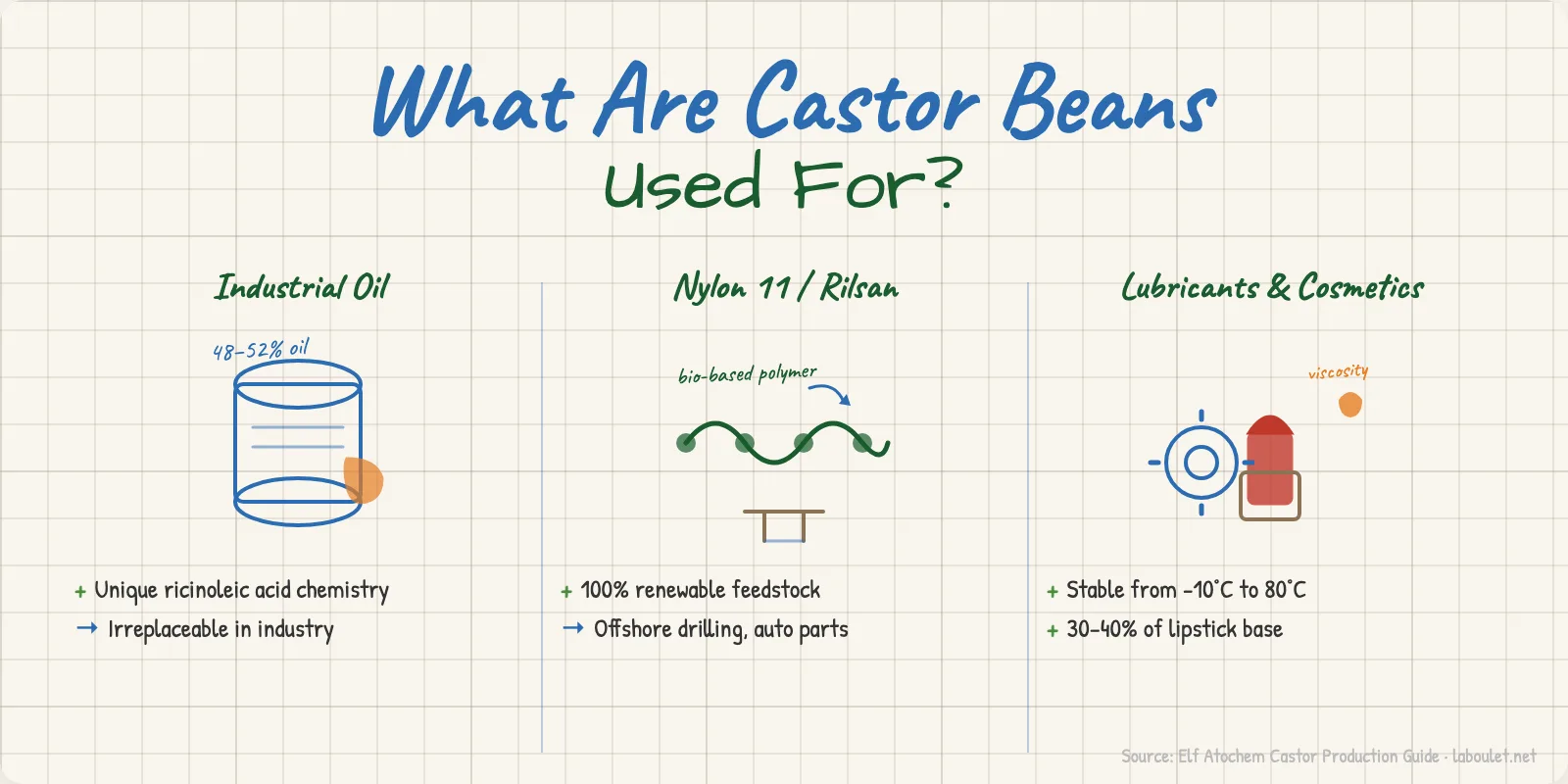
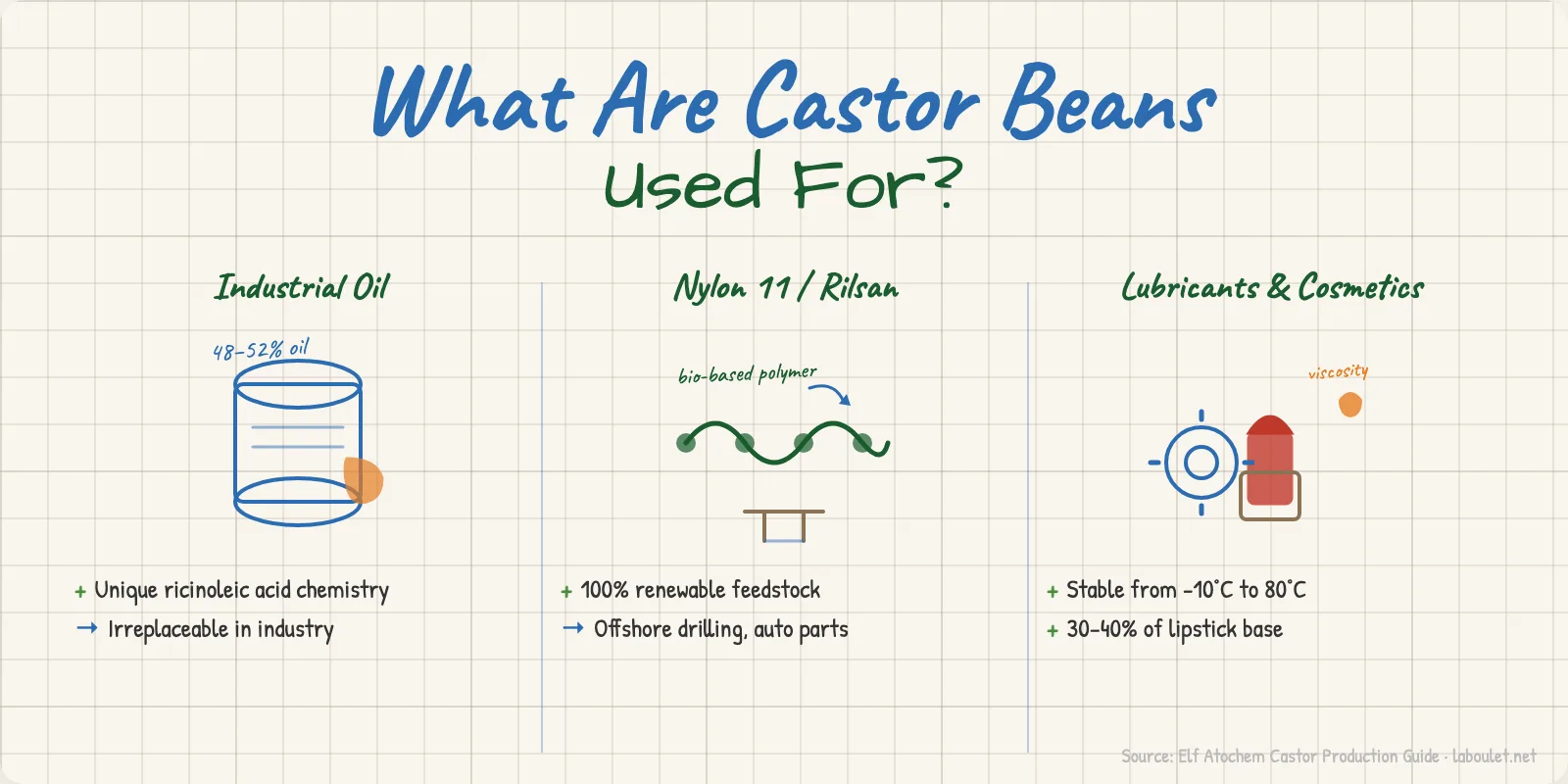
Seeds contain from 35 to 57 percent oil by weight. Current commercial hybrids average 48 to 52 percent, which is exceptionally high for an oilseed crop — comparable to sunflower at its best, and significantly above soybean or rapeseed. High oil content is one of Laboulet’s primary breeding targets: hybrids like LS Peter are selected not only for yield per hectare but for the quality and quantity of oil in every seed.
Primary Use: Castor Oil Extraction
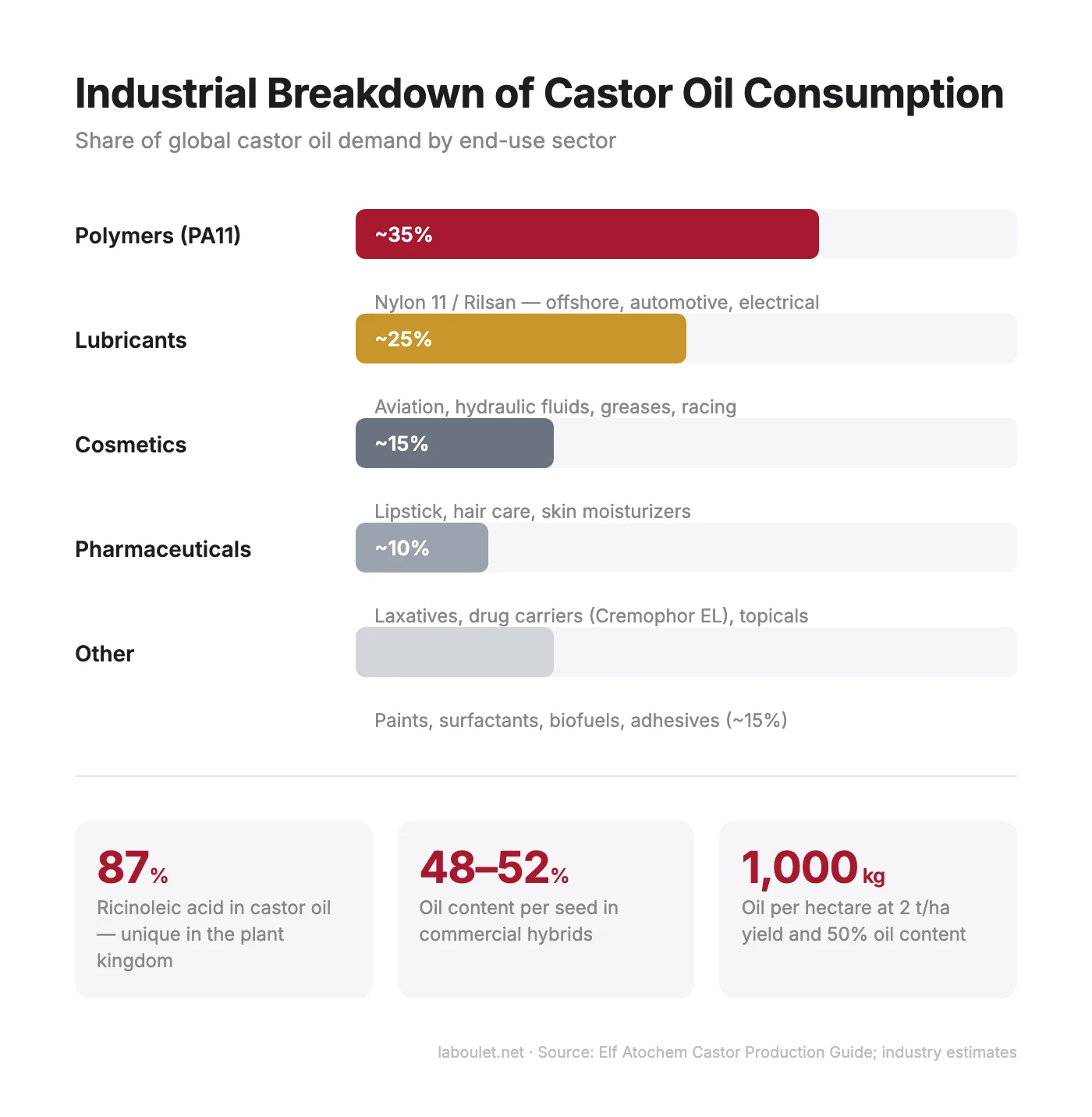
The dominant use of castor beans — accounting for virtually all commercial production worldwide — is the extraction of castor oil. This oil has a chemical composition unlike any other naturally occurring vegetable oil: approximately 87 to 90 percent of its fatty acids are ricinoleic acid, a C18 hydroxy fatty acid that does not exist in significant quantities in any other oil or fat.
This unique chemistry is the foundation of castor oil’s extraordinary industrial versatility. The hydroxyl group on the ricinoleic acid molecule allows it to react in ways that standard oils like sunflower, palm, or soybean cannot. It gives the oil exceptional viscosity stability across a wide temperature range, outstanding lubricity, and the ability to be chemically transformed into dozens of derivative products.
How Castor Oil Is Extracted
Extraction follows one of two industrial routes, depending on the intended application:
- Cold pressing (expeller pressing) — The dehulled seeds are mechanically pressed at low temperature. This first-press oil retains its natural pale yellow color and is suitable for pharmaceutical, cosmetic, and food-grade uses. It typically yields around 40 percent of seed weight as oil.
- Solvent extraction — The pressed cake is further extracted with hexane (similar to soybean and canola processing) to recover residual oil. This maximizes the total oil recovery but requires refining. Most industrial-grade castor oil is produced this way.
After extraction, the raw oil is filtered, dewaxed, and refined to different grades depending on the end market: USP-grade for pharmaceuticals, cosmetic-grade for personal care, and technical-grade for industrial applications.
Industrial Uses: Where Most Castor Oil Goes
Industry consumes the vast majority of global castor oil production. The applications are wide-ranging and deeply embedded in modern manufacturing supply chains.
Nylon 11 and Rilsan: The Most Valuable Transformation
The highest-value industrial application of castor oil is the production of polyamide 11 (PA11), sold under the trade name Rilsan by Elf Atochem (now Arkema). This is a biobased engineering plastic made entirely from castor oil — one of the few industrial polymers with a fully renewable carbon footprint.
The process begins by cracking ricinoleic acid at high temperature to yield 11-aminoundecanoic acid, which is then polymerized into nylon 11. Elf Atochem pioneered this transformation and developed the high-yielding castor hybrids (through their research branch COSTASEM) precisely to secure a reliable supply of high-quality raw material.
Rilsan/nylon 11 finds application wherever a flexible, lightweight, chemically resistant polymer is needed under demanding conditions:
- Textile fibers — sportswear, technical fabrics
- Mouldings and tubes — fuel lines, brake tubing, medical tubing
- Wire insulation — high-performance electrical cables
- Offshore drilling — flexible risers and umbilicals in deepwater oil and gas production, where the combination of chemical resistance and flexibility under pressure is critical
- Coatings — powder coatings for corrosion protection
- Automotive components — under-hood parts, fuel system components
The castor-to-Rilsan value chain is one of the most compelling examples of agricultural raw material becoming a high-performance industrial product. It is also one of the reasons why castor has a steady, long-term industrial market that does not fluctuate as wildly as food commodity markets.
Lubricants and Hydraulic Fluids
Castor oil’s exceptional viscosity index — it remains fluid at -18°C while staying stable at high temperatures — makes it one of the most effective natural lubricants available. Key applications include:
- Aviation lubricants — castor oil was the original engine lubricant for early aircraft and racing engines; it remains used in piston aircraft engines and high-performance two-stroke engines because it bonds to metal surfaces even when oil pressure fails
- Hydraulic fluids — particularly where biodegradability and low toxicity are required (agriculture, food processing)
- Greases — in combination with lithium or other thickeners
- Two-stroke racing engine oil — castor-based oils (Castrol R being the historic example) are still preferred in motorcycles, karts, and classic car racing for their high-load film strength
Paints, Coatings, and Adhesives
Dehydrated castor oil (DCO) — produced by removing the hydroxyl group from ricinoleic acid — behaves similarly to tung oil as a drying oil, making it valuable in alkyd resins for paints and varnishes. Castor oil derivatives are also used in urethane coatings, sealants, and adhesives due to their reactivity with isocyanates.
Plasticizers and Surfactants
Ethoxylated castor oil (castor oil reacted with ethylene oxide) produces a family of nonionic surfactants widely used in industrial cleaning products, textile processing, and agrochemical formulations. Hydrogenated castor oil serves as a wax-like plasticizer in cosmetics and pharmaceuticals.
Biofuels
Castor oil can be transesterified into biodiesel (FAME — fatty acid methyl esters) using the same process as soybean or rapeseed biodiesel. However, high ricinoleic acid content gives castor biodiesel a very high cloud point, limiting its direct use in cold climates. It is more commonly used as a blend component or feedstock for specialty biofuels and bioplastics.
Cosmetic and Personal Care Uses
Cosmetics are the most visible consumer application of castor oil. The same properties that make it industrially useful — high viscosity, film-forming ability, moisturizing effect, and lubricity — translate well to personal care products.
- Lipsticks and lip balms — castor oil is the dominant carrier in most lipstick formulations, providing gloss, adhesion, and the ability to suspend pigments evenly
- Hair care — thick castor oil (especially Jamaican Black Castor Oil, processed with ash) is widely used as a hair and scalp treatment
- Skin moisturizers — cold-pressed castor oil is an effective occlusive humectant for dry skin
- Mascara and eyeliner — as a conditioning and film-forming agent
- Nail care — in nail hardeners and cuticle treatments
Pharmaceutical Uses
Castor oil has been used medicinally for thousands of years. Its pharmaceutical applications today include:
- Stimulant laxative — castor oil has FDA approval as an OTC laxative in the US. When ingested, ricinoleic acid activates EP3 receptors in the intestinal wall, stimulating peristalsis. It is used for rapid bowel preparation before medical procedures.
- Excipient and carrier — polyethoxylated castor oil (Cremophor EL) is a standard solubilizing excipient for insoluble drugs, including taxol (paclitaxel) in cancer chemotherapy
- Topical emollient — in wound healing preparations, eye drops, and dermatological products
- Labor induction — historically used to induce labor (not recommended for self-administration)
Castor Seed Meal: The By-Product After Oil Extraction
After oil extraction, what remains is the seed meal (also called castor cake). This meal has high protein content — potentially valuable as animal feed or fertilizer — but there is a critical constraint: it contains ricin and ricinine, highly toxic compounds present in the seed endosperm.
Raw castor meal is toxic to livestock and humans. However, heat treatment and other detoxification processes can reduce or eliminate ricin, producing detoxified castor meal that is used as:
- Organic nitrogen fertilizer — the most common use for raw (non-detoxified) cake; it has an N-P-K profile similar to cottonseed meal and decomposes slowly in soil
- Animal feed — only when properly detoxified (autoclaving at high temperature and pressure) and verified by assay; regulatory frameworks vary by country
The detoxification question is one reason why castor processing facilities require significant investment — and why the oil extraction industry tends to be concentrated in a relatively small number of specialized plants.
Agricultural Uses: Castor as a Rotation Crop
Beyond the seed’s direct products, castor beans provide significant value as a rotation crop — an aspect that matters particularly for farmers integrating castor into an existing cropping system.
A five-year rotation trial comparing nine crops showed that maize planted after castor yielded 110.88 percent of the control — significantly higher than maize after beans (104%), after soybean (104%), or after sunflower (100%). No other rotation partner tested in the trial outperformed castor for subsequent maize yields.
Why does castor benefit the following crop?
- Soil moisture conservation — castor’s deep tap root does not deplete soil moisture more than other crops; at end of season, moisture levels under castor were actually higher than under maize or other grains
- Organic matter — large leaf biomass ploughed in adds significant organic material
- Weed suppression — once established, castor’s dense canopy shades weeds, reducing the weed seed bank for the following crop
- Break crop benefits — interrupting cereal disease and pest cycles, as with most broadleaf rotation crops
Laboulet Semences positions castor as a strategic rotation partner precisely because many customers already grow maize, sunflower, or other cereals. The dwarf hybrids LS Peter and LS Harold fit into arable farming systems with minimal additional equipment: they are mechanically harvested, suited to standard row-crop spacing, and fit the same calendar as summer crops in temperate zones.
Why Oil Content Matters: From Field to Factory
For growers selling castor beans into the industrial supply chain, oil content is the most important quality parameter — it directly determines price per tonne, just as oil content drives pricing for sunflower and rapeseed.
Seeds with higher oil content also tend to produce higher-quality oil with lower impurity loads, simplifying processing and reducing refining costs. This is why Laboulet’s breeding program targets not just yield per hectare but oil percentage per seed. Commercial hybrids from Laboulet typically deliver 48 to 52 percent oil, at the high end of the commercial range.
The arithmetic is straightforward: at 50% oil content and a field yield of 2,000 kg/ha, a farmer delivers the equivalent of 1,000 liters of castor oil per hectare. At 48% oil with the same yield, that drops to 960 liters — a 4% revenue difference simply due to oil content.
A Note on Safety: Ricin in Castor Beans
Any discussion of castor bean uses must address the elephant in the room: raw castor seeds are toxic to humans and animals due to the presence of ricin, one of the most toxic naturally occurring proteins. Ingestion of even a small number of raw seeds can be fatal.
However, this toxicity is entirely removed during standard oil processing. The oil itself contains no ricin — the protein is destroyed by the heat used in commercial extraction, or retained in the meal and water phases of solvent extraction. Properly produced castor oil, whether food-grade or industrial-grade, poses no ricin risk to the end user.
For farmers, the practical safety considerations are:
- Handle seeds with standard agricultural PPE; avoid inhalation of dust from crushed seeds or meal
- Some individuals may develop allergic reactions to castor seed dust — this is an allergen concern, separate from ricin toxicity
- Do not use raw castor meal as animal feed without verified detoxification
Modern non-shattering hybrid varieties (like those in Laboulet’s range) minimize seed handling exposure during harvest by keeping capsules intact until deliberate threshing.
Conclusion: A Crop Worth Knowing
Castor beans are used for an exceptionally diverse range of applications — far beyond what most growers associate with a single oilseed crop. The oil is the foundation of a high-performance polymer (nylon 11/Rilsan) that is irreplaceable in offshore drilling and automotive applications. It lubricates jet engines, conditions hair and skin, and has a long history as a pharmaceutical. The meal fertilizes the next crop, and the plant itself improves soil conditions for whatever follows in the rotation.
For a farmer evaluating whether castor fits their operation, the value proposition comes down to three points: a steady industrial market, a crop that is an excellent rotation partner, and a value chain that rewards high oil content — which is exactly what modern hybrids are bred to deliver. Explore Laboulet’s castor bean hybrid range to find the type — dwarf, giant, or semi-dwarf — that fits your farming system and harvest method.
Our varieties: castor bean
| Variety | Type | Earliness |
|---|---|---|
| LS Harold | Dwarf castor bean | Very early flowering and maturity |
| LS Peter | Dwarf castor bean | Very early |
| LS Suzi | Semi-dwarf castor bean | Early |
| LS Marilou | Giant castor bean | Semi-early |
Frequently asked questions
What are castor beans used for?
Castor beans (Ricinus communis seeds) are pressed for castor oil, which has thousands of industrial applications: nylon-11 polyamide for engineering plastics, biodegradable lubricants, hydraulic fluids, biofuels, cosmetics, pharmaceuticals (laxatives), paints and coatings, and lubricants for high-performance engines. The press cake is used as fertilizer after detoxification.
What products contain castor oil?
Castor oil and its derivatives appear in nylon-11 fibers, hydraulic and brake fluids, jet engine lubricants, soaps, lipsticks and mascara, hair products, polyurethane foams, biodegradable plastics, biodiesel feedstock, printing inks, paints, and pharmaceutical excipients. Approximately 75% of global castor oil production goes to industrial uses.
Is castor oil used in industry?
Yes, the majority of castor oil is consumed by industry. Major segments include polyamide nylon-11 (Rilsan), specialty lubricants for aerospace and motorsport, biodiesel and bio-based hydraulic fluids, and surface coatings. Castor oil derivatives like sebacic acid, undecylenic acid, and 12-hydroxystearic acid are key chemical building blocks.
What are castor beans good for besides oil?
After oil extraction, the press cake (meal) is rich in nitrogen and used as organic fertilizer once the toxic ricin is denatured by heat. The whole castor plant biomass can be returned to soil for organic matter. The hull is sometimes used as solid biofuel. Castor is also valued in crop rotations as a deep-rooted scavenger.
Is castor used for biofuel?
Yes. Castor oil is increasingly used as a biodiesel feedstock, particularly in Brazil and India where it grows on marginal land that cannot support food crops. Unlike soy or rapeseed, castor does not compete with food production. Its high viscosity requires transesterification to meet biodiesel specifications.
Can castor beans be eaten?
No — raw castor beans contain ricin, one of the most toxic naturally occurring proteins. Castor oil itself does not contain ricin (the protein is water-soluble and stays in the cake), and is safe for the FDA-approved uses (laxatives, cosmetics). The seeds must never be consumed directly.