
How to Plant Castor Bean Seeds: Complete Growing Guide
Castor bean (Ricinus communis L.) is one of the most versatile oilseed crops in the world. Its seeds contain 35 to 57 percent oil — the raw material for nylon 11, lubricants, bioplastics, and cosmetics — and the plant itself is an excellent rotation crop that leaves the soil in better condition for whatever follows. […]
Castor bean (Ricinus communis L.) is one of the most versatile oilseed crops in the world. Its seeds contain 35 to 57 percent oil — the raw material for nylon 11, lubricants, bioplastics, and cosmetics — and the plant itself is an excellent rotation crop that leaves the soil in better condition for whatever follows. Yet for all its potential, castor rewards careful planting and punishes shortcuts. Get the soil temperature wrong, choose the wrong spacing, or lose the weed battle in the first six weeks, and your yield will suffer dramatically.
This guide covers everything you need to know to plant castor bean seeds successfully, from soil preparation to early crop management. The recommendations draw on field trial data and decades of breeding experience, illustrated with real spacing guidelines from Laboulet Semences’ castor bean hybrid range — including dwarf, giant, and semi-dwarf types bred for modern mechanized farming.
Understanding the Castor Bean Plant
Castor belongs to the Euphorbiaceae (spurge) family. In its tropical native habitat it grows as a perennial tree reaching up to five meters, but in temperate agriculture it is cultivated as an annual. Modern commercial hybrids range from 1.20 meters (dwarf types) to three meters (tall/giant types), depending on variety and growing conditions.
The plant has a strong tap root with shallow lateral roots spreading just below the soil surface. The main stem ends in an inflorescence (the primary raceme), which typically appears 40 to 55 days after planting. After the first raceme, lateral shoots develop progressively at the nodes — each ending in its own raceme. In well-bred modern hybrids like LS Peter, four to five synchronized inflorescences develop, concentrating yield and enabling a clean single-pass harvest.
Understanding this growth pattern matters for planting decisions: the earlier you plant (within safe temperature limits), the longer the growing season, and the more racemes the plant can develop — meaning higher yield.
Climate and Soil Requirements
Temperature and Growing Season
Castor needs a frost-free growing season of five to eight months, depending on the hybrid. The ideal temperature range through the cycle is 20–28°C. Castor grows well under conditions similar to cotton, maize, and sorghum — and will produce crops under marginal conditions where many other crops would fail.
That said, cool and humid conditions slow growth considerably and reduce yield. Incessant rain for five days or more during flowering will damage the racemes through fungal infection. Castor also requires a dry period at harvest to prevent capsule mould and drop.
Rainfall
A total of 450 to 1,000 mm of well-distributed rainfall during the growing season will produce good crops. The ideal pattern front-loads moisture: 100–125 mm per month in the first three months (establishment and vegetative growth), tapering to 25–60 mm in later months as the plant approaches maturity. Where rainfall drops below 300 mm during the growing season, supplementary irrigation is necessary for high-potential hybrids.
Soil Type and Preparation
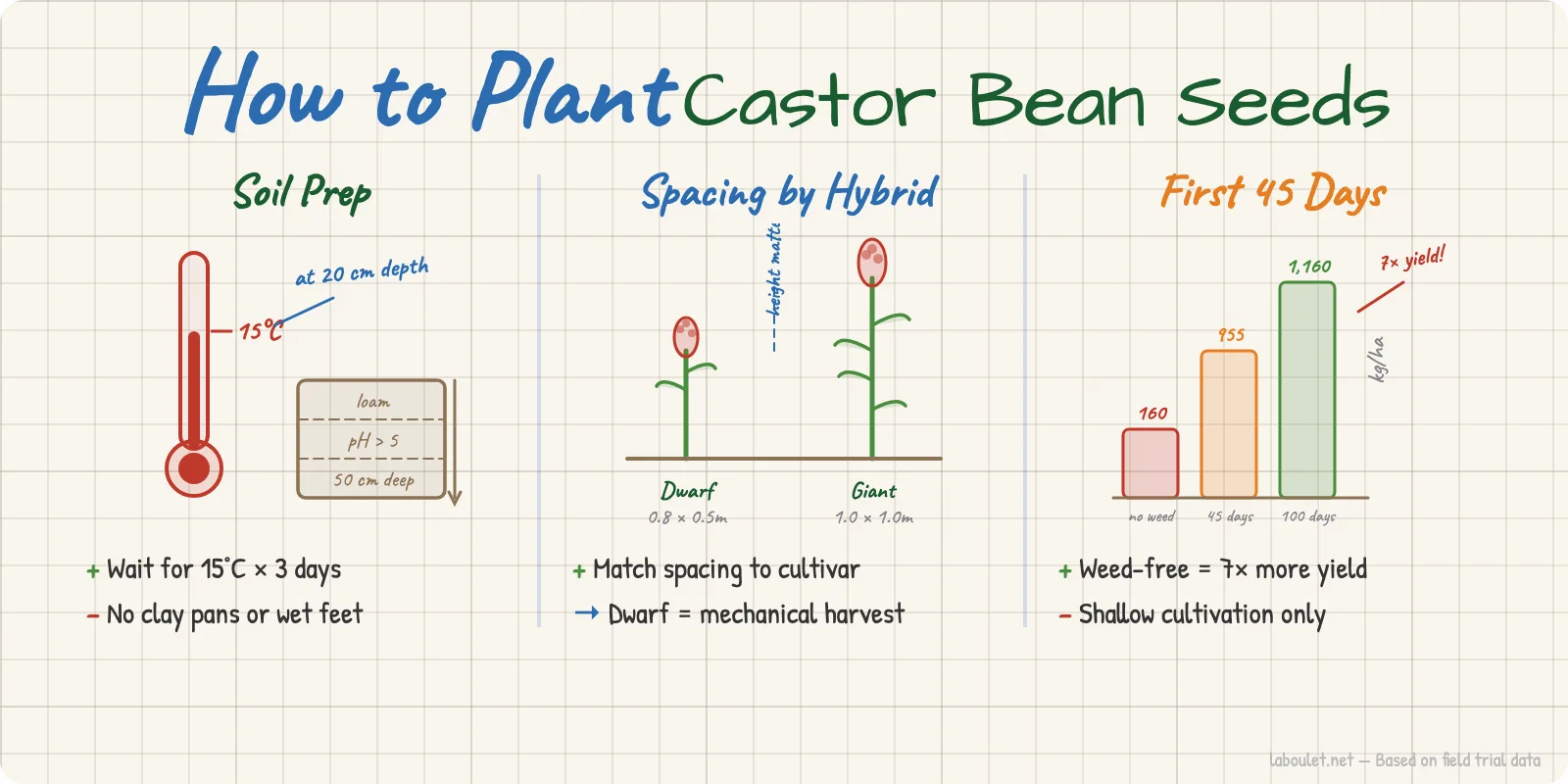
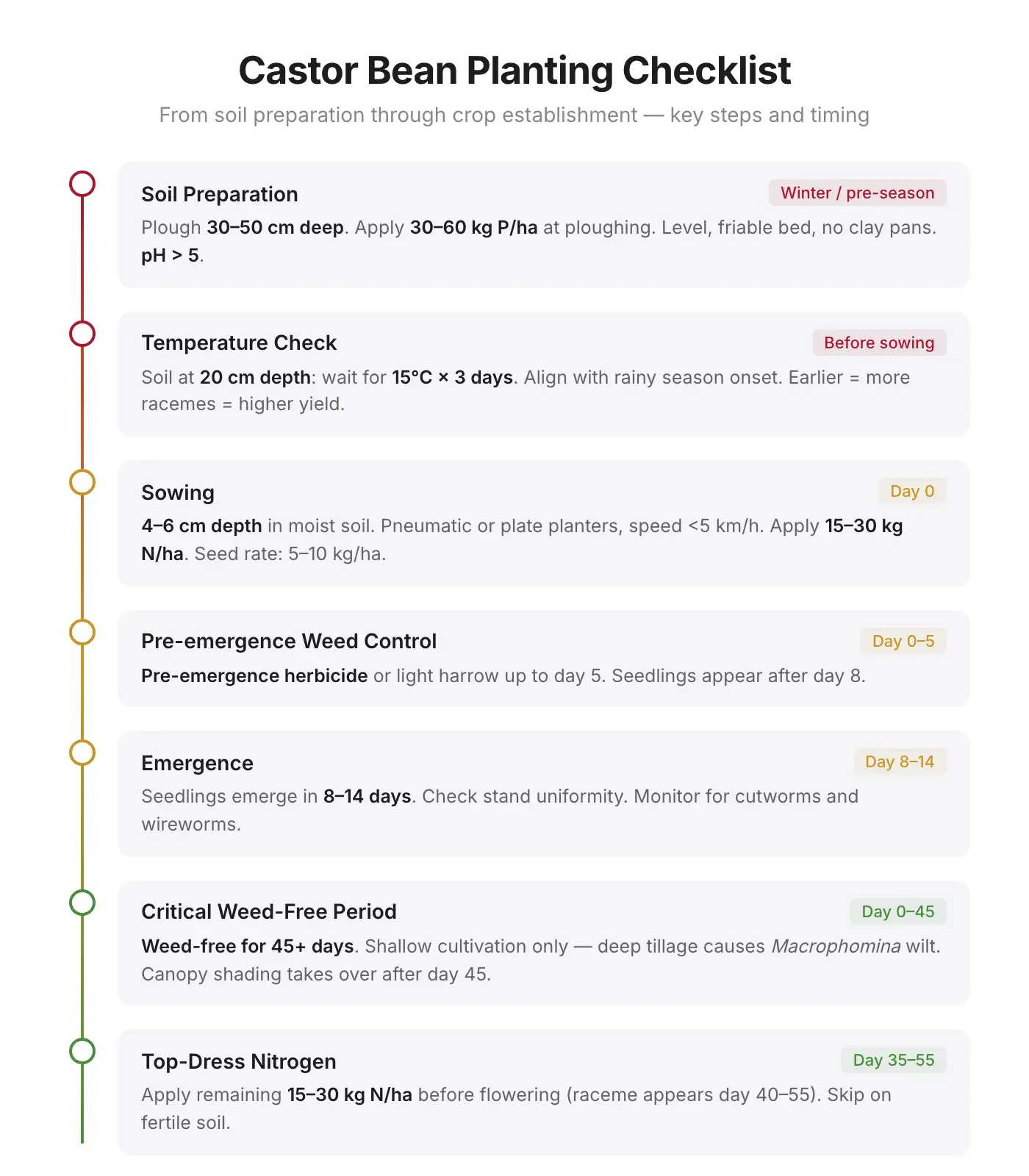
The highest yields are obtained on loam to sandy loam soils with a minimum depth of 50 cm. Castor has a well-developed tap root, so it does not tolerate clay pans or impermeable layers. Blow sand is not recommended either. Soils must be well drained — castor does not tolerate “wet feet.” The minimum pH is 5 (water); soils below this threshold must be limed.
One important caution: soils with high nitrogen tend to produce very tall plants without improving yield, which makes harvesting more difficult — especially with dwarf hybrids bred for mechanical harvest.
For soil preparation:
- Light soils with hard pans — subsoiling is recommended.
- Heavy soils — plough to a depth of 30 to 50 cm. In temperate climates, deep ploughing or subsoiling should be done in winter, applying phosphate at the same time.
- The seed bed should be level, friable, and retain adequate moisture. Prepare for flat planting or on beds for irrigated conditions.
When to Plant Castor Bean Seeds
Timing is critical and governed by one rule: plant as soon as soil temperature reaches 15°C at a depth of 20 cm for three consecutive days. Below this threshold, germination is slow, uneven, and seeds are exposed to soil pathogens for too long.
Under dryland conditions, plant as early as possible in the months when most rain is expected. Keep in mind that most modern hybrids start drying out at 3.5 months — this should coincide with a dry period for clean harvesting.
Field trial data confirms this clearly: in a semi-tropical planting date trial with three different hybrids, yields dropped sharply with each delayed planting. The earliest planting date consistently produced the highest yields across all cultivars — up to 4,628 kg/ha for the best treatment, compared to just 870 kg/ha for the latest planting.
The takeaway is simple: the longer the growing season, the higher the yield. Do not wait for “perfect” conditions if 15°C soil temperature has been reached.
Spacing: One Size Does Not Fit All
Spacing is one of the most consequential planting decisions in castor production. It depends on the hybrid type, climate, cultivation method, and tillage equipment. Getting it wrong affects not only yield but also plant height, branching, and harvestability.
Trial data on a dwarf hybrid (H.343) with 350 mm rainfall showed a clear optimum: 100 cm × 45 cm produced the highest yield at 1.547 t/ha — significantly better than both tighter (60 × 15 cm) and wider (200 × 100 cm) configurations. Adding nitrogen pushed the best treatment to 1.652 t/ha.
Dwarf Hybrids — LS Peter and LS Harold
Laboulet’s dwarf castor hybrids are designed for mechanized farming. Their compact architecture (1.20–1.50 m height) allows combine harvesting, and their synchronized inflorescences concentrate maturity.
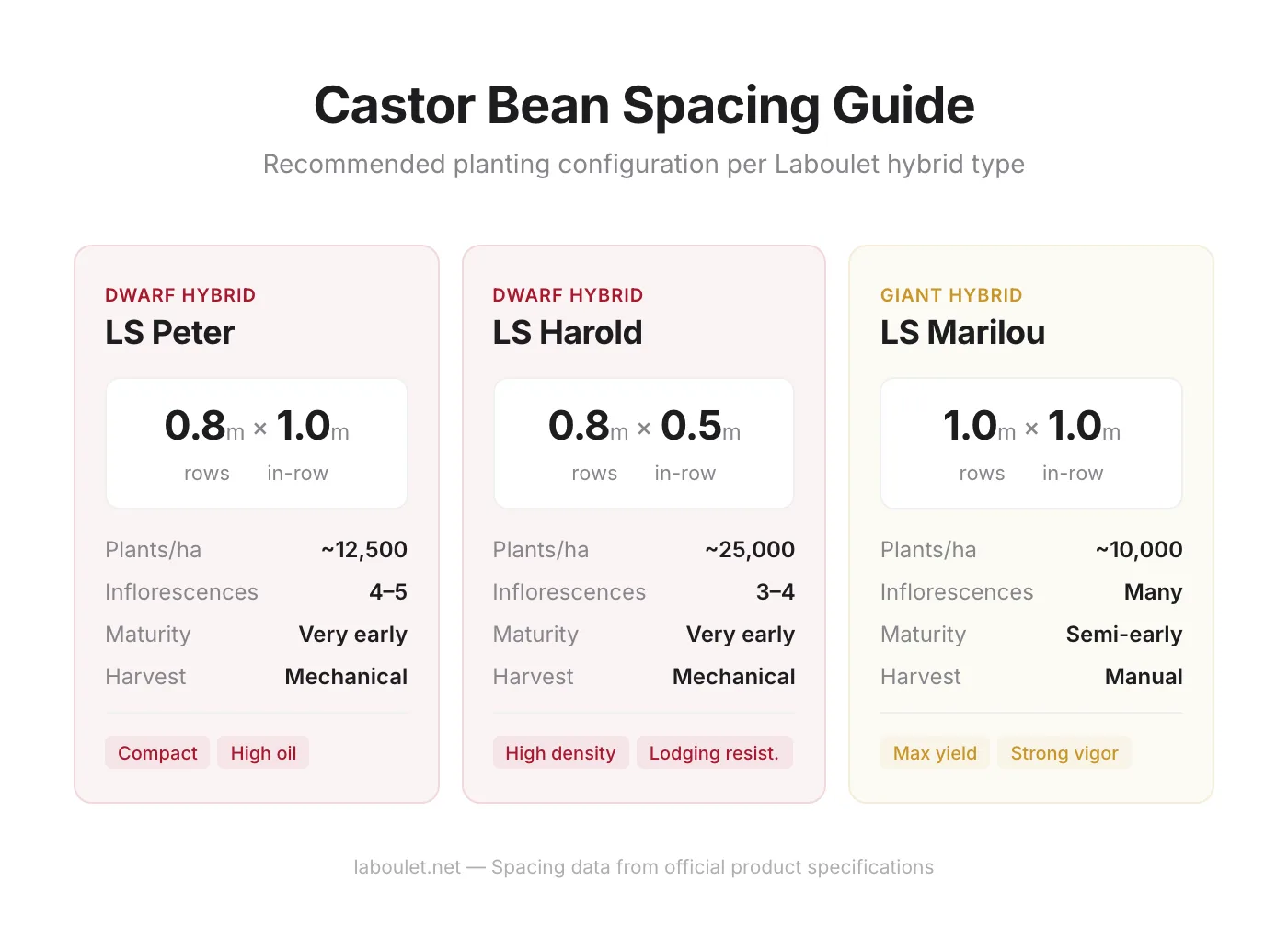
- LS Peter — Very early dwarf with 4–5 synchronized inflorescences. Recommended spacing: 0.8 m between rows × 1 m between plants. This gives approximately 12,500 plants per hectare.
- LS Harold — Very early dwarf with 3–4 inflorescences and excellent lodging resistance. Recommended spacing: 0.8 m between rows × 0.5 m between plants. This gives approximately 25,000 plants per hectare — a higher-density approach that maximizes yield per hectare.
The tighter in-row spacing of LS Harold (50 cm vs. 100 cm for LS Peter) is possible because of its more compact branching habit. Both hybrids are suitable for pneumatic or inclined plate planters.
Giant Hybrids — LS Marilou
LS Marilou is a giant castor hybrid with very tall plants and strong vigor. Recommended spacing: 1 m between rows × 1 m between plants (10,000 plants/ha). Manual harvesting is indicated for this type given its height. LS Marilou’s numerous inflorescences and high biomass make it the yield leader where labor for manual harvest is available.
Dryland Manual Cultivation
For dryland conditions using strong-growing perennial varieties with hand planting, the recommendation is wider: 2 m between rows, with 2 to 3 seeds every meter in the row. After germination (about two weeks), thin to one plant per hill. This corresponds to roughly 5,000 plants per hectare, requiring 4 to 6 kg of seed.
Planting Depth and Technique
Plant castor seeds into the moist soil layer at a depth of 4 to 6 cm. The exact depth depends on how fast the soil will dry out after planting — shallower in moist conditions, deeper if the surface dries quickly.
Castor seeds take 8 to 14 days to germinate depending on soil temperature and moisture. A few critical points on planting technique:
- Planter choice — Pneumatic planters give the most even spacing and use less seed. If unavailable, ordinary inclined plate planters work well. Use plates with cells at least 6 mm thick, 14 mm long, and 5 mm wide. Do not use plates with round holes — castor seeds break readily, causing poor germination.
- Planting speed — Do not exceed 5 km/h with inclined plate planters or horizontal plate planters.
- Press wheels — Use open press wheels to ensure good seed-to-soil contact.
- Seed quantity — For mechanized planting at 10,000 to 22,500 plants/ha, plan for 5 to 10 kg of seed per hectare.
If soils dry out quickly after planting, planters equipped with sweeps that remove dry surface soil — allowing the seed to be placed in undisturbed moist soil beneath — will significantly improve stand establishment.
Fertilization at Planting
Fertilizer requirements vary with location, but field trial data reveals a clear hierarchy of nutrient importance for castor:
- Phosphate — significant yield response. Apply 30 to 60 kg of P equivalent before or at planting. In temperate climates, phosphate can be incorporated during winter ploughing. Trial data shows yield increasing from 1.66 t/ha (no phosphate) to 2.30 t/ha (high phosphate) — a 39% gain.
- Nitrogen — modest response. Apply 30 to 60 kg N/ha, split in two: half at planting, half as top-dressing before flowering (35–55 days after seeding). Avoid excess nitrogen — it produces rank vegetative growth and taller plants without improving yield, making harvest harder.
- Potassium — no response in most trials. Unless soils are severely deficient, skip potash. There is even evidence that potassium chloride may depress yields.
If castor follows a heavily fertilized crop like lucerne (alfalfa), additional fertilizer may not be needed at all — castor’s strong tap root can extract nutrients unavailable to shallower-rooted plants.
Weed Control: The Critical First 45 Days
This is arguably the single most important management factor in castor production. Young castor plants are very poor competitors with weeds because the crop grows relatively slowly during its first six weeks. After about 45 days, the plant gains enough height and canopy to shade out weeds naturally.
The yield impact of early weed competition is staggering. In a dryland trial with Hybrid 343:
- No weeding — 160 kg/ha
- Weeded up to 20 days — 785 kg/ha
- Weeded up to 40 days — 955 kg/ha
- Weeded up to 60 days — 1,143 kg/ha
- Weeded up to 100 days — 1,160 kg/ha
The data is clear: keeping castor weed-free for at least 45 days is essential. After that point, the crop itself suppresses weeds and additional weeding provides diminishing returns. The oil content also improves from 47% (no weeding) to over 50% (full season weed control), because weed competition causes blasted, poorly filled seeds.
A practical weed control program includes:
- Pre-emergence herbicides incorporated before planting.
- Pre-emergence light harrowing up to 5 days after planting (seedlings do not appear before day 8).
- Post-emergence shallow cultivation — critical: because castor has wide-spreading shallow lateral roots, all cultivations must be shallow. Deep cultivation wounds roots and dramatically increases wilt disease from Macrophomina phaseolina.
The 0.8 m row spacing used by Laboulet’s dwarf hybrids (LS Peter and LS Harold) is wide enough for mechanical inter-row cultivation, making weed management practical at field scale.
Irrigation Basics
Castor responds well to sub-irrigation, furrow irrigation, and overhead irrigation. Where total growing-season rainfall falls below the 450–600 mm minimum, supplementary irrigation is needed.
Under irrigation, plan for approximately 600 mm of water over 4.5 months, distributed over 10 to 14-day cycles. A few key rules:
- Stop irrigating every row once plants reach the four-leaf stage — switch to alternate row irrigation to encourage deeper rooting.
- Apply the final irrigation three weeks before harvest.
- Never allow wilting during early stages and flowering. Plants that wilt during the early hours of the day will produce blasted or poorly filled seeds, especially on high-potential hybrids.
- With a 7-day irrigation cycle, inspect regularly for capsule mould — high atmospheric moisture promotes fungal development on racemes.
Common Planting Mistakes to Avoid
- Planting too deep. Anything beyond 6 cm delays emergence and exposes seeds to soil pathogens. Stick to 4–6 cm in moist soil.
- Ignoring the 15°C rule. Cold soil leads to uneven stands, poor germination, and higher disease pressure. Wait for three consecutive days at 15°C measured at 20 cm depth.
- Using the wrong planter plates. Round holes crack castor seeds. Use oblong cells (6 × 14 × 5 mm minimum). Planting speed above 5 km/h also damages seed.
- Neglecting weed control after planting. Yield can collapse from 1,160 to 160 kg/ha — a 7× difference — with no weeding. The first 45 days are non-negotiable.
- Over-fertilizing with nitrogen. More N does not mean more yield. It means taller, harder-to-harvest plants and sometimes lower yields, especially if applied during flowering.
- Deep cultivation after emergence. Castor’s shallow lateral roots are easily wounded. Deep tillage introduces Macrophomina wilt through damaged root tissue. Keep all post-emergence cultivations shallow.
- Using a single spacing for all hybrids. A dwarf hybrid like LS Harold performs best at 0.8 × 0.5 m. A giant like LS Marilou needs 1 × 1 m. Follow the breeder’s recommendation — it is based on the plant’s architecture and branching habit. See hybrid vs. traditional castor varieties for more on matching genetics to your farming system.
Conclusion
Planting castor beans is not complicated, but it is unforgiving of carelessness. The fundamentals are clear: wait for 15°C soil temperature, prepare a level and friable seed bed on well-drained soil, plant at 4–6 cm depth with spacing matched to your hybrid type, apply phosphate at planting, and keep the field weed-free for at least 45 days. Do these things right, and yields of 1,500 to over 4,000 kg/ha are achievable depending on conditions and cultivar.
The choice of hybrid — dwarf, semi-dwarf, or giant — determines your spacing, your harvest method, and your planting equipment. Laboulet Semences offers castor hybrids across all three types, bred for high oil content, strong adaptability, and reliable performance under diverse growing conditions. Start with the right genetics, follow the planting fundamentals, and castor will reward you with a profitable and soil-improving crop.
Our varieties: castor bean
| Variety | Type | Earliness |
|---|---|---|
| LS Harold | Dwarf castor bean | Very early flowering and maturity |
| LS Peter | Dwarf castor bean | Very early |
| LS Suzi | Semi-dwarf castor bean | Early |
| LS Marilou | Giant castor bean | Semi-early |
Frequently asked questions
How deep should castor bean seeds be planted?
Plant castor bean seeds 3 to 5 cm (1.2-2 inches) deep in well-drained, warm soil. Deeper planting (up to 7 cm) is acceptable in light, sandy soils to maintain moisture contact. Shallower than 2 cm risks poor anchorage and bird predation.
When is the best time to plant castor beans?
Sow castor bean seeds when soil temperature at 5 cm depth has stabilized above 15°C (59°F) and frost risk has passed. In temperate zones this is typically late April to mid-May. Castor is a long-cycle crop (130-170 days) so early sowing maximizes the harvest window.
How long does a castor bean plant take to grow?
Castor beans require 130 to 170 days from sowing to full physiological maturity, depending on the variety and climate. Dwarf hybrids designed for mechanical harvest can complete the cycle in 130-150 days, while traditional tall types may need 160+ days.
How do you start castor bean seeds for the best germination?
Soak seeds in lukewarm water for 12-24 hours before sowing to soften the hard seed coat. Sow in moist, warm soil (15-25°C). Germination typically occurs in 7-14 days. Avoid waterlogged conditions, which cause seed rot.
What spacing should be used for castor bean planting?
For dwarf hybrid castor, a spacing of 70-80 cm between rows and 40-50 cm within row works well for mechanical harvest. Traditional tall varieties need wider spacing of 100-150 cm × 60-80 cm. Adjust based on soil fertility and water availability.
Can I grow castor beans from kernels collected from harvested seeds?
You can germinate seeds collected from castor plants, but for hybrid varieties the second-generation seed will not maintain hybrid vigor and oil-content traits. For commercial production, always source certified F1 hybrid seed from a breeder.
How to Plant Castor Bean Seeds
- Prepare the seedbed
Plough or strip-till to 25-30 cm depth in autumn. Castor needs deep, loose soil to develop its taproot. Eliminate compaction and ensure good drainage — castor is intolerant to waterlogging.
- Wait for soil temperature to reach 15°C
Measure soil temperature at 5 cm depth. Sow only when soil has stabilized above 15°C (59°F) and frost risk has passed. In temperate Europe this is typically late April to mid-May.
- Pre-soak the seeds for 12-24 hours
Soak certified F1 hybrid seed in lukewarm water for 12-24 hours before sowing to soften the hard seed coat and accelerate germination. Drain well before drilling.
- Drill at 3-5 cm depth
Sow seeds at 3 to 5 cm depth in moist soil. In light, sandy soils go up to 7 cm to maintain moisture contact. Use a precision row planter for uniform depth and spacing.
- Set the right spacing
For dwarf hybrid castor: 70-80 cm between rows × 40-50 cm within row. For tall traditional varieties: 100-150 cm × 60-80 cm. Adjust to match your harvester row width if mechanical harvest.
- Monitor emergence
Castor germinates in 7-14 days at 15-25°C soil temperature. Check field 5 days after sowing for emergence problems (crusting, slugs, birds). Plan a replant decision before day 12 if stand is below target.
- First weed control at 2-4 leaves
Castor is slow to canopy and weak against early weed competition. Apply a pre-emergence herbicide before sowing or do a mechanical hoeing at 2-4 leaves. Keep weed pressure low for the first 6 weeks — after canopy closure castor outcompetes most weeds.