
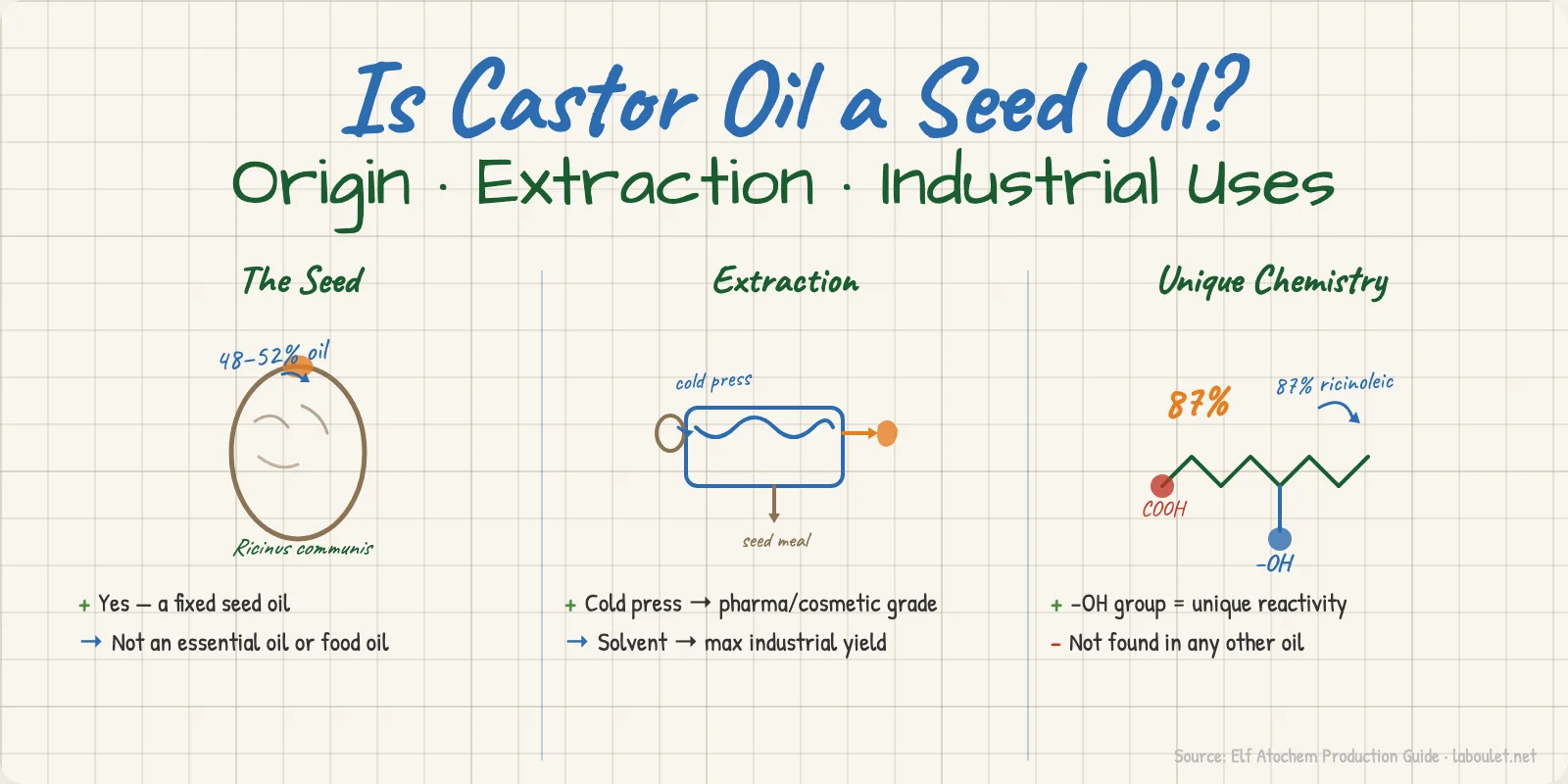
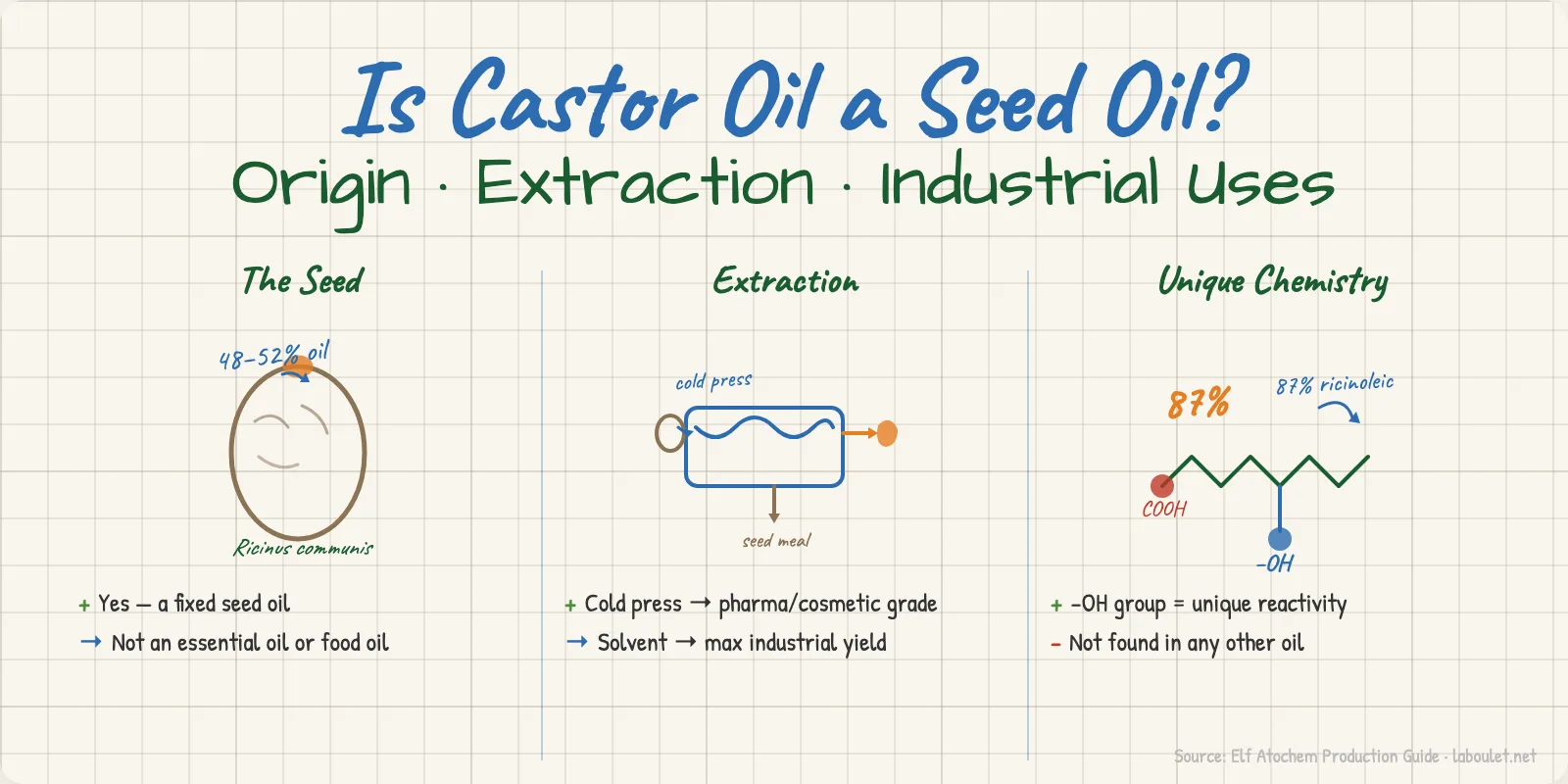
Is Castor Oil a Seed Oil? Origin, Extraction & Uses
Is Castor Oil a Seed Oil? Origin, Extraction and Industrial Uses The short answer is yes: castor oil is a seed oil. It is extracted from the seeds of Ricinus communis L., the castor bean plant — just as sunflower oil comes from sunflower seeds or soybean oil from soybean seeds. But that similarity ends […]
Is Castor Oil a Seed Oil? Origin, Extraction and Industrial Uses
The short answer is yes: castor oil is a seed oil. It is extracted from the seeds of Ricinus communis L., the castor bean plant — just as sunflower oil comes from sunflower seeds or soybean oil from soybean seeds. But that similarity ends quickly. While most seed oils are pressed primarily for food use, castor oil is almost exclusively industrial and pharmaceutical. Its chemical composition is so unusual — and so useful — that it occupies a niche few other natural oils can fill.
This article explains what makes castor oil a seed oil, how the seeds are processed to extract it, what gives it its extraordinary properties, and why it ends up in everything from offshore drilling equipment to lipstick.
What Is a Seed Oil?
A seed oil is any oil extracted from the seed (or seed kernel) of a plant — as opposed to oils extracted from fruit pulp (like olive oil or palm oil), roots, or other plant parts. The extraction involves either mechanical pressing or solvent extraction of the oil-bearing tissues inside the seed.
Common seed oils include sunflower oil (from sunflower seeds), rapeseed/canola oil (from rapeseed), soybean oil, flaxseed/linseed oil, and cottonseed oil. Castor oil belongs in exactly this category: it is obtained from the seed kernels of the castor plant, using the same industrial processes as other vegetable seed oils.
The confusion sometimes arises because castor oil is not consumed as food — unlike nearly every other major seed oil. Some people also confuse “seed oil” with “essential oil” (which is a concentrated aromatic extract, typically steam-distilled from flowers, leaves, or bark, and has nothing to do with fatty acids). Castor oil is a fixed oil, meaning it is a triglyceride-based fat that does not evaporate — the same class of substance as cooking oils. It simply happens to be non-edible in the conventional sense.
Where Does Castor Oil Come From?
The Plant: Ricinus communis
Castor oil comes from the seeds of Ricinus communis L., a member of the Euphorbiaceae (spurge) family. The plant grows as a perennial in tropical climates — potentially reaching five meters — but is cultivated as an annual in temperate agriculture. India accounts for approximately 85 to 90 percent of global production, with Brazil and China as secondary producers.
In Europe, castor cultivation was historically limited but is gaining renewed interest, partly driven by the demand for bio-based industrial materials (including nylon 11 / Rilsan) and the search for profitable rotation crops for arable farms. Laboulet Semences, based in France, has been at the forefront of developing castor hybrids adapted to European growing conditions, specifically the dwarf types suited to mechanical harvesting.
The Seed Structure
Castor seeds develop inside spiny capsules (three seeds per capsule) on flower spikes called racemes. Each seed consists of:
- Seed coat (testa) — the hard, mottled outer shell. This is where most of the ricin (the toxic protein) is concentrated. It is removed (dehulled) before extraction.
- Endosperm / kernel — the oil-bearing interior. This contains the triglycerides that make up castor oil, plus protein, ricin, and ricinine (another toxic compound).
- Caruncle — a small appendage at the seed tip, involved in germination.
Seeds vary considerably in size, shape, and color — from nearly white to black, grey, brownish-yellow, and various shades of brown or red. Size and color are variety-specific and do not directly affect oil content.
Oil Content: How Much Oil Is in a Castor Seed?
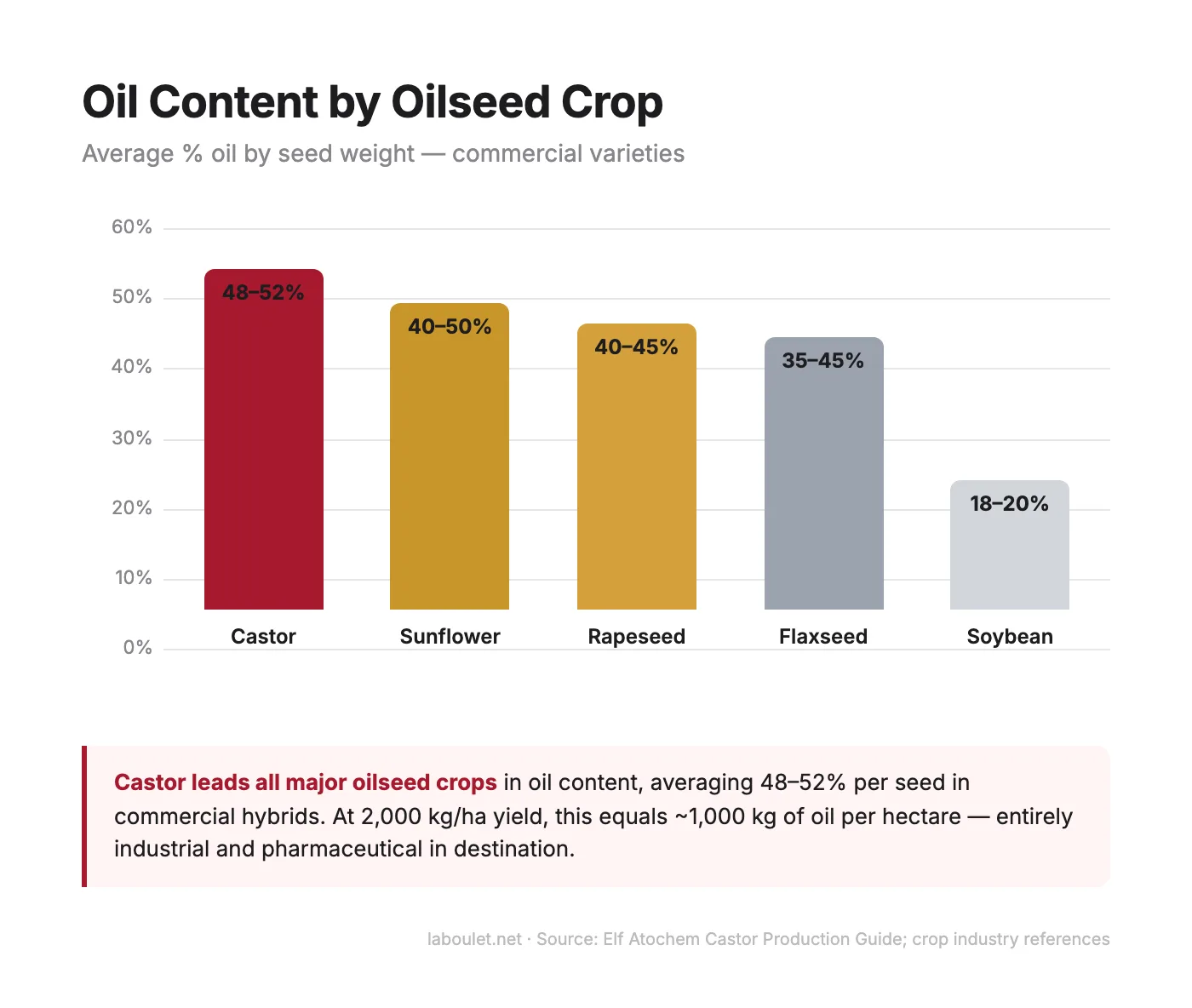
This is where castor stands out among oilseed crops. Castor seeds contain from 35 to 57 percent oil by weight, depending on variety and growing conditions. Current commercial hybrids and inbred varieties average 48 to 52 percent oil — consistently at the high end of the range achieved by modern breeding.
For comparison:
- Sunflower seeds: 40–50% oil (high-oleic varieties at the top)
- Rapeseed/canola: 40–45% oil
- Soybean: 18–20% oil (soybean is primarily a protein crop)
- Linseed/flaxseed: 35–45% oil
- Castor: 48–52% oil (commercial hybrids)
High oil content is a primary breeding objective for castor genetics at Laboulet Semences, alongside yield per hectare and adaptation to mechanized harvesting. At 50% oil content and a typical yield of 2,000 kg/ha, one hectare of castor delivers the equivalent of 1,000 kg of oil — a substantial industrial raw material quantity per unit of land.
How Is Castor Oil Extracted?
Industrial castor oil extraction follows the same general sequence as other vegetable oil extraction, with a few steps specific to castor’s characteristics.
Step 1: Cleaning and Dehulling
Incoming seeds are cleaned to remove dirt, stones, and plant debris. The seed capsules are then dehulled (the outer hull removed), and in many cases the hard seed coat is also partially removed. Dehulling reduces the hull fraction — which contains little oil but a lot of ricin and fiber — before extraction, improving oil quality and reducing equipment wear.
Step 2: Conditioning
The dehulled kernels are heated and conditioned to reduce moisture content and make the cell walls more permeable to oil release. Proper conditioning temperature is critical: too hot and ricinoleic acid can begin to degrade; too cold and oil extraction efficiency drops.
Step 3a: Cold Pressing (Expeller Pressing)
In the first mechanical press, the conditioned kernels are fed through a screw press (expeller) that applies high mechanical pressure, forcing oil out through small gaps while the pressed cake exits at the other end. This “first press” or “cold press” oil is light yellow, relatively clean, and retains its natural properties. It is the basis for:
- Pharmaceutical-grade castor oil (USP grade)
- Cosmetic-grade castor oil
- High-quality industrial-grade oil
A single cold press typically recovers 35 to 40 percent of the seed weight as oil, leaving a pressed cake with 8 to 12 percent residual oil.
Step 3b: Solvent Extraction
To recover the residual oil from the pressed cake, large-scale processors use hexane solvent extraction — the same technology used for soybean and canola processing. The solvent dissolves the remaining oil, which is then separated from the solvent by evaporation and steam stripping. This recovers virtually all remaining oil and produces a very lean “exhausted meal.”
Solvent-extracted oil requires more refining before use (degumming, deacidification, bleaching) but allows maximum recovery of oil from the seed. Most of the world’s industrial castor oil supply is produced by combined mechanical pressing and solvent extraction.
Step 4: Refining
Crude castor oil undergoes several refining steps depending on its intended use:
- Degumming — removes phospholipids and mucilages
- Neutralization / deacidification — removes free fatty acids
- Bleaching — removes pigments with activated clay
- Deodorization — for pharmaceutical and cosmetic grades, removes volatile odor compounds
The result is a pale to colorless oil with very low odor, meeting the tight specifications required by pharmaceutical and polymer-grade buyers.
What Makes Castor Oil Chemically Unique?
The distinctive property of castor oil is its fatty acid composition. Where sunflower oil is predominantly oleic and linoleic acid (both standard C18 fatty acids), castor oil contains:
- Ricinoleic acid: ~87–90% of total fatty acids
- Oleic acid: ~3–4%
- Linoleic acid: ~4–5%
- Stearic acid: ~1–2%
- Minor fatty acids: remainder
Ricinoleic acid (12-hydroxy-9-octadecenoic acid) is a hydroxy fatty acid — it has an –OH group at carbon-12 of the chain, in addition to the standard carboxyl group. This single structural feature creates a cascade of unusual properties:
- Very high viscosity — the hydroxyl groups hydrogen-bond between molecules, creating a thick, cohesive oil (viscosity 3–4× higher than most vegetable oils at room temperature)
- Viscosity stability — relatively stable viscosity from -10°C to 80°C, unlike most mineral or vegetable oils
- High boiling point — around 313°C, making it suitable for high-temperature industrial use
- Reactivity — the hydroxyl group allows chemical reactions (dehydration, hydrogenation, polymerization, esterification) that produce dozens of derivative materials
- Insolubility in petroleum-based oils — an important property in certain applications (e.g., separating from gasoline in two-stroke engine fuel mixtures)
No other commercially available natural oil offers this combination of properties. Ricinoleic acid simply does not occur in significant amounts anywhere else in the plant kingdom — making castor oil genuinely irreplaceable for certain industrial applications.
Industrial Uses of Castor Oil
Nylon 11 / Rilsan: The Signature Application
The highest-value industrial use of castor oil is the production of polyamide 11 (nylon 11), commercialized under the Rilsan brand by Elf Atochem (now Arkema). This engineering plastic is derived entirely from castor oil through a multi-step chemical transformation: the ricinoleic acid is first cracked by pyrolysis into 11-undecylenic acid and heptanal, then the undecylenic acid is converted to 11-aminoundecanoic acid, and finally polymerized into the polyamide chain.
The resulting polymer is used in:
- Offshore and subsea applications — flexible risers and umbilicals in deepwater oil and gas installations, where nylon 11’s chemical resistance, flexibility, and hydrolytic stability are essential
- Automotive fuel systems — fuel lines, vapor recovery hoses, brake tubing
- Electrical wire insulation — especially in demanding environments (aviation, defense)
- Powder coatings — for metal surface protection
- Medical devices — catheters and surgical instrument coatings
Elf Atochem’s investment in castor crop development — through COSTASEM, their agricultural research branch — was a direct response to needing a reliable, high-quality supply of castor oil with controlled oil content. This is the historical context for the development of the modern commercial hybrids that Laboulet’s range descends from: industry drove agronomy.
Lubricants
Castor oil’s viscosity index and film strength make it an outstanding lubricant for demanding applications. It is used in aviation piston engine oils, high-performance two-stroke racing engine oils (Castrol R being the classic formulation), hydraulic fluids where biodegradability matters, and industrial greases. It remains liquid at temperatures where mineral oils would gel, and maintains its lubricating film where others fail.
Cosmetics and Personal Care
Cosmetics represent the most consumer-visible use of castor oil. Its high viscosity, film-forming capacity, and moisturizing properties make it the primary carrier oil in lipstick — most commercial lipstick formulations contain 30 to 40 percent castor oil as the base. It is also found in hair oils, skin moisturizers, mascaras, nail treatments, and soap bars.
Pharmaceuticals
Castor oil holds USP pharmaceutical grade status in multiple countries. It is used as a stimulant laxative (activating intestinal EP3 receptors via ricinoleic acid), as a carrier/solubilizer for poorly water-soluble drugs (polyethoxylated castor oil, Cremophor EL), and as a topical emollient in wound care and dermatology products.
Castor Oil vs. Other Seed Oils: Key Differences
Understanding how castor oil differs from other seed oils helps clarify why it occupies its unique industrial position — and why it cannot easily be replaced by sunflower, rapeseed, or soybean oil, even when those commodities are cheaper.
- Edibility — most seed oils are primarily consumed as food; castor oil is not (its ricinoleic acid content makes it a potent laxative in food quantities, and industrial grades may contain trace impurities). Pharmaceutical-grade castor oil is the exception, used in specific medical formulations.
- Viscosity — castor oil is approximately 3–4 times more viscous than sunflower or rapeseed oil at room temperature, due to hydrogen bonding between hydroxyl groups.
- Reactivity — the hydroxyl group in ricinoleic acid enables chemical derivatives (dehydration, hydrogenation, sulfation, ethoxylation) that are impossible or impractical with standard seed oils. This drives the whole downstream industrial chemistry.
- Market price — castor oil trades at a significant premium over food-grade seed oils precisely because of this unique functionality. Industrial buyers pay for irreplaceability.
- Safety — all other major seed oils are free of toxicity concerns in their raw form. Castor seeds contain ricin and require careful processing; however, properly extracted and refined castor oil contains no ricin.
The Castor Value Chain: From Field to Factory
Understanding castor oil as a seed oil means understanding the value chain that connects a farmer growing LS Harold on an arable farm to the automotive engineer specifying a fuel line made from Rilsan:
- Seed selection — high oil content, adapted to local climate, suited to mechanical harvest. This is where Laboulet’s breeding work creates value.
- Crop production — optimized agronomy (spacing, fertilization, weed control) to maximize seed yield and oil content per hectare.
- Harvest and dehulling — non-shattering dwarf hybrids allow combine harvest; capsules are dehulled to separate seeds from hull material.
- Oil extraction — cold pressing + solvent extraction at a processing plant to maximize oil yield and produce clean, low-acid crude oil.
- Refining and grading — crude oil is refined to pharmaceutical, cosmetic, or industrial grade depending on end market.
- Chemical transformation — for the highest-value applications (nylon 11, lubricant additives, surfactants), the oil undergoes further chemistry at industrial facilities.
- End product — the finished material (polymer, lubricant, cosmetic) reaches its end application, sometimes thousands of kilometers from the original field.
This chain illustrates why castor oil has a structural, long-term demand base. The downstream industries — particularly those depending on nylon 11 for offshore oil infrastructure and automotive systems — cannot simply switch to a different raw material. The demand for castor oil, and therefore for castor seeds, is anchored in industrial supply chains that take years to redesign.
Conclusion
Castor oil is unambiguously a seed oil: it is obtained by mechanical or solvent extraction from the seeds of Ricinus communis, using processes identical in principle to those used for sunflower, rapeseed, or soybean oil. What distinguishes it from all other seed oils is its unique fatty acid — ricinoleic acid — which gives it a viscosity, stability, and chemical reactivity found nowhere else in the plant kingdom.
For farmers, this translates into a crop with a steady, industrially anchored market, premium pricing driven by unique functionality, and no direct competition from food-commodity seed oils. Modern hybrids with 48–52% oil content at 2,000 kg/ha yields deliver a compelling economics per hectare — especially as a rotation partner for cereals.
If you’re evaluating castor for your rotation, start with the genetics: see Laboulet’s castor bean hybrid range for dwarf types suited to mechanical harvesting and the highest oil content available in commercial varieties.
Our varieties: castor bean
| Variety | Type | Earliness |
|---|---|---|
| LS Harold | Dwarf castor bean | Very early flowering and maturity |
| LS Peter | Dwarf castor bean | Very early |
| LS Suzi | Semi-dwarf castor bean | Early |
| LS Marilou | Giant castor bean | Semi-early |
Frequently asked questions
Is castor oil a seed oil?
Yes, castor oil is a seed oil. It is extracted from the seeds (commonly called "castor beans") of Ricinus communis, a tropical and subtropical plant. By the technical definition — a vegetable oil obtained from the kernel of a seed — castor oil qualifies as a seed oil.
Where does castor oil come from?
Castor oil comes from the seeds of the castor plant (Ricinus communis), originally native to East Africa but now cultivated commercially in India (the world leader), Brazil, China, Mozambique, and other tropical regions. The seeds are pressed or solvent-extracted to release the oil.
How is castor oil extracted from seeds?
Two main methods: (1) cold pressing the kernels through a screw press, yielding food-grade and pharmaceutical-grade oil, and (2) solvent extraction with hexane on the press cake to recover residual oil for industrial use. The whole seed must first be dehulled and the toxic ricin protein deactivated through heat treatment of the meal byproduct.
Is castor oil and castor seed oil the same thing?
Yes, "castor oil" and "castor seed oil" refer to the same product — the triglyceride oil extracted from Ricinus communis seeds. The longer "castor seed oil" appears more often in industrial and INCI cosmetic naming, while "castor oil" is the consumer name.
What is the chemical composition of castor seed oil?
Castor oil is uniquely rich in ricinoleic acid (85-90% of fatty acids), with smaller amounts of oleic, linoleic, palmitic, and stearic acids. The high ricinoleic content gives it distinctive properties — high viscosity, water solubility partial, and the chemistry that makes it valuable for nylon-11, lubricants, and pharmaceuticals.
Is castor oil considered a vegetable oil?
Yes, castor oil is a vegetable oil since it is extracted from a plant source (Ricinus communis seeds). However, unlike most edible vegetable oils, castor oil is not used for cooking due to its laxative effect. It is mainly used industrially and in cosmetics.