
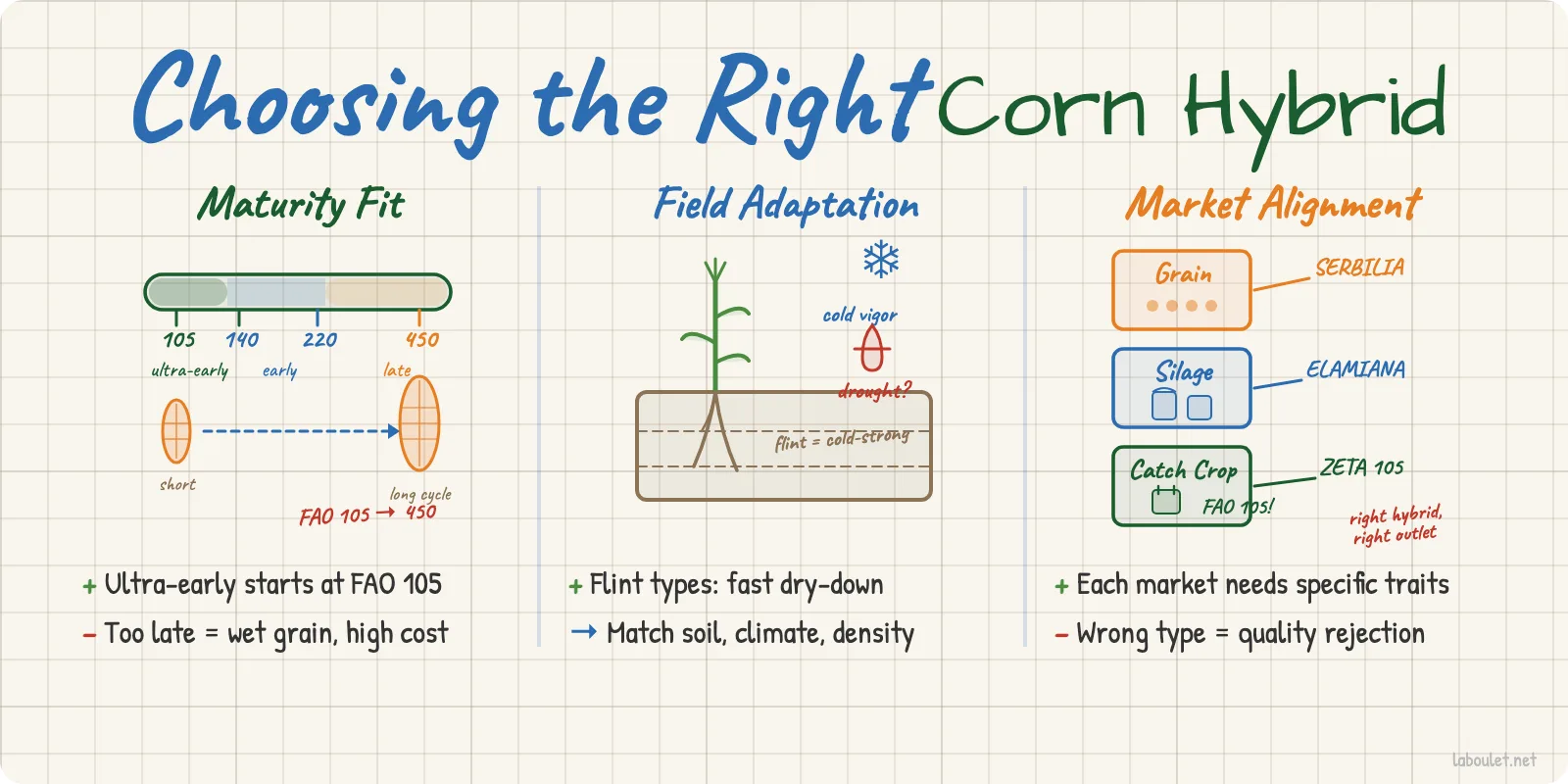
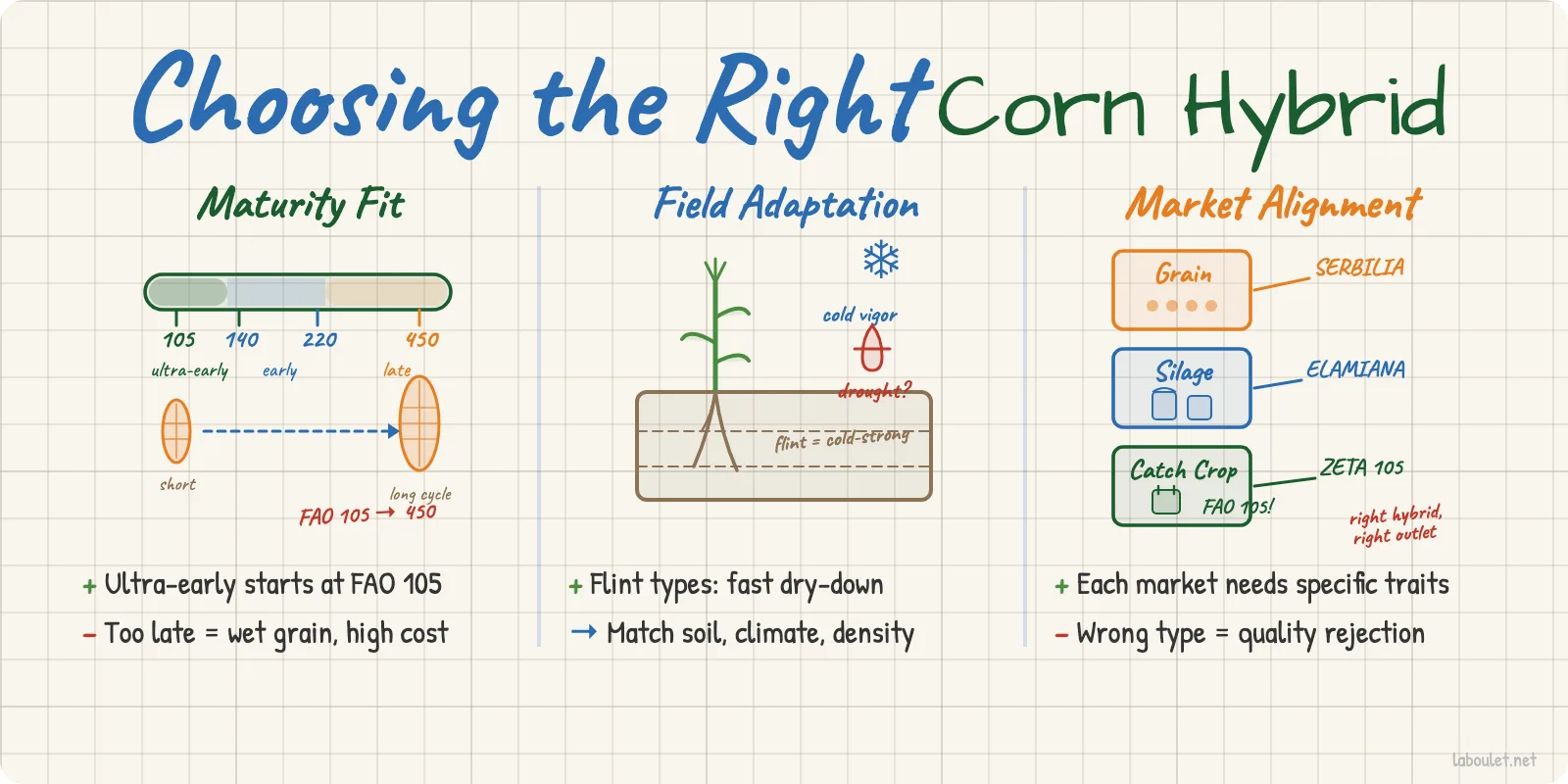
How to Choose the Right Corn Hybrid for Your Farm
Every season starts with the same question: which hybrid goes into the planter? The answer determines your yield ceiling, your harvest date, your drying costs, and ultimately your margin. Yet too many growers default to habit — replanting last year’s pick or copying a neighbor — without asking whether that hybrid actually fits their field, […]
Every season starts with the same question: which hybrid goes into the planter? The answer determines your yield ceiling, your harvest date, your drying costs, and ultimately your margin. Yet too many growers default to habit — replanting last year’s pick or copying a neighbor — without asking whether that hybrid actually fits their field, their climate, and their market.
This guide breaks down the decision into practical steps. We will cover maturity ratings from FAO 105 all the way to FAO 450, explain why soil and climate should narrow your shortlist before yield data ever enters the picture, and show how market requirements — grain, silage, food — influence the right genetic choice. The examples draw on the Laboulet Semences corn range, a catalog that spans the full maturity spectrum with varieties bred and tested across European conditions since 1996.
Maturity First: The FAO Index Explained
The FAO maturity index is the universal starting point. It reflects the cumulative heat units a hybrid needs from emergence to physiological maturity. A lower number means a faster cycle. In Europe, the scale runs from roughly FAO 100 to FAO 600, though most commercially relevant hybrids sit between FAO 100 and FAO 500.
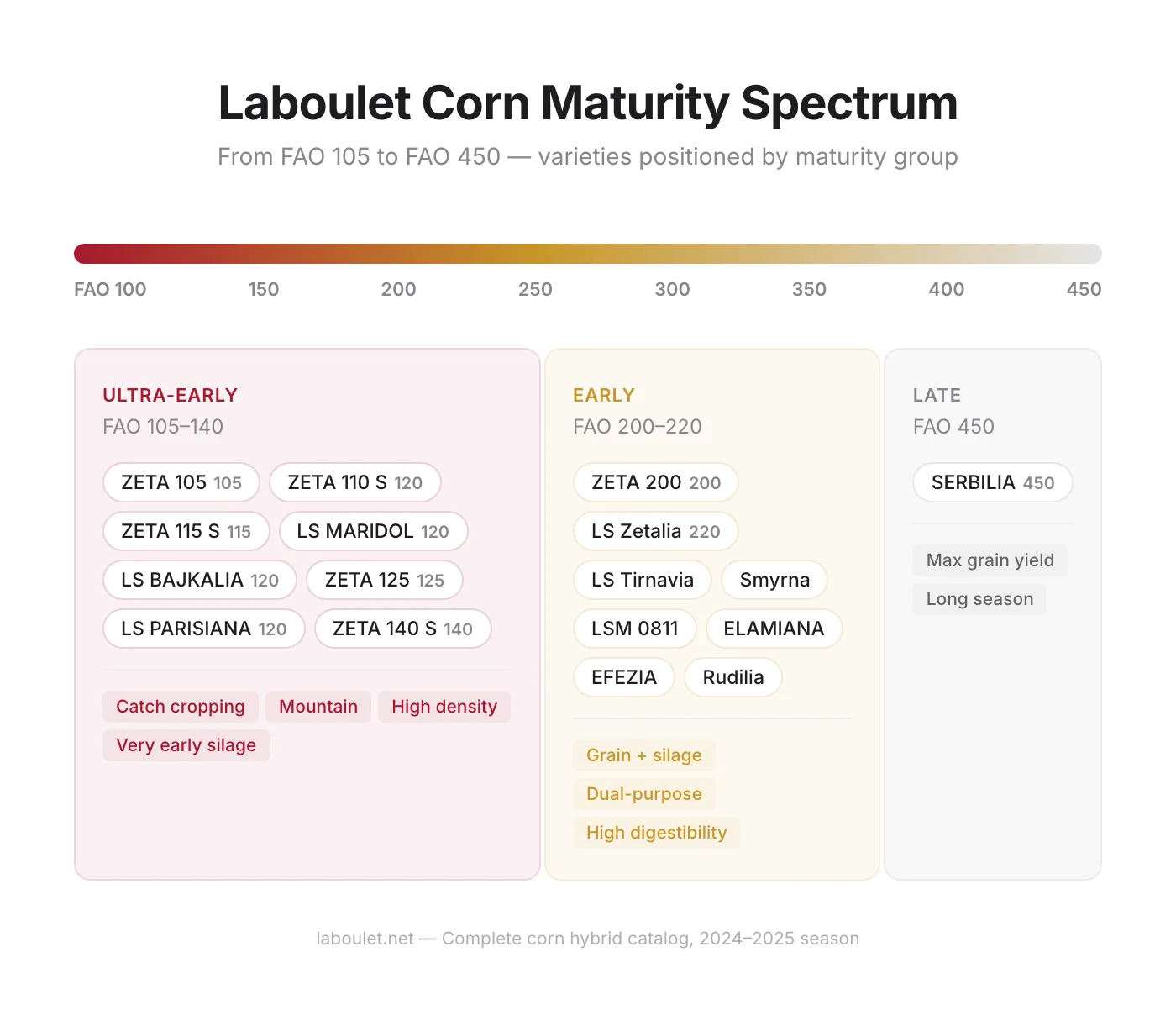
What many growers do not realize is that ultra-early genetics now start well below FAO 150. Breeders like Laboulet have developed hybrids at FAO 105, 110, 115, 120, 125, and 140 — a level of granularity in the ultra-early segment that did not exist a decade ago. This matters because the difference between FAO 105 and FAO 140 can represent two to three weeks of growing season, which is decisive for catch cropping, mountain regions, or high-latitude farms.
Ultra-Early Hybrids (FAO 105–140)
This is where Laboulet’s expertise stands out. Their ultra-early range includes hybrids like ZETA 105 (FAO 105) — one of the earliest commercially available corn hybrids in Europe — along with ZETA 110 S, ZETA 115 S, ZETA 125, ZETA 140 S, LS MARIDOL, LS BAJKALIA, and LS PARISIANA, all sitting between FAO 105 and FAO 140.
These hybrids are three-way or double-cross flint types, bred for ultra-short cycles and very fast dry-down. Their primary use cases include:
- Catch cropping and double cropping — Harvest early enough to establish a winter cover crop or a second cash crop. A hybrid at FAO 105 can be harvested weeks before a standard early variety, giving the following crop a critical head start.
- Mountain regions and high latitudes — Where growing seasons are compressed and frost risk comes early. LS PARISIANA, for example, is explicitly bred for intercropping and mountain conditions.
- High-density planting — Most Laboulet ultra-early hybrids are adapted to 110,000–125,000 seeds per hectare, making them efficient in intensive silage systems where plant population drives total dry matter yield.
- Very early silage — ZETA 110 S enables very early silage harvests, securing a feed stock window that later hybrids simply cannot reach.
The trade-off with ultra-early genetics is absolute yield potential. A shorter cycle means less time to accumulate biomass. But the point is not to compete on raw tonnage with a FAO 400 — it is to deliver reliable, harvestable yield in conditions where later hybrids would fail to mature or would be harvested at unacceptable moisture levels.
Early Hybrids (FAO 200–220)
Moving up the maturity scale, the early hybrid segment (FAO 200–220) is the workhorse class for much of northern and central Europe. Laboulet’s catalog here includes LS Zetalia (FAO 220), ZETA 200, LS Tirnavia, Smyrna, LSM 0811 (Algor), Rudilia, ELAMIANA, and EFEZIA.
These hybrids offer a different balance: more yield potential, longer grain fill, but still manageable harvest dates for continental and oceanic climates. Key traits to evaluate in this group:
- Yield stability across years — LS Zetalia, registered in 2023, is described as delivering “strong and consistent yield” with solid agronomic balance. Consistency across variable seasons matters more than a single-year peak.
- Dual-purpose flexibility — Several varieties like LSM 0811 (Algor) perform well for both silage and grain. If your farm straddles both markets, dual-purpose genetics simplify logistics.
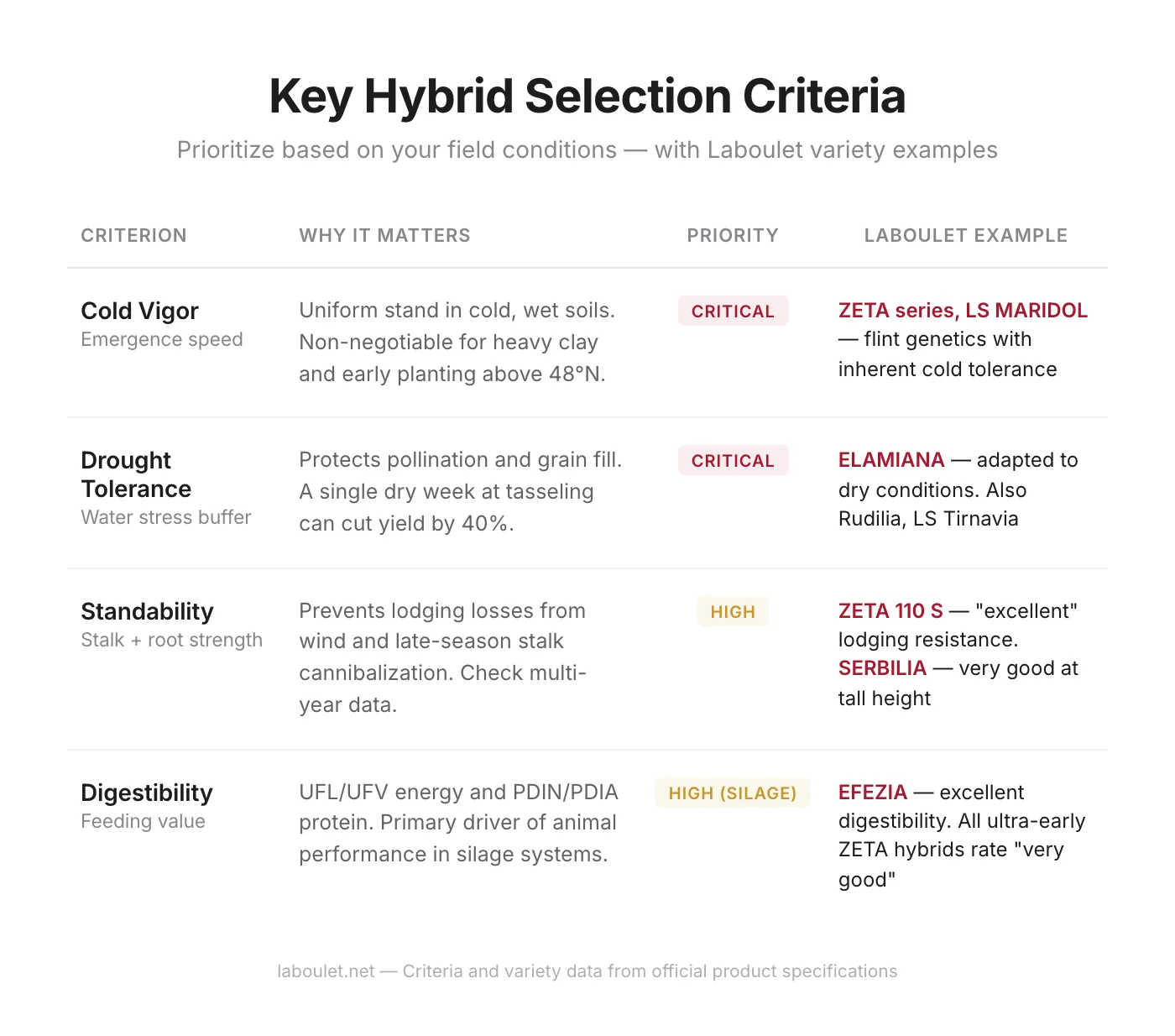
- Digestibility and feeding value — For silage growers, ELAMIANA stands out with high protein content, excellent digestibility, and adaptation to drier conditions. EFEZIA offers very good feeding value with a rustic, tolerant profile.
Late Hybrids (FAO 450)
At the other end of the spectrum, SERBILIA (FAO 450) is Laboulet’s late dent hybrid, designed for regions with long, warm growing seasons — southern France, the Po valley, Romania, Spain. It is a single hybrid registered since 2014, delivering strong grain yield with excellent standability and disease tolerance.
SERBILIA’s staygreen characteristic is notable: the plant maintains green leaf area longer, which supports continued grain fill and better stalk quality through harvest. For growers with the heat units to support a FAO 450 — roughly 1,900 cumulative degree-days to grain maturity — this hybrid maximizes the yield ceiling.
Beyond Maturity: Matching Genetics to Your Field
Once you have identified the right maturity window, the real selection work begins. Within each FAO group, hybrids differ substantially in how they respond to soil type, water availability, and temperature stress.
Cold Vigor and Spring Establishment
Cold soils slow germination and expose seeds to pathogens. Hybrids with strong cold vigor — a trait particularly important in flint and semi-flint genetics — emerge faster and more uniformly. This directly translates into a more even canopy and better light interception.
Laboulet’s ultra-early flint hybrids (ZETA series, LS MARIDOL) carry inherently good cold vigor because flint grain types are naturally more tolerant of cold germination conditions than dent types. If your fields are heavy clay, north-facing, or you plant early to gain a harvest advantage, this trait is non-negotiable.
Drought Tolerance and Root Architecture
Drought stress during tasseling and silking can cut yield by 40 percent or more in a single week. Hybrids with deeper root systems, flexible ear development, and better anther-silk synchrony buffer against moderate water deficit.
ELAMIANA, for instance, is specifically described as “adapted to fairly dry conditions” with fast growth and plasticity — useful traits in areas where summer rainfall is unreliable. LS Tirnavia and Rudilia also offer solid stress tolerance with strong lodging resistance.
Standability: Stalk and Root Strength
Late-season standability determines whether yield potential makes it to the combine. ZETA 110 S scores “excellent” for lodging resistance despite its ultra-early cycle. At the late end, SERBILIA combines tall plant height with very good lodging tolerance — a balance that is not easy to achieve in high-biomass dent genetics.
Aligning Hybrid Choice with Your Market
The end market dictates quality parameters that should influence hybrid selection from the start.
Grain Corn
Feed markets reward volume and low moisture at harvest. Focus on the highest-yielding, most stable entries within your maturity window. SERBILIA (FAO 450) excels here in long-season environments. For shorter seasons, LSM 0811 (Algor) offers very high grain yield potential with excellent hardiness.
Food-grade and industrial contracts may impose stricter thresholds: minimum test weight, kernel hardness, or specific grain type. Flint corn — the texture of most Laboulet ultra-early hybrids — is preferred for certain food applications (polenta, grits, traditional corn products) and typically commands a premium.
Silage Corn
Silage evaluation is different: total dry matter yield, starch content, and fiber digestibility matter more than grain yield alone. Laboulet’s catalog is heavily oriented toward silage performance — nearly every variety reports digestibility, UFL/UFV energy values, and protein metrics (PDIN, PDIA).
For early silage with maximum digestibility, the ultra-early range (ZETA 105 through ZETA 140 S) enables harvest at optimal dry matter content without waiting for late-season conditions. For higher silage tonnage, early hybrids like EFEZIA and ELAMIANA push yield while maintaining excellent feeding value.
Reading Trial Data Without Being Misled
Every seed company publishes trial results. The challenge is interpreting them correctly.
- Look for multi-year, multi-location data. A hybrid that tops the chart at one site in one year may be mediocre across a broader dataset. Prioritize hybrids with consistent top-third performance across several locations and at least two years.
- Compare within the same FAO band. Comparing a FAO 450 to a FAO 120 in a long-season environment is meaningless — the later hybrid will almost always outyield the earlier one in absolute terms. Compare within ±20 FAO points.
- Look at the full profile, not just yield. Digestibility, lodging score, disease ratings, and dry-down speed all affect real-world profitability. A hybrid that yields 3% more but lodges badly or dries slowly may cost you more than it earns.
- Ask the breeder. Trial data tells you what happened. The breeder can tell you why. Understanding a hybrid’s parentage and known limitations helps with field placement decisions. A company like Laboulet, breeding corn since 1996 and testing across European environments, brings agronomic knowledge that goes well beyond the data sheet.
Common Mistakes to Avoid
Even experienced growers fall into predictable traps:
- Planting too late a maturity. Growers in borderline zones often push FAO ratings for extra yield, only to harvest at 30+ percent moisture and erase the gain in drying costs. A ZETA 140 S that matures cleanly will always outperform an ambitious FAO 300 that never dries down.
- Ignoring the ultra-early option. Many growers still think ultra-early corn starts at FAO 150. It does not. With hybrids available at FAO 105, the catch cropping and double cropping possibilities are wider than ever — and the digestibility and grain potential of modern ultra-early genetics have improved dramatically.
- Chasing last year’s winner. A hybrid that excelled in a warm, dry year may underperform in a cool, wet one. Diversify across at least two or three genetics with complementary stress profiles.
- Buying on price alone. Seed cost is typically 5 to 8 percent of total production cost. The cheapest bag is rarely the most profitable choice when you account for yield, standability, dry-down, and grain quality.
- Overlooking grain type. Flint types (dominant in Laboulet’s ultra-early range) offer cold vigor and fast dry-down advantages. Dent types (like SERBILIA) maximize grain fill in long seasons. Matching grain type to your environment is as important as matching FAO number.
A Practical Selection Process
- Define your maturity window. Based on latitude, elevation, and typical planting date, identify the FAO range that reliably matures in your environment. Do not stretch it.
- Filter by non-negotiable field traits. Cold vigor if you plant early or farm heavy clay. Drought tolerance if you are on shallow soils without irrigation. Disease resistance if you run tight rotations.
- Rank by multi-year yield stability. Use regional trial data and on-farm experience. Stability across years beats a single record score.
- Verify market fit. Confirm grain type (flint vs. dent), quality profile, and end-use compatibility with your buyer or feed system.
- Consider seeding rate. Ultra-early hybrids often perform best at higher densities (110,000–125,000 seeds/ha), while later hybrids may optimize at lower populations. Follow the breeder’s recommendation.
- Diversify. Plant two to three hybrids with complementary profiles. If one struggles in an unusual season, the others may hold.
Conclusion
Choosing the right corn hybrid is not about finding the single “best” variety — it is about finding the best fit for your specific context. The maturity spectrum today runs from FAO 105 to FAO 450 and beyond, with more precision in the ultra-early segment than ever before. Growers who take the time to match FAO rating, grain type, and agronomic traits to their field conditions, climate, and market will consistently outperform those who pick by habit or price.
Start with maturity. Narrow by field traits. Verify market alignment. And work with a breeder who tests across the conditions you actually farm in — because the best genetics are the ones that perform where it matters: in your field.
Our varieties: corn
| Variety | Maturity (FAO) | Type | Use |
|---|---|---|---|
| LS Norvia | FAO 100 | Flint to semi-flint | Silage |
| ZETA 105 | FAO 105 | Flint – soft flint | Grain and silage |
| ZETA 110 S | FAO 110 | Flint | Silage and grain |
| ZETA 115 S | FAO 115 | Flint | Silage and grain |
| LS Arolia | FAO 120 | — | Silage |
| LS Maridol | FAO 120 | — | Silage - grain |
Frequently asked questions
What is FAO maturity rating in corn hybrids?
FAO is a European corn maturity scale ranging from FAO 100 (ultra-early, ~85-day cycle) to FAO 800 (very late, ~150-day cycle). Each 100-point increment represents roughly 5 days of cycle. Choose a FAO group that matches your growing degree days (GDD) availability — too late and the crop won't mature, too early and yield potential is wasted.
How do I choose the right corn hybrid for my region?
Match the hybrid to four factors: (1) cumulative GDD available in your region — this sets the maximum FAO group; (2) end use — grain corn vs silage corn need different maturity targets; (3) soil type — heavy soils favor robust standers, light soils favor drought-tolerant types; (4) main pest and disease pressure locally.
What are the best corn hybrids for high yield?
Highest-yield hybrids are typically late-maturity (FAO 400-700) types grown in regions with long warm seasons. For shorter seasons, mid-late hybrids (FAO 300-400) deliver the best balance of yield and security. Modern Laboulet hybrids combine FAO matching with strong tolerance to fusarium ear rot, drought, and lodging.
What is the difference between grain corn and silage corn?
Grain corn is harvested at 30-35% kernel moisture, dried, and sold as feed or starch feedstock. Silage corn is harvested earlier (whole plant, 32-35% dry matter), chopped, and ensiled for ruminant feed. Silage hybrids prioritize biomass and stay-green; grain hybrids prioritize kernel yield and dry-down speed.
How many corn seeds per hectare should I plant?
Standard seeding density is 75,000 to 90,000 plants/ha for grain corn under irrigation, 60,000-75,000 plants/ha rainfed, and 90,000-110,000 plants/ha for silage. Adjust based on soil fertility, water availability, and the hybrid's recommended density on the breeder spec sheet.
How to Choose the Right Corn Hybrid
- Calculate your available growing degree days (GDD)
Pull 10-year average GDD data for your region (base 6°C, sum from sowing window to first frost). This sets the maximum FAO maturity group you can safely grow. Aim for hybrids that need 90-95% of your GDD — never 100%.
- Decide grain or silage
Grain corn aims for kernel yield and fast dry-down. Silage corn aims for whole-plant biomass and stay-green. The two require different hybrid genetics — never compromise by using a grain hybrid for silage or vice versa.
- Match FAO group to GDD
For temperate Northern France or Germany (1500-1800 GDD), choose FAO 200-300. For central France or Hungary (1800-2200 GDD), FAO 300-500. For Southern Europe and the US Corn Belt (2200+ GDD), FAO 500-700. Going one group above your GDD limit means moisture risk at harvest.
- Identify your main disease and pest pressure
List the main local pressures: fusarium ear rot, corn borer, Diabrotica rootworm, northern leaf blight, gray leaf spot. Then read each candidate hybrid's tolerance ratings on the breeder spec sheet — prioritize tolerance to the 2-3 worst pressures in your area.
- Check standability and dry-down speed
In wet autumns, lodging and slow dry-down can erase yield gains. Look for a "standability" or "stalk strength" rating ≥ 7/10 and a "dry-down speed" rating ≥ 7/10. Soft flint hybrids excel here.
- Test on 10% of your acreage before scaling
Even with strong specs, every hybrid behaves differently on your specific soil. Test 1-2 candidate hybrids on 10% of your acreage for one season alongside your current variety. Decide based on your own data, not just the breeder brochure.